 WriterMorph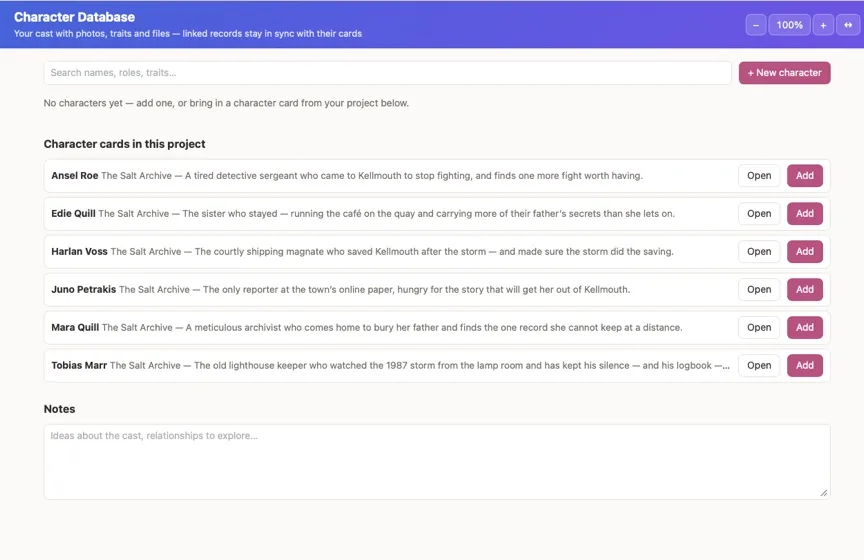
Character Database
Your cast with photos, roles, traits, files and links. Records can link to character cards and stay in sync with them.
Write the book, plan it on a canvas, and track it with Live Pages: dashboards, trackers and planners inside your project that read your cards as you write. WriterMorph comes with 48 of them in seven groups, plus a blank page for your own.
Live Pages are a Labs feature. They have no internet access, and a page changes your cards only after you allow it.
Open Settings › Labs and turn on Live Pages. Turning them off later keeps every page and its data.
In the sidebar, choose New › Live Page › Examples. The templates are grouped as on this page. Or start from a blank page.
New › Live Page › Template Gallery… lets you search the templates, preview each one, read what it works with, and export or share a template as a .wmpage package.
With AI Connections on, ask Claude Code or Codex for a page in the same style. Its Live Page Designer skill starts from the closest template.
Some pages read the cards you already have, others keep records of their own. Click a picture to see it larger.
Dashboards and reference pages for novels and stories, read from your scene, character and place cards.
Your cast with photos, roles, traits, files and links. Records can link to character cards and stay in sync with them.
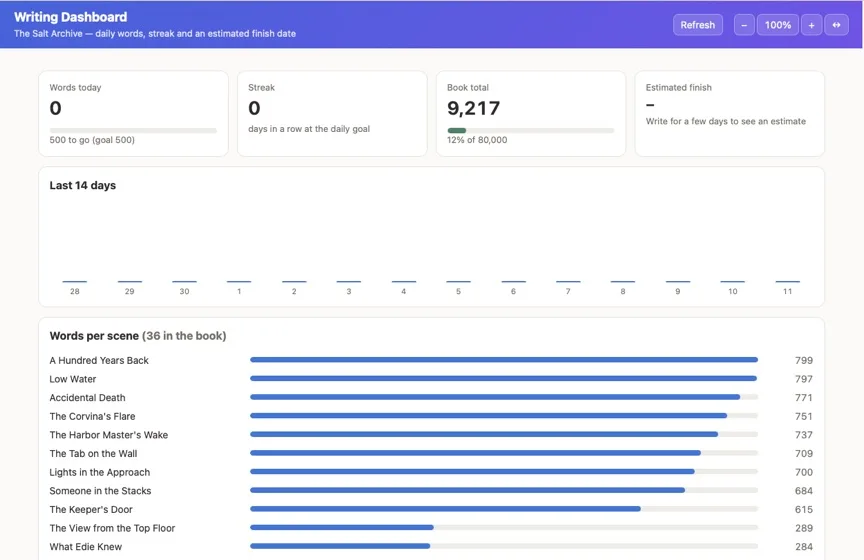
Words today, streak, book total and an estimated finish date, with a 14-day chart and words per scene.
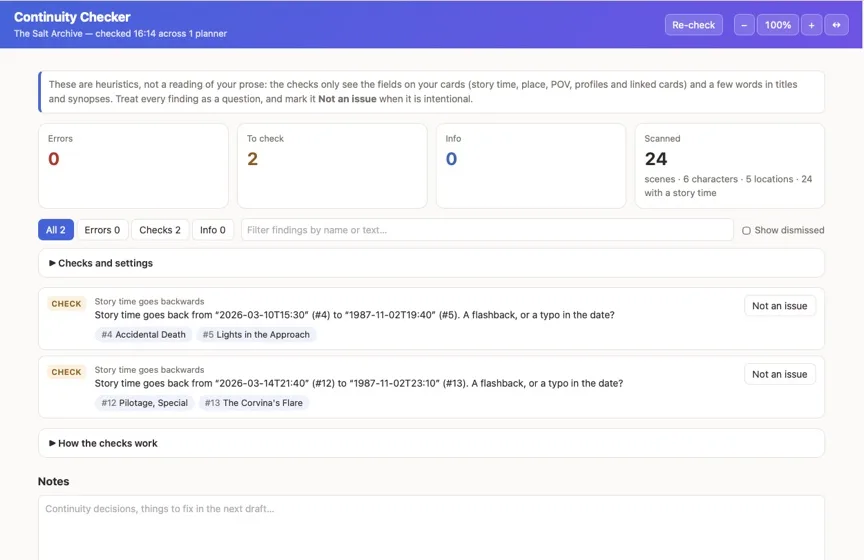
Rule-based checks over your scenes: timeline order, a character in two places at once, characters who appear after their death, POV gaps and scenes without place or cast.
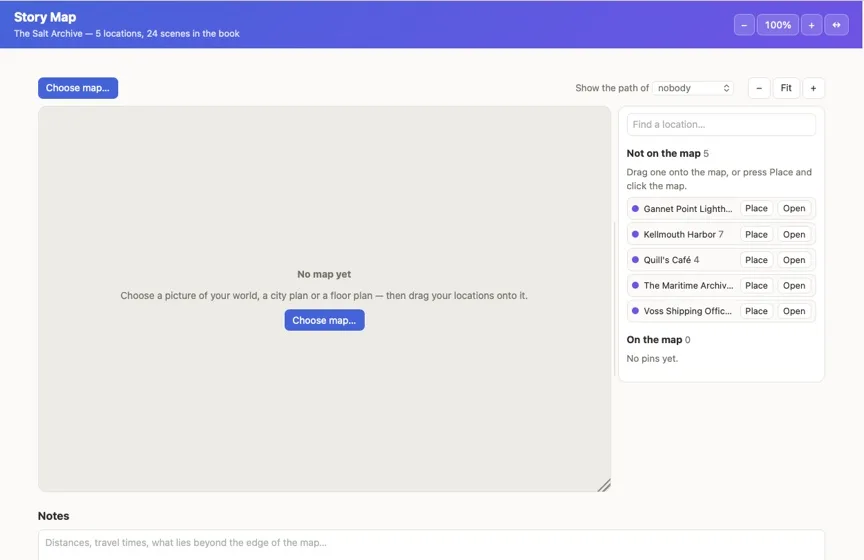
Put your location cards on a map image of your world: drag a place onto the map, see which scenes happen there and open its card.
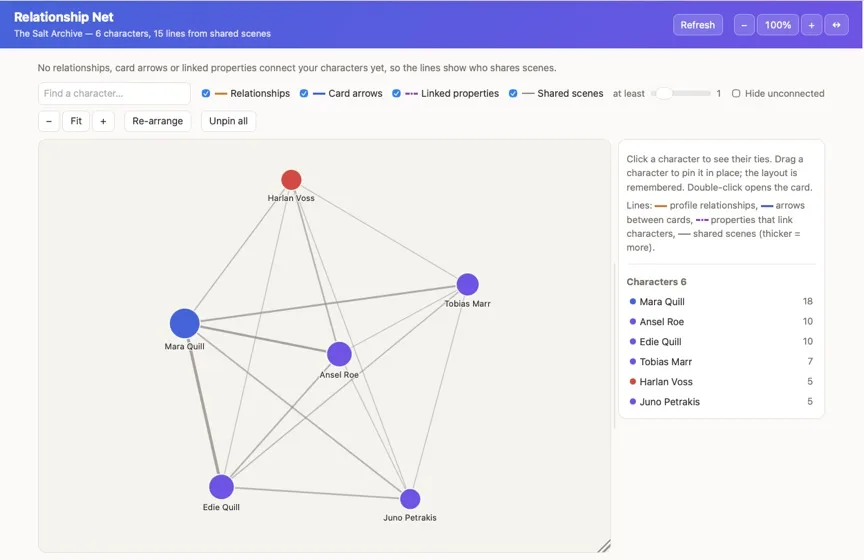
A network of your characters from card connections, relation fields and shared scenes. Drag, zoom, filter and open cards.
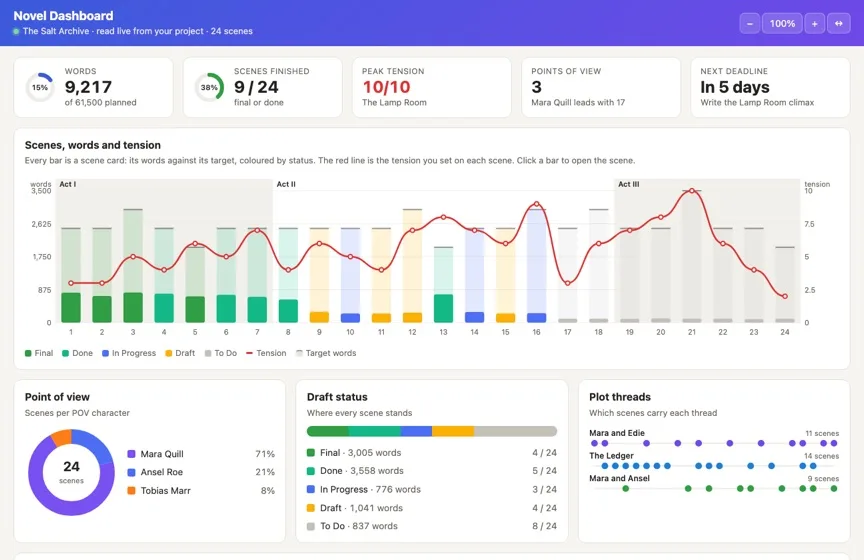
A dashboard for a novel, read live from your scene cards: words against targets, a tension curve with the acts, points of view, who is in each scene, plot threads, task deadlines, scenes still to finish (change their status here) and a writing log.

See how your scenes cover the beat sheet: gaps, crowded beats, beats that land early or late against the template, act balance and a pacing strip with tension. Give unplaced scenes a beat in one click.
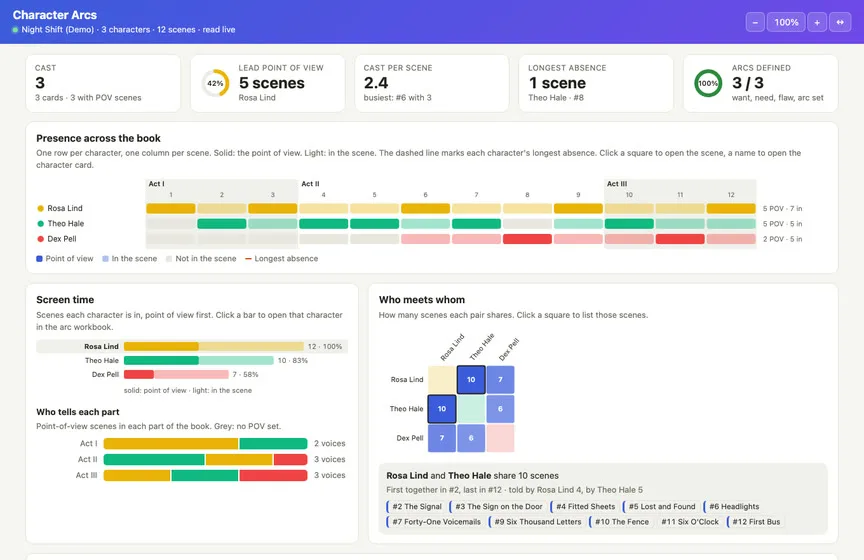
Follow every character through the book: presence across scenes and acts, POV share, longest absence, screen time and who meets whom, with want, need, flaw and arc from the card and your own arc notes per act.
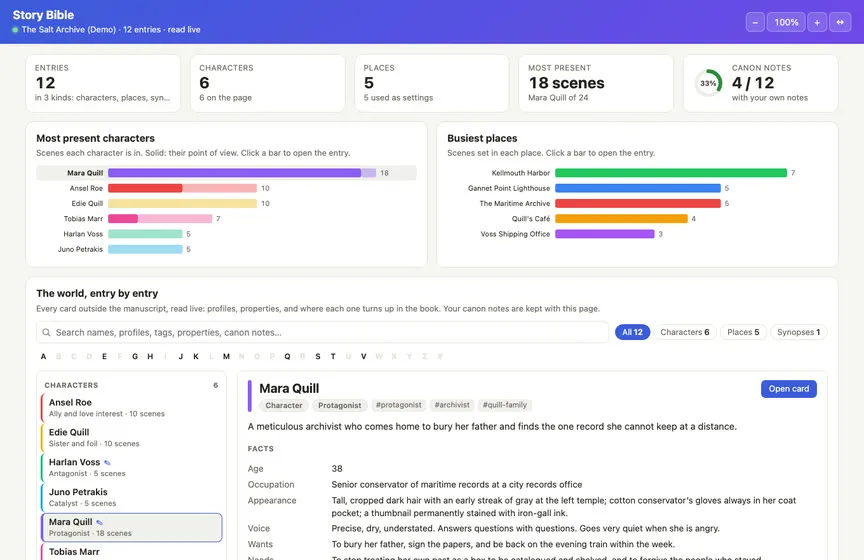
A live, searchable wiki of your world: characters, places, backdrops and notes with their profiles and properties, the scenes each one appears in, related entries, who goes where, and your own canon notes.
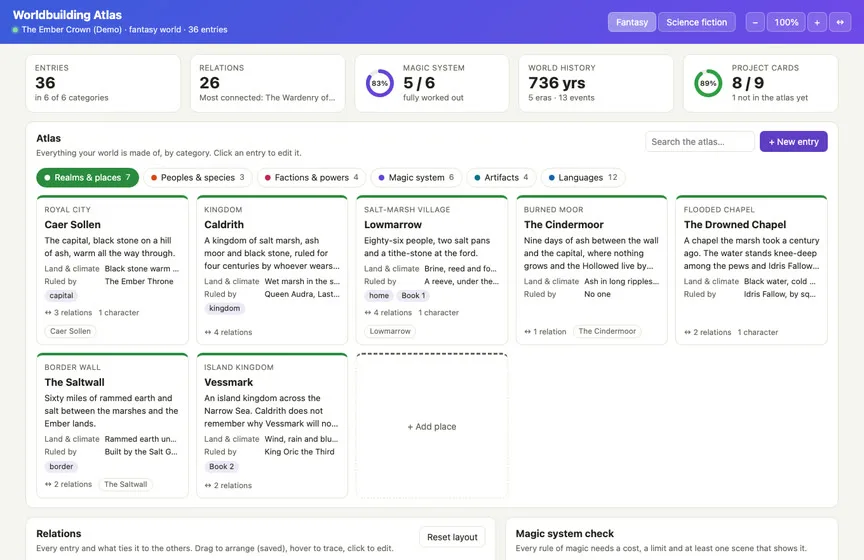
A world bible for fantasy or science fiction: places, peoples, factions, magic or technology rules, artifacts or ships and invented words, with a relations network, eras, a glossary and your cast and places.
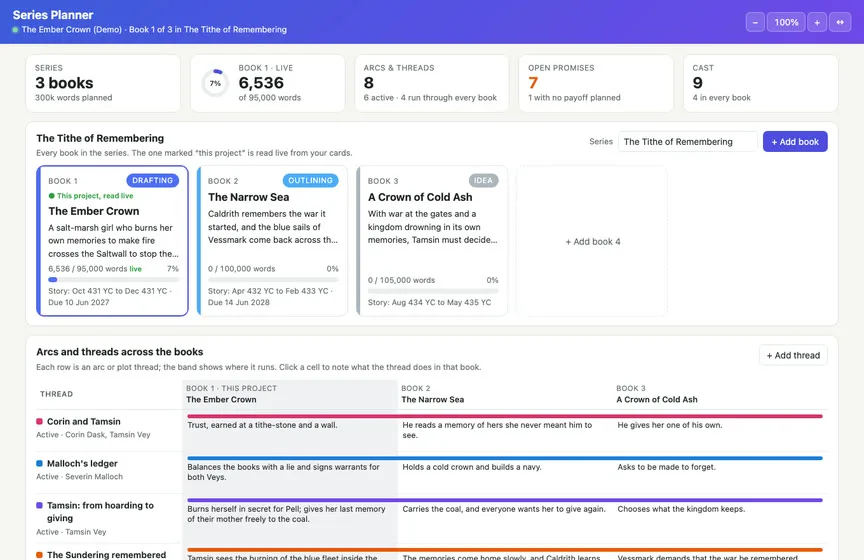
Plan a series across books: targets and premises, arcs and threads in a books-by-threads grid, a story-time timeline, the cast of each book and promises to pay off, with this book read live from your cards.
Revising, writing challenges, submissions, book proposals, poems and reading.
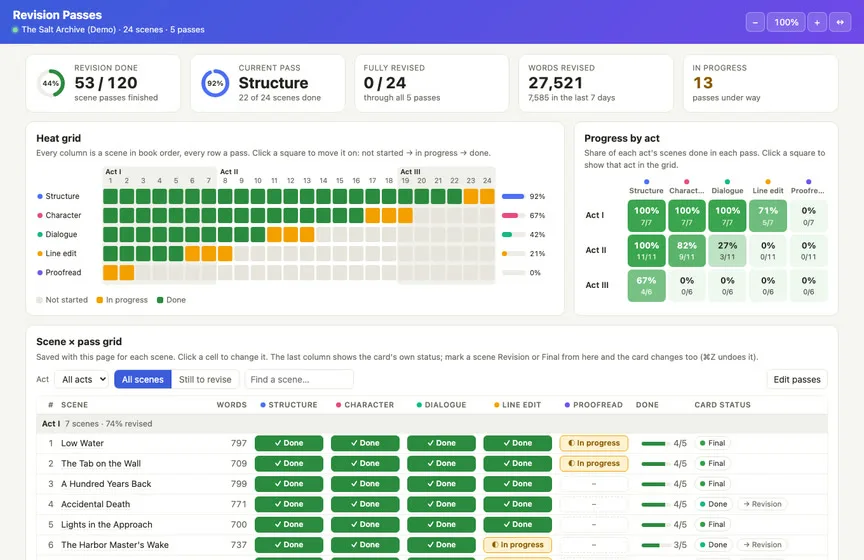
Plan your edit as passes over every scene: a scene × pass grid you click through, progress by pass and act, a heat grid, the next five scenes to work on and words revised. Mark scenes Revision or Final.
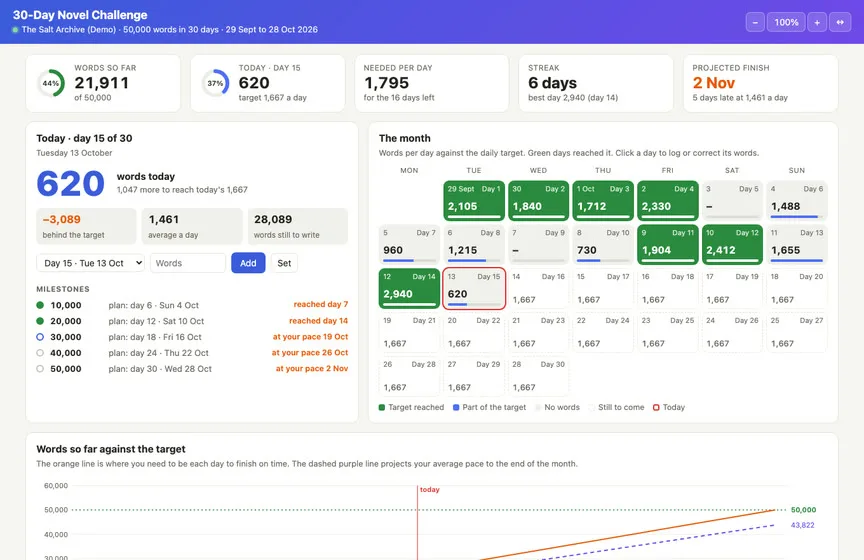
A month-long writing challenge, 50,000 words from 1 November by default: a calendar of daily words, your running total against the target, streak, projected finish, words needed a day and a prep checklist.

Track where your work is out: agents, publishers, magazines and contests. A status board, response times, request and acceptance rates, follow-ups due and a timeline. Starts empty; the sample data is fictional.
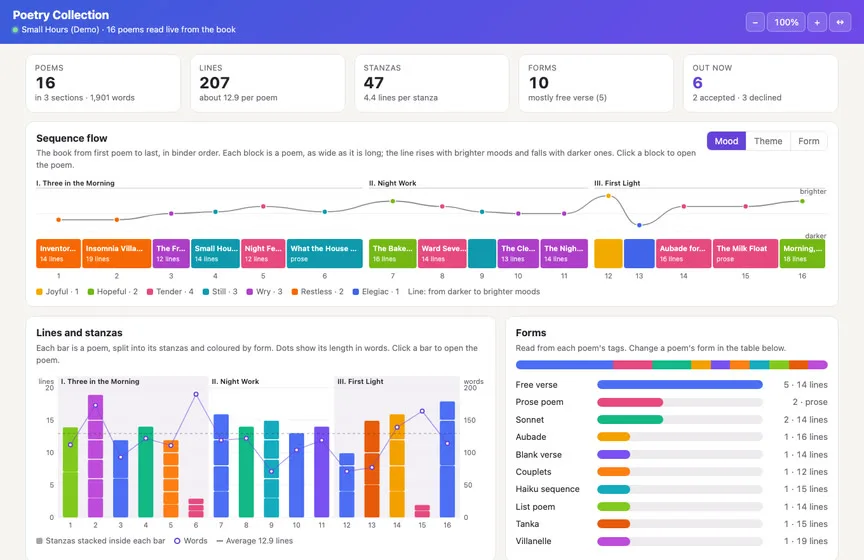
Reads every poem in the book: lines and stanzas, forms and themes from tags, a mood arc through the sequence, repeated words, the shape of each poem and a log of where each poem was sent.
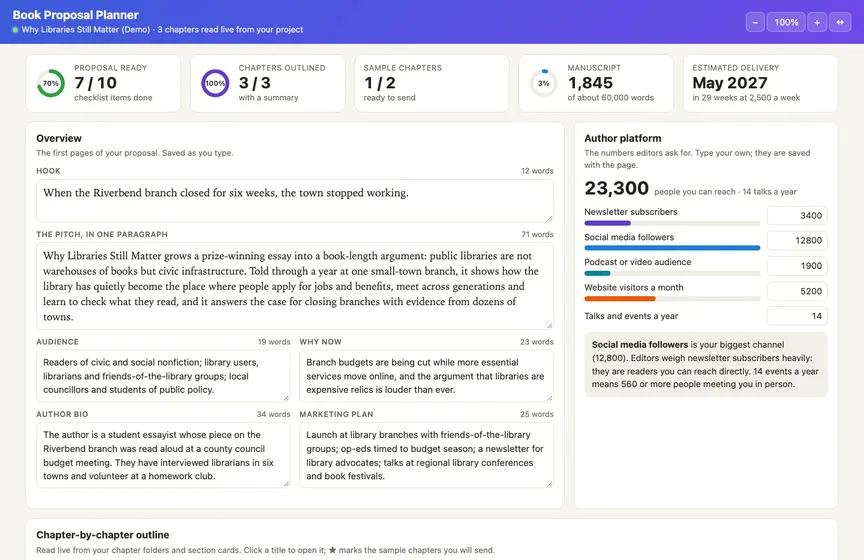
Build a nonfiction book proposal: hook, pitch and platform, a chapter outline read live from your cards, sample-chapter readiness, comparable titles, a proposal checklist and a delivery estimate.
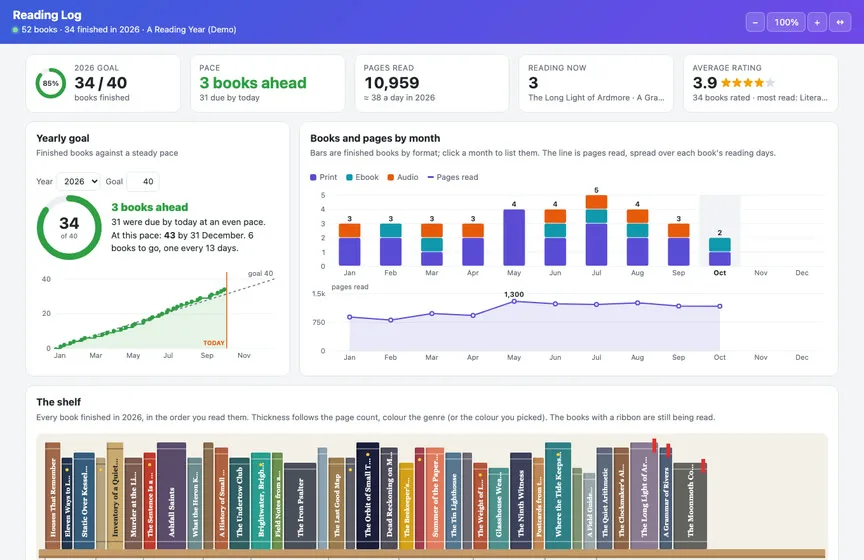
Books read and to read: a yearly goal with pace, books and pages by month, a spine shelf of the year, pages logged per day, a to-read queue, ratings, genres, reading speed and a quotes wall.
Theses, essays, literature reviews and lab work.
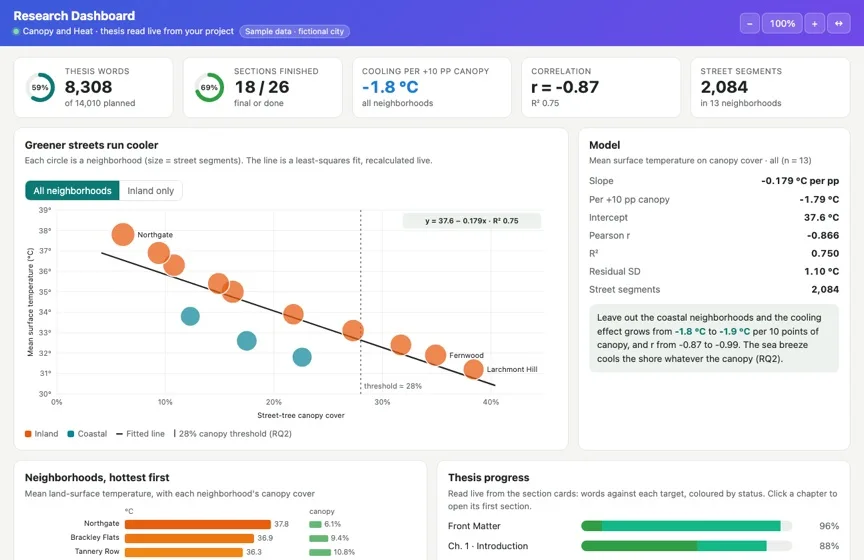
A thesis dashboard: chapter progress from your section cards, a data table with a live scatter chart and regression, and a reading tracker. Starts empty; load the sample data for a fictional city to see how it works.
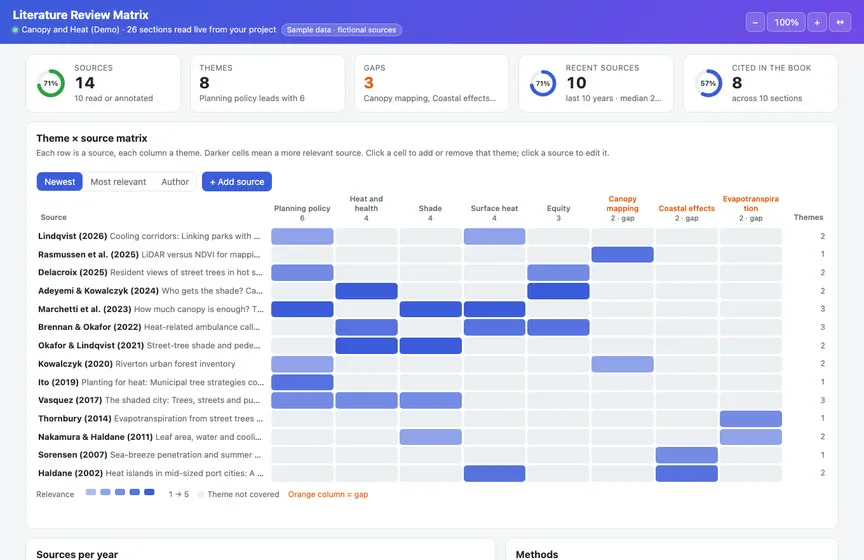
Track your sources with a theme × source heat grid, gaps in the literature, years and methods, and an APA reference list; tag which sections of your book cite each source.
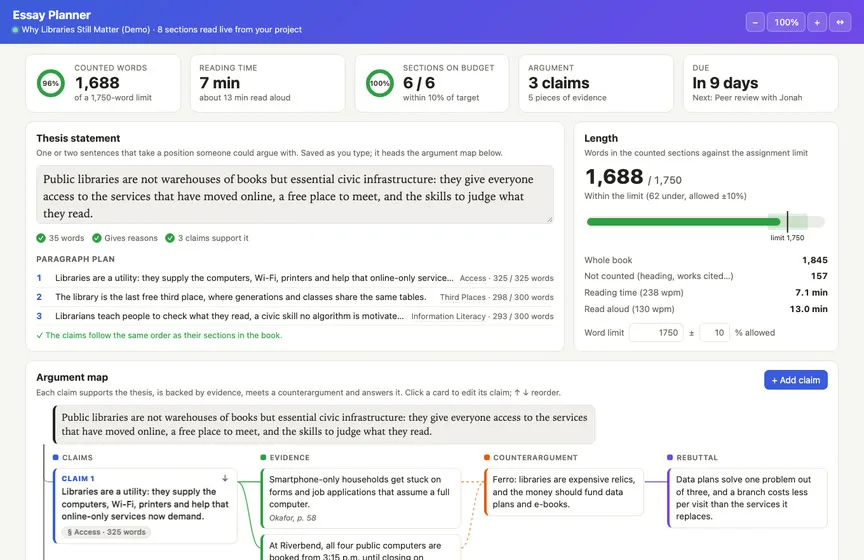
Plan an essay or paper: thesis, an argument map from claims to evidence, counterargument and rebuttal, word budget per section, the word limit, a marking rubric and a deadline with milestones.
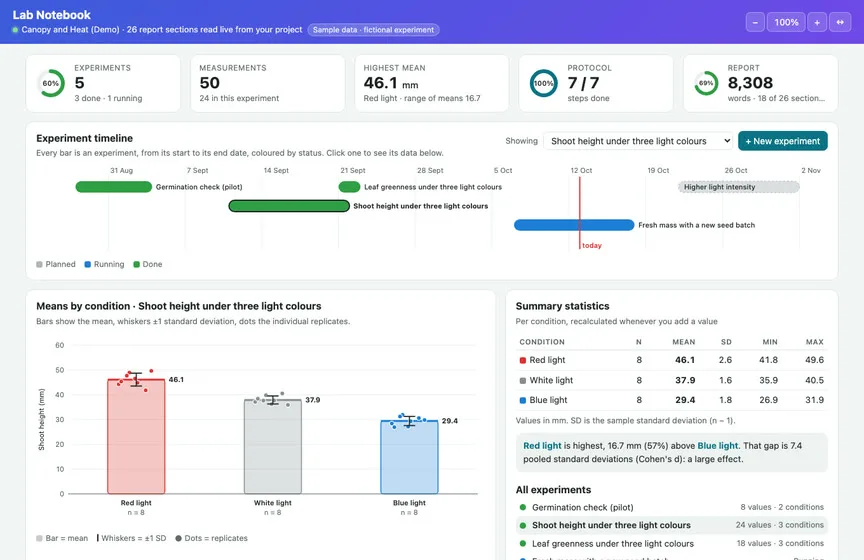
Log experiments with aims, hypotheses, methods and variables, enter measurements and see means with SD error bars, summary statistics, a timeline, protocol checklists and your report's progress.
For students, teachers and young writers.
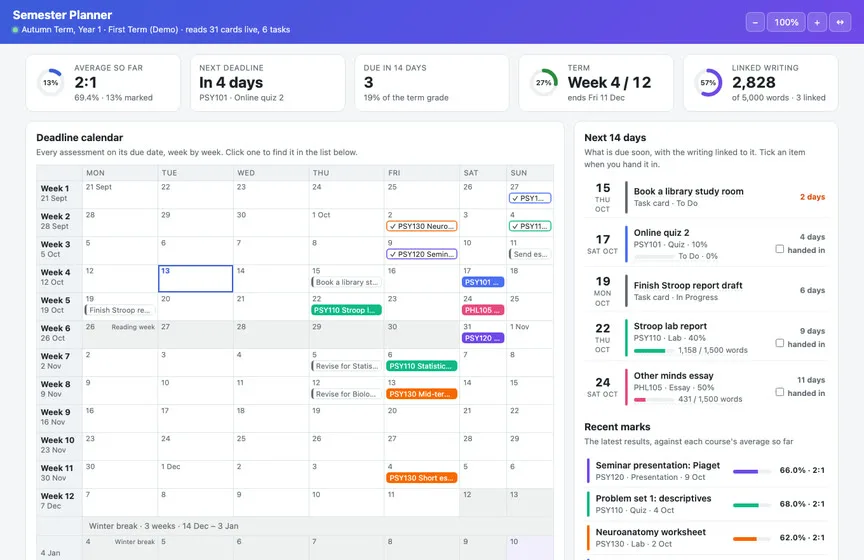
Plan a university term: every deadline on a calendar, weekly workload, a grade calculator that shows what you need for your target, GPA or UK classes, and essays linked to their cards with live word counts.
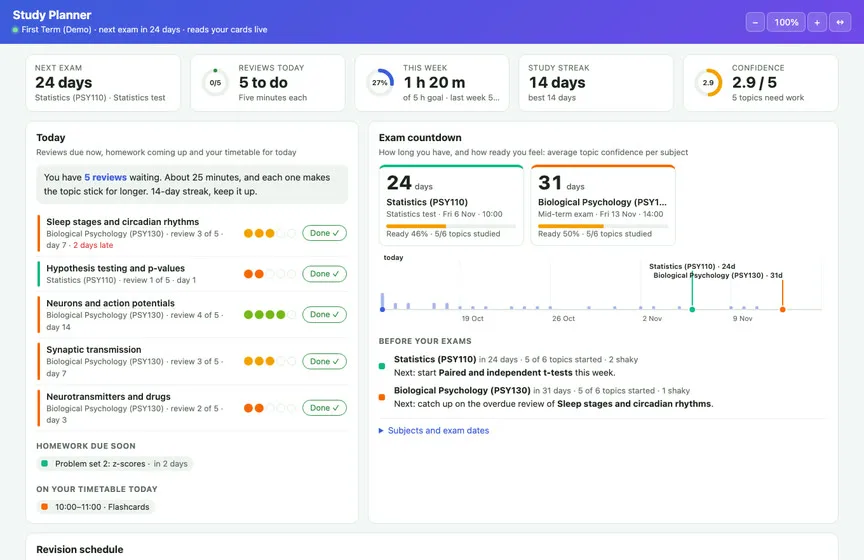
Revise for exams: countdowns, topics rated 1 to 5, spaced-repetition reviews after 1, 3, 7, 14 and 30 days, today's to-do list, homework, a weekly timetable and a study log with streaks.
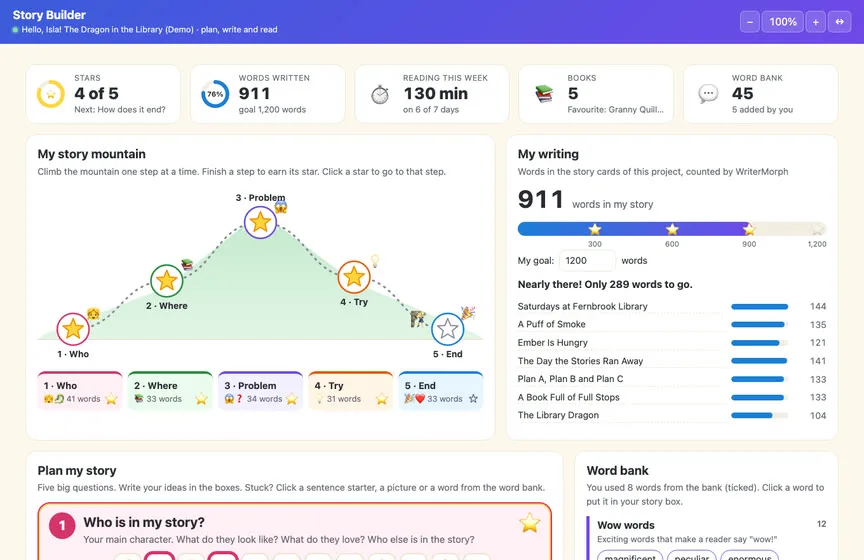
A playful story planner for children aged 7 to 11: five story-mountain steps with sentence starters and pictures, stars to earn, a word bank, a reading log with a weekly chart and a word goal.
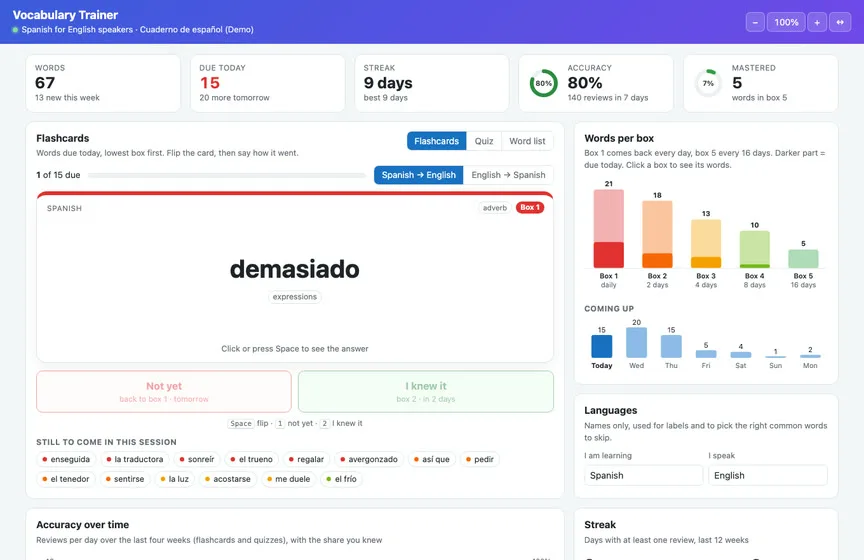
Learn a language through your own writing: a word list in five Leitner boxes with flashcards, scored quizzes, search and tags, reviews due today, streak and accuracy charts, and new words found in your book cards.
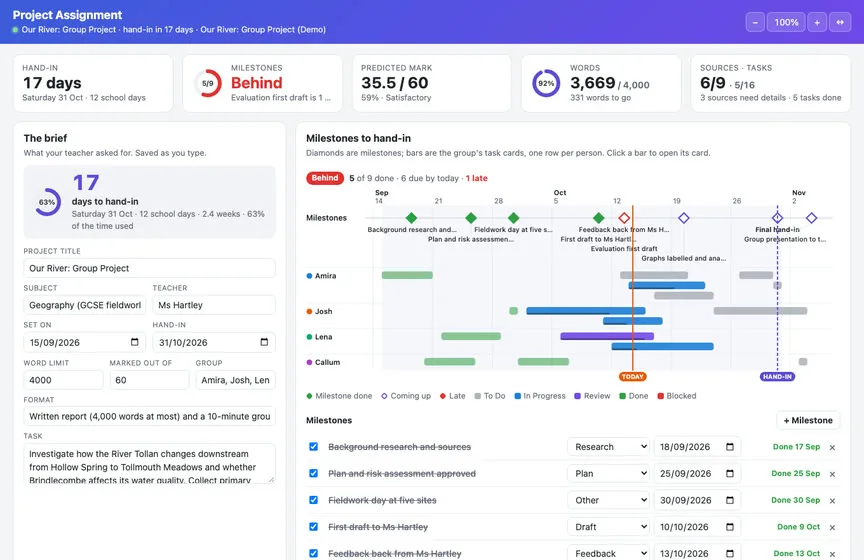
Take a school project from brief to hand-in: a countdown, milestones that say if you are on track, rubric self-assessment with a predicted mark, who does what from task cards, a citation check and the live word count.
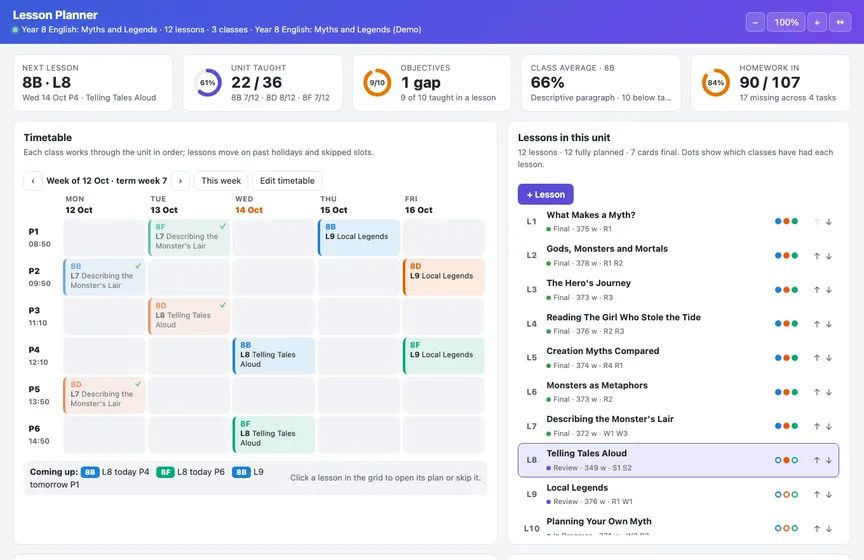
For teachers: a unit of lessons placed in your weekly timetable around holidays, lesson plans linked to their cards, curriculum coverage with gaps flagged, a markbook with who needs support, and homework hand-in.
Scripts, storyboards, channels, podcasts and posting plans.
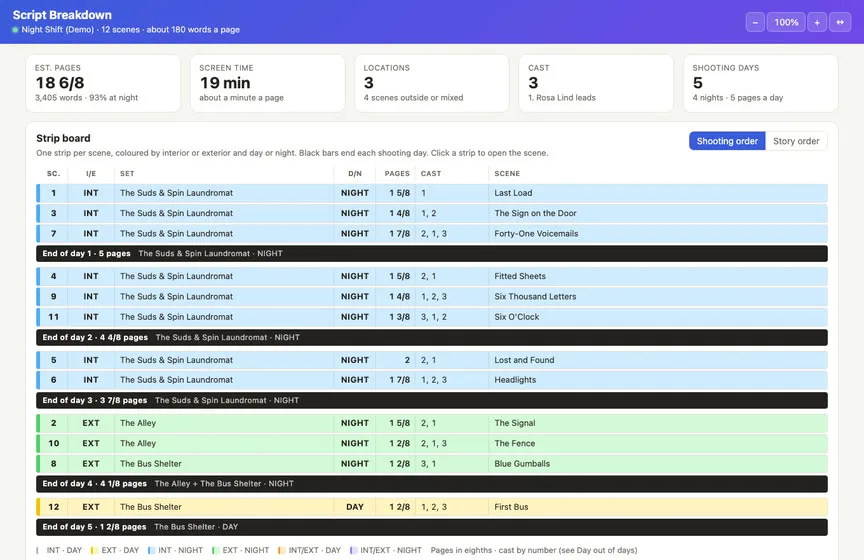
Break a screenplay or short film down for the shoot: INT/EXT and DAY/NIGHT per scene, pages in eighths, screen time, a colour-coded strip board, a cast day-out-of-days grid and shooting days by location.
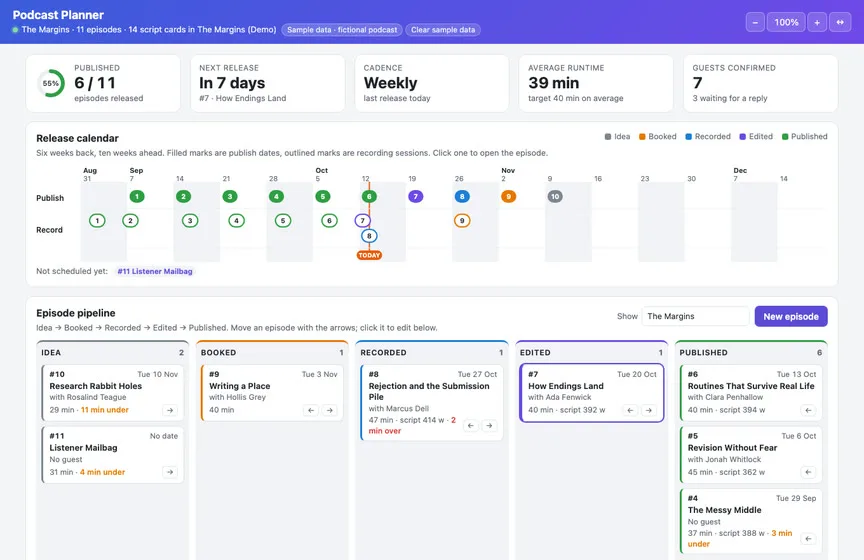
Plan a podcast season: an episode pipeline, a run-of-show editor with live runtime totals, guest outreach and a release calendar. Link episodes to script cards for word count and spoken length.
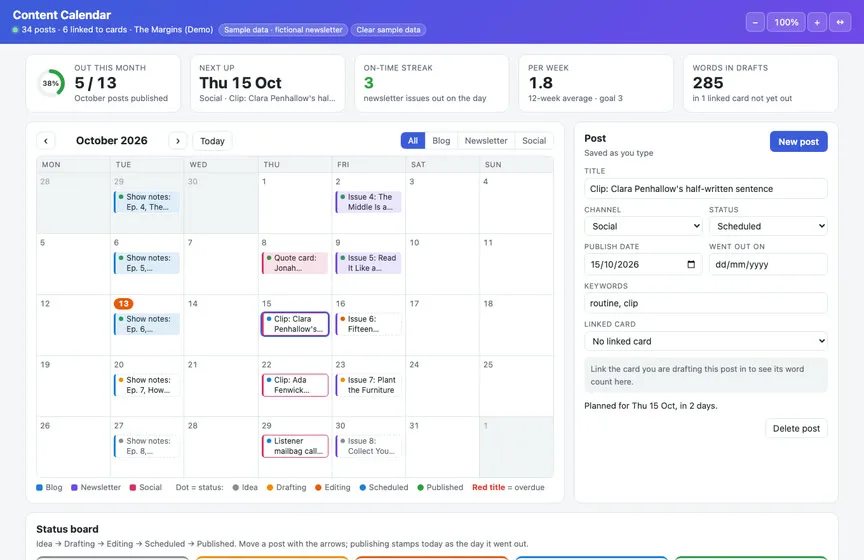
Plan blog posts, newsletter issues and social posts on a month calendar and a status board, with a 12-week cadence chart, an on-time streak, keywords and word counts from linked cards.
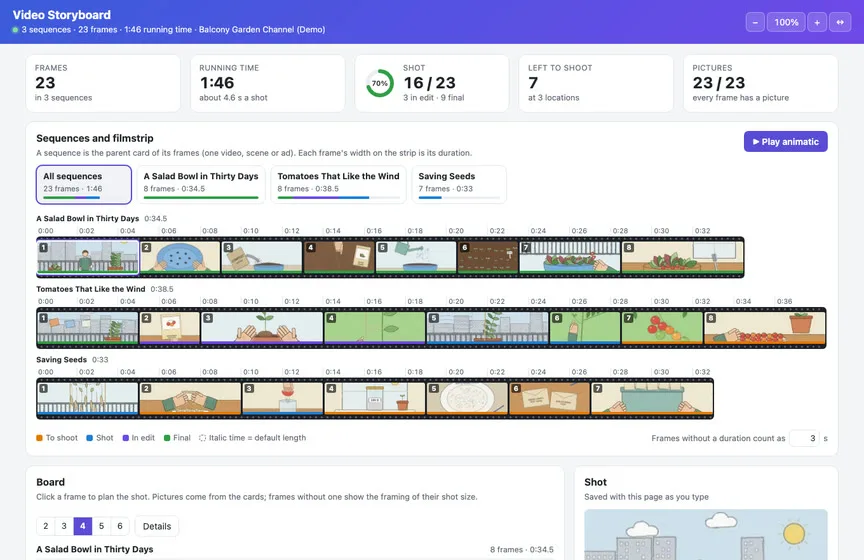
Plan every shot of a video from your Storyboard cards: a zoomable board, a filmstrip timed by duration, an animatic player, a printable shot list, coverage checks and a to-shoot list by location.
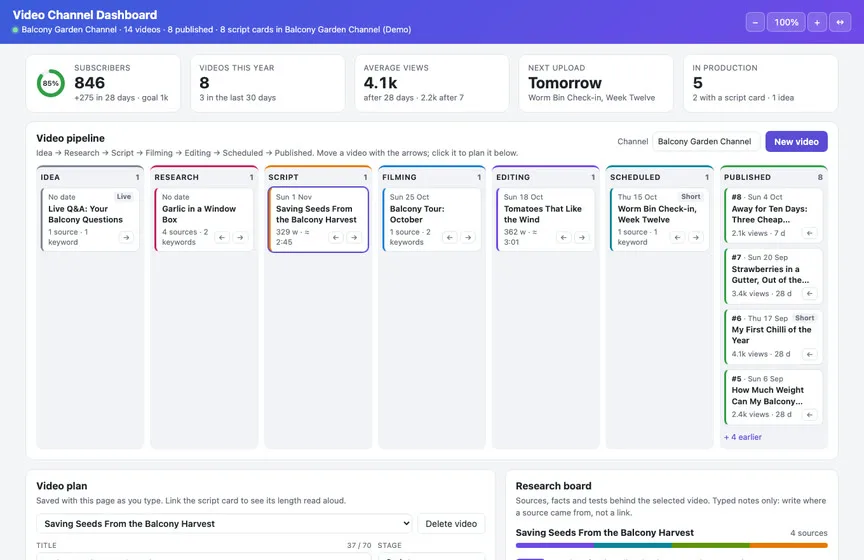
Run a video channel: a pipeline from idea to published, script cards with spoken length, research and title ideas per video, a cadence calendar, and charts of views, subscribers, click-through and best upload times.
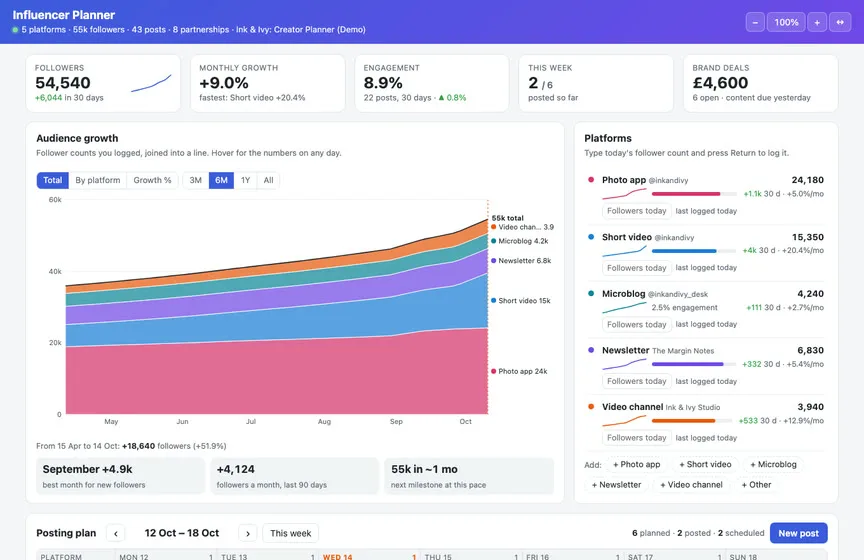
Track follower growth on every platform, plan posts week by week, enter each post's numbers to see engagement by pillar, format and time, run campaigns, take brand deals from pitch to paid and copy a media kit.
Journals, habits, family history, recipes and places.
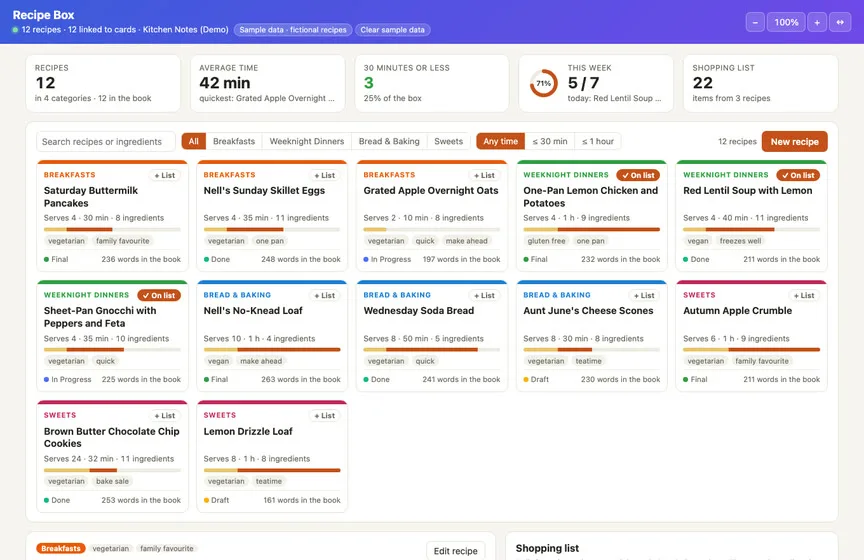
A cookbook companion: a filterable recipe gallery, a servings scaler, a merged, printable shopping list, a 7-day menu and time and category charts. Link recipes to the cards you write them up in.
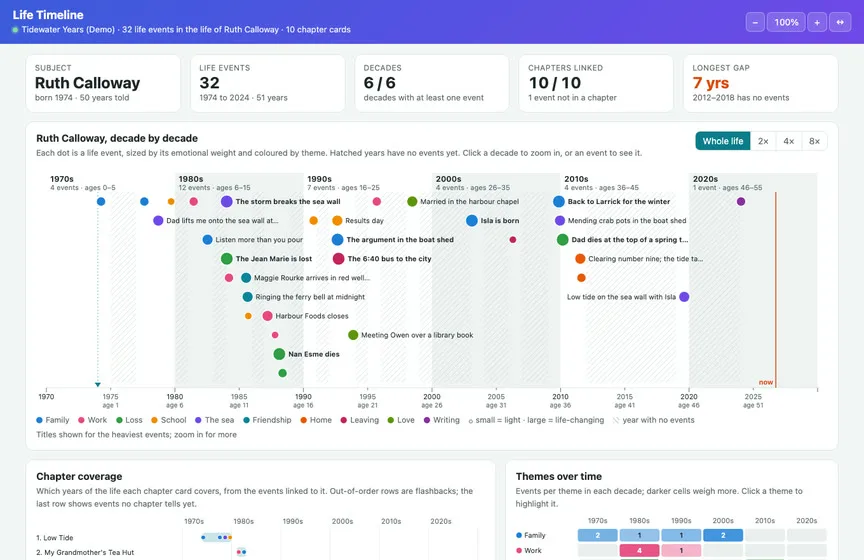
Maps a life for memoir or biography: events by decade with zoom, people, places and themes over time, which years each chapter covers, and the gaps no chapter tells yet.
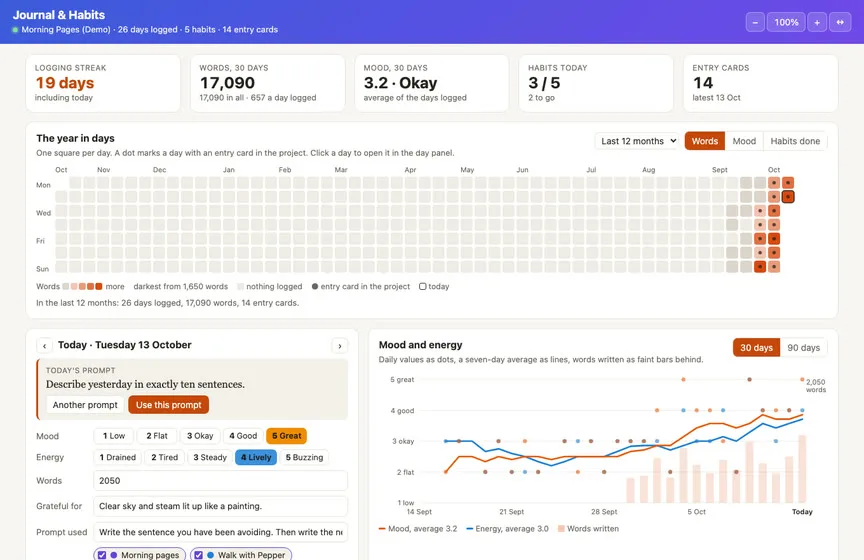
A daily writing practice tracker: mood, energy, words and up to eight habits on a year heatmap, streaks and trend lines, 60 rotating prompts, and links to dated entry cards.
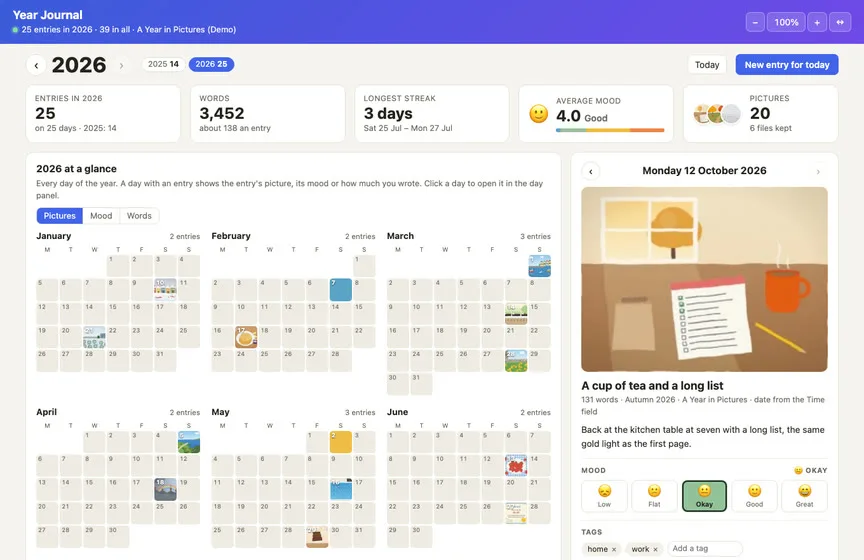
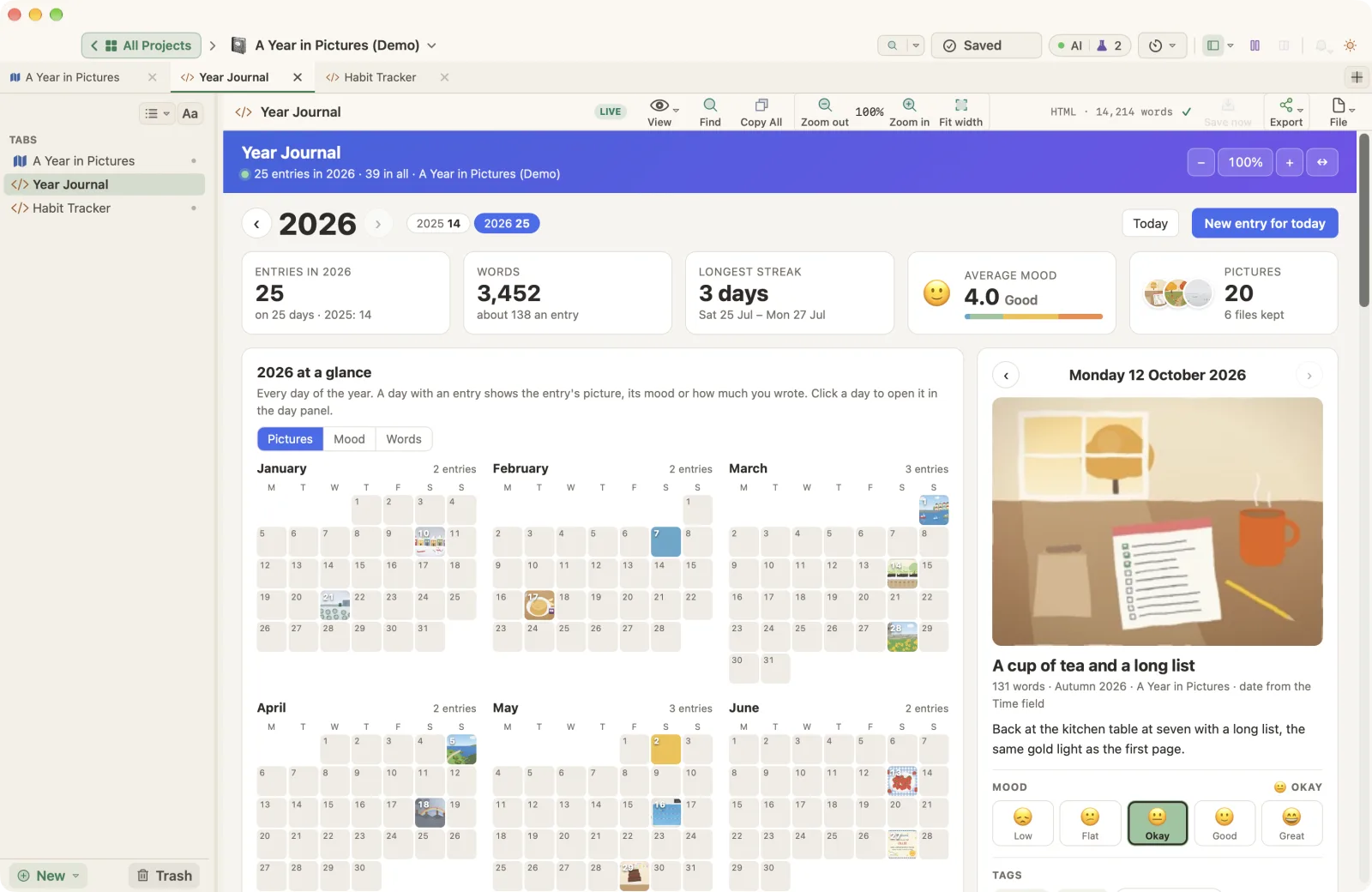
A picture journal for the year: dated entry cards on a 12-month calendar with their pictures or moods, a year mosaic, photo wall, on this day, moods, tags, streaks and keepsake files. Switch years with the arrows.

Habits on their own schedules (every day, n times a week or set days): a week grid to tick, streaks, 30 and 90-day completion, weekly targets, a year heatmap per habit, day notes and word goals linked to cards.
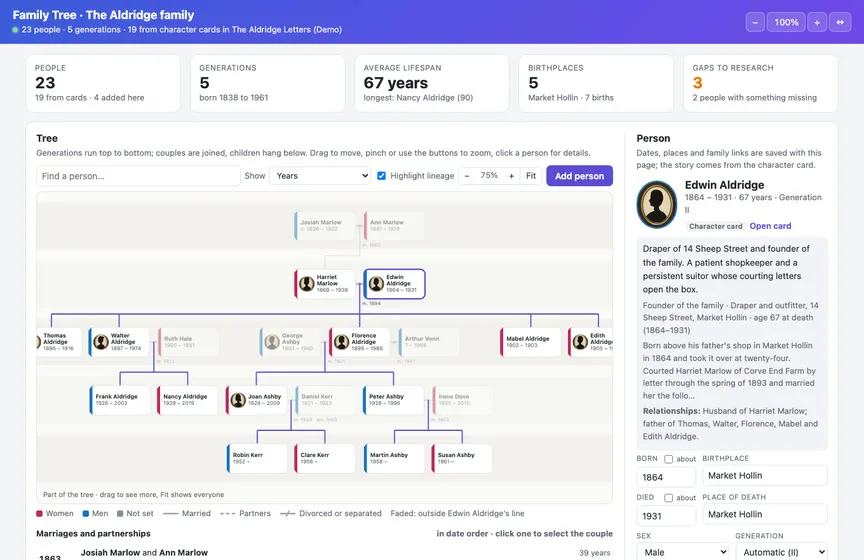
A generational family tree from your character cards and people you add: couples, children, dates and places, a zoomable tree, lifespans against the eras, birthplaces and the gaps still to research.
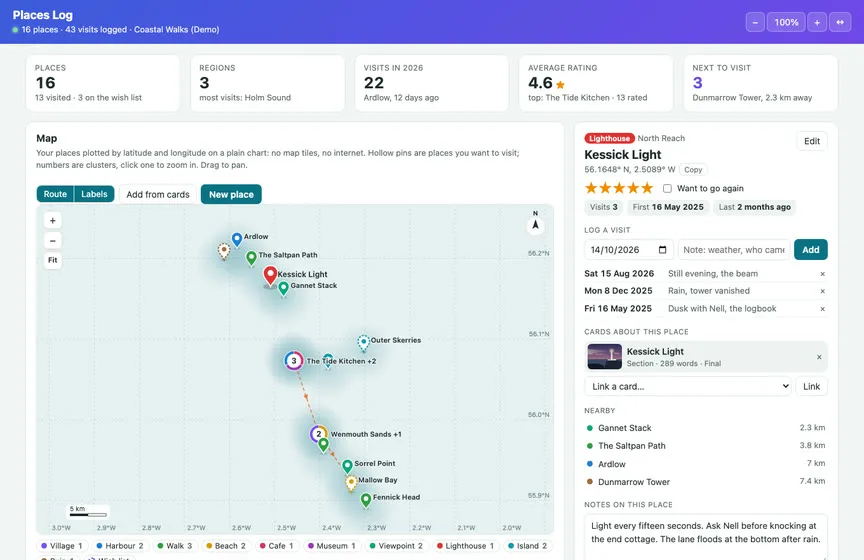
A register of real places: an offline map plotted from latitude and longitude with clusters and a route, visits by month, a wish list by distance, a sortable table and a photo wall from linked cards.
Projects, meetings, events, budgets, invoices and records.
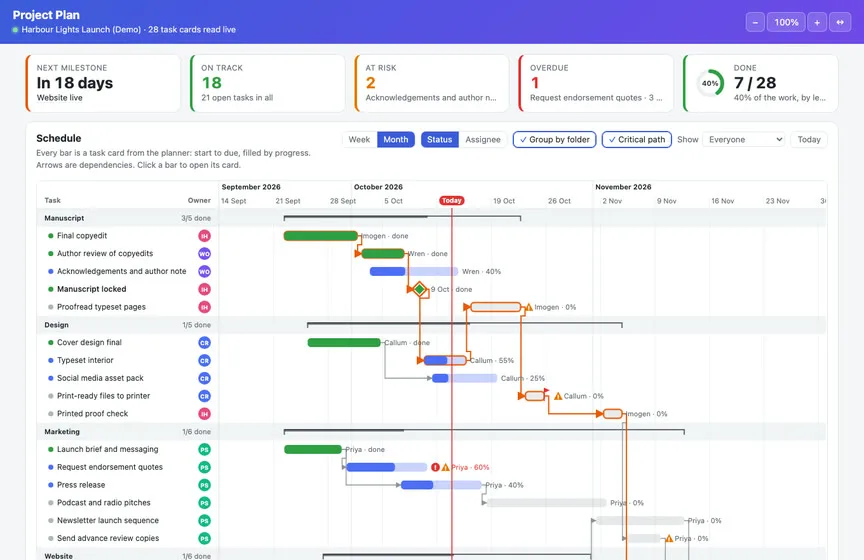
A live work programme from your task cards: a Gantt chart with dependencies, milestones and the critical path, workload per person, deadlines you can update from the page, and a risk register with a risk matrix.
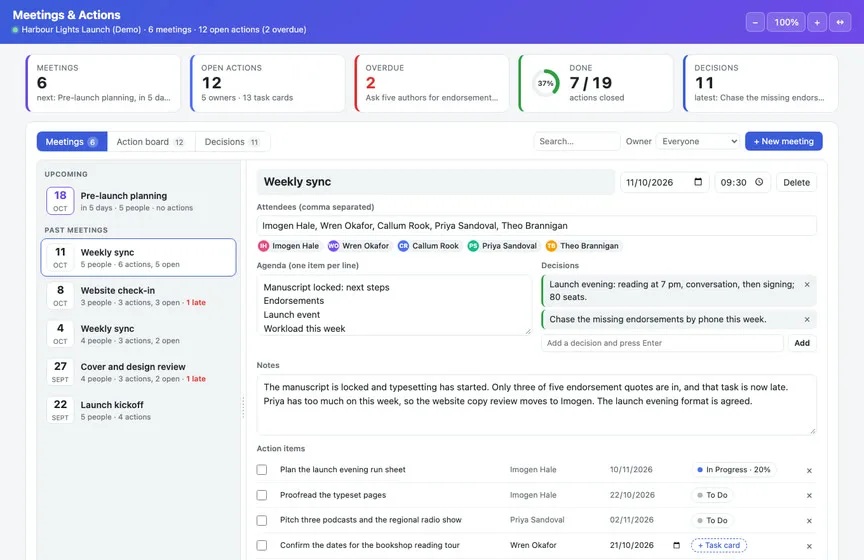
Meeting notes with attendees, agenda and decisions, an action board across meetings (open, overdue, done) with an owner filter, a decisions log, and one click to turn any action into a task card in the planner.
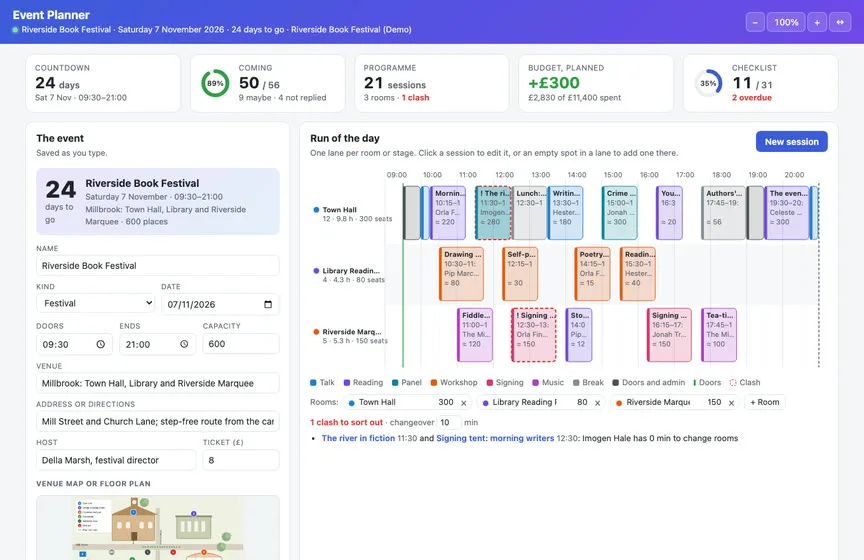
Plan a book launch, reading or festival: countdown, run of the day by room with clash checks, guests and RSVPs, speakers, vendors, budget, a weeks-before checklist and a printable run sheet.
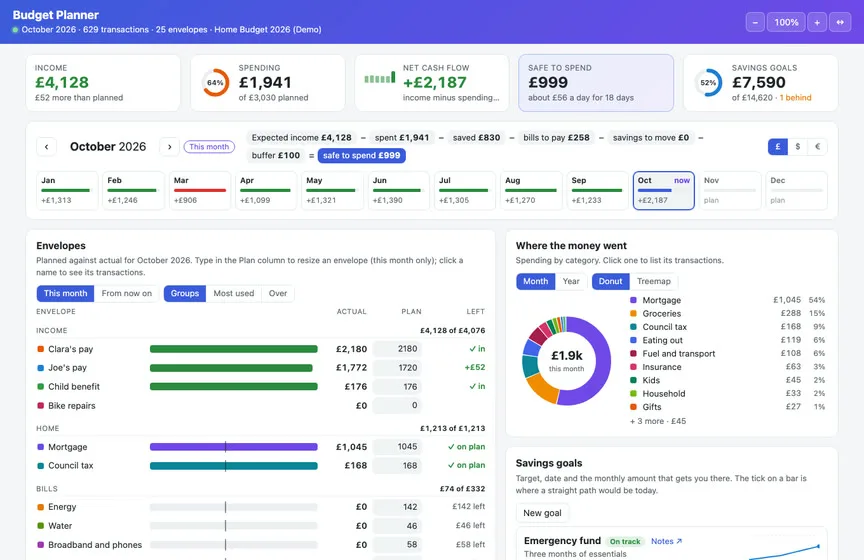
A household budget, month by month: envelopes with plan against actual, a transaction log with quick add and bank CSV import, a bills calendar, savings goals, safe to spend and a 12-month chart.
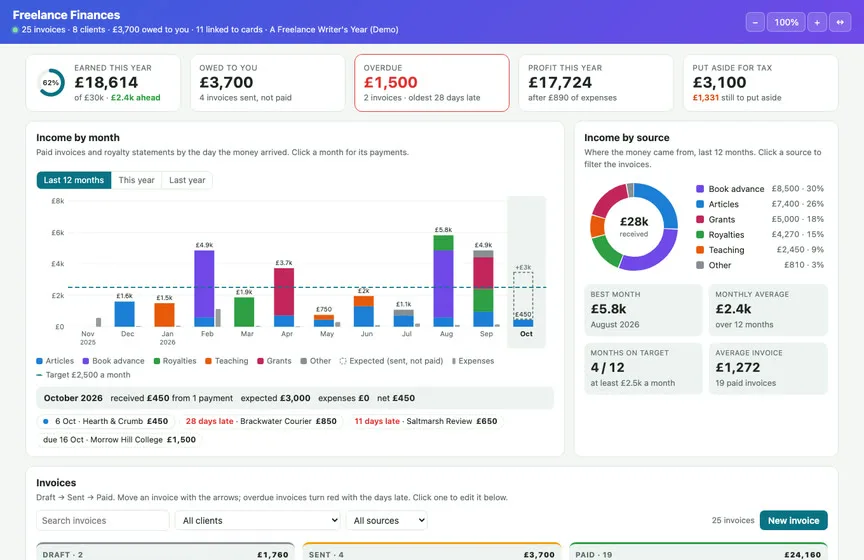
A freelance writer's money: invoices from draft to paid with days overdue, clients and how fast they pay, income against a target, expenses with receipts, royalty statements and tax set-aside.
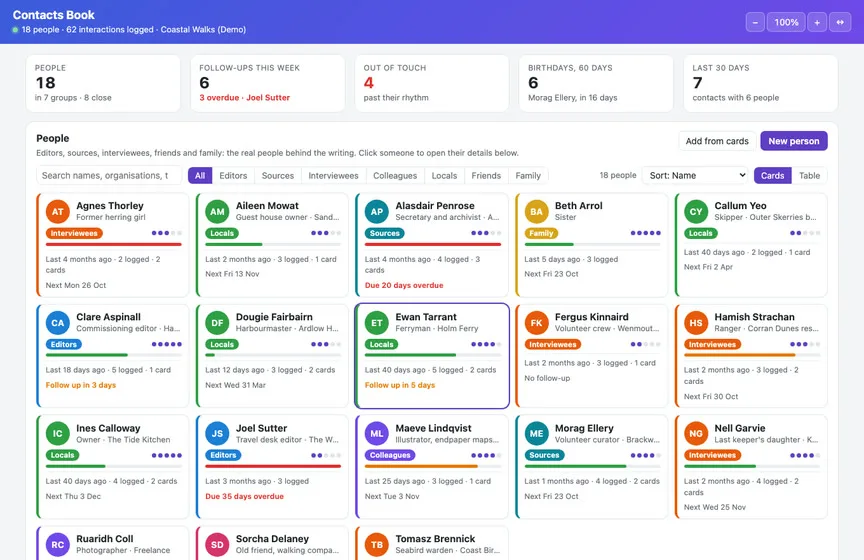
The real people behind your writing: editors, sources, interviewees, friends. A follow-up queue, a keep-in-touch chart, birthdays in the next 60 days, a log of every conversation and links to cards.
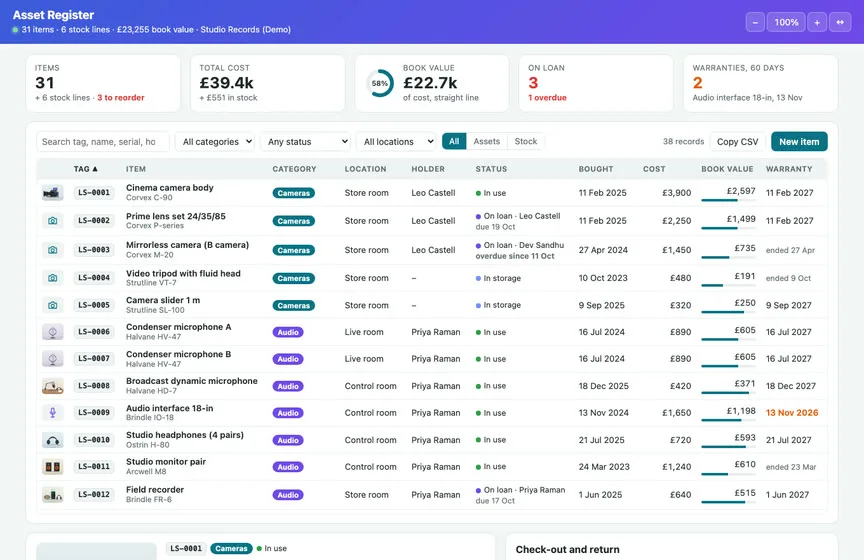
Inventory and fixed assets: tagged items with photos, places and holders, straight-line book values, a loan log with due dates, maintenance checks, stock reorder levels and a printable tag sheet.

Contracts, policies, certificates and IDs with renewal dates and reminders: a 12-month renewals timeline, a needs-attention list, a required-documents checklist, attached PDFs and scans, and version history.
Every demo project in WriterMorph comes with its Live Pages filled in. Open one from Help › Demo Projects, or download it from Sample projects.


Change any page until it fits, then choose File › Save as Page Template… and give it a name. A template keeps the page and its files, never its data. Your templates appear in the gallery under Yours, where you can rename, export or share them, and Import Template Package (.wmpage)… adds one someone sent you.
WriterMorph has no AI inside. If you already use Claude Code or Codex, connect it in Settings › AI Connections and describe the page you need, such as a tracker for a book club or a dashboard for a grant application. It reads the closest template and builds a page in the same style, which you can change like any other.
How Live Pages work, step by step: Live Pages in the help center

Try every feature free for 30 days of use. Your files stay yours whatever you decide.

Other product names mentioned (e.g. Scrivener, Microsoft Word, Obsidian, Notion) belong to their owners and are used only to describe compatibility.