 WriterMorph

How to write a novel synopsis: a worked example with Pride and Prejudice
Agents ask for a one- or two-page synopsis with the ending included. Here is how to write one in an evening, worked through on a novel everyone knows, from 61 chapters down to about 450 words.
Revision season runs through the winter, and many novelists who drafted in the autumn plan to send their book to agents in the new year. Almost every agent and publisher who takes submissions asks for the same three things: a query letter, the opening pages and a synopsis. The synopsis is the one writers dread, because it has to tell a 300-page story in one or two pages, ending included.
This article shows how to write one, step by step, on a book you already know: Jane Austen's Pride and Prejudice. WriterMorph includes the complete novel as a demo project (it is in the public domain), with a one-line synopsis on each of its 61 chapters. By the end you will have seen the whole route, from that chapter list to a finished synopsis of about 450 words, and you can follow the same route with your own book.
What agents expect from a synopsis
Guidelines differ, so always read the agency's own page first. When they don't say, the advice in Jane Friedman's guide to the novel synopsis is a safe default:
| Question | Default answer |
|---|---|
| How long? | One to two single-spaced pages, roughly 500 to 1,000 words |
| Person and tense? | Third person, present tense, even if the novel is in first person |
| The ending? | Always included. The synopsis is where an agent finds out whether the story pays off |
| Which characters? | Only those who change the direction of the story. Give minor figures a role instead of a name |
| What else? | Cause and effect, the turning points and how the main character feels about them |
| What to leave out | Subplots that don't affect the main plot, themes, comments on the book's craft, dialogue and headings |
Friedman also recommends setting a character's name in capitals the first time it appears, so a busy reader can find the cast at a glance.
Step 1: Start from a chapter map
Nobody writes a good synopsis by rereading the whole book. Start from a list with one line per chapter or scene that says what happens. If you outlined before drafting, or mapped your draft afterwards, you have it already.
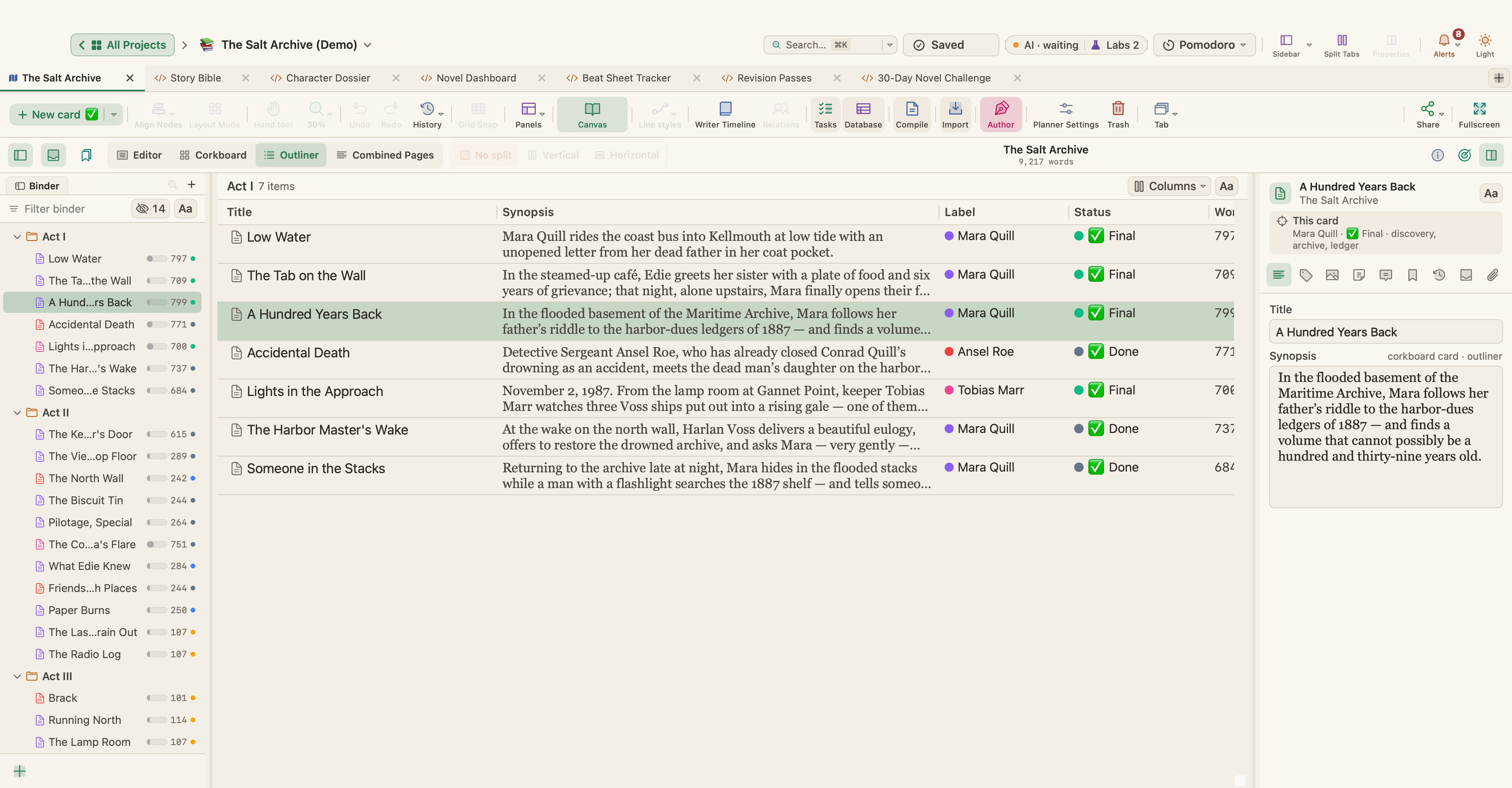
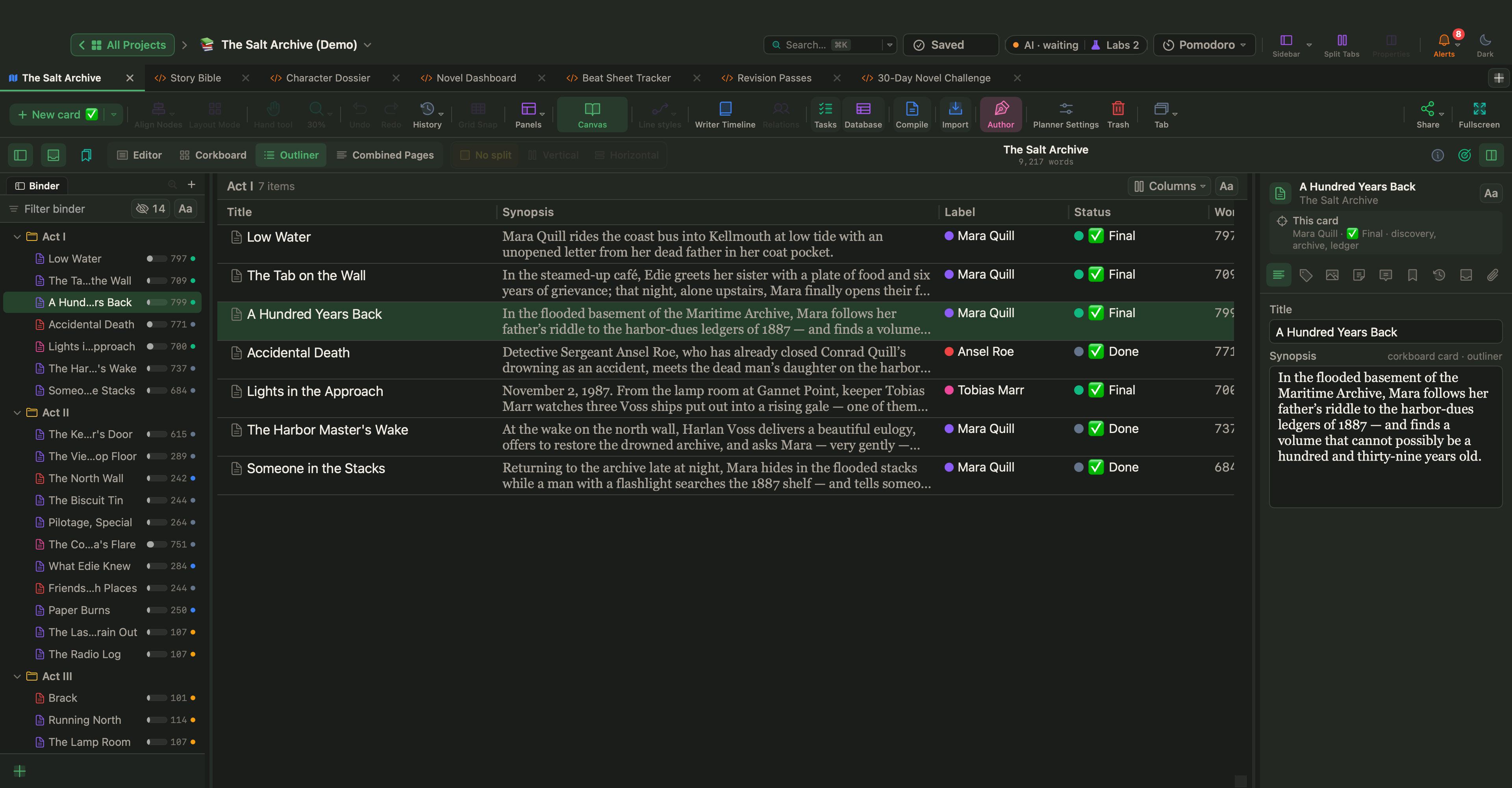
In WriterMorph, open the demo with Help › Demo Projects (it is in the Fiction & Screen group). Each of the 61 chapters has its synopsis, which you can read in a column in the Outliner (⌘3; View › Outliner Options adds the column if it is hidden) or as continuous prose in the Writer Timeline: choose View › Writer Timeline (⌥⌘T) and click Outline.
Then narrow the list. The demo files every chapter under one or more plotlines: Main Plot (22 chapters), Class and Manners, Wickham's Deception, Lydia's Folly, the Jane-Bingley Romance and Charlotte's Pragmatism. In the Outline view, Filter by Main Plot, and 61 chapters become 22. That is the spine of the synopsis.
Step 2: Choose the turning points
From the spine, keep the events that turn the story: the moments after which something can't be undone. A subplot gets back into the synopsis only where it changes the main plot. Lydia's elopement does, so it stays; Mary's singing at the ball doesn't.
For Pride and Prejudice that gives ten turning points:
| Chapter | Turning point | Why it stays |
|---|---|---|
| 3 | Darcy slights Elizabeth at the Meryton assembly | Her first impression starts the plot |
| 16 | Wickham tells his story against Darcy | The false evidence she builds on |
| 21 | The Netherfield party leaves for London | Darcy's interference, which she later holds against him |
| 34 | Darcy's first proposal, and her refusal | The midpoint: everything comes into the open |
| 35 | Darcy's letter | The turn in her self-knowledge |
| 43 | Pemberley: Darcy is changed | The reversal of the first impression |
| 46 | Lydia runs off with Wickham | The crisis |
| 52 | Mrs. Gardiner's letter: Darcy paid | Proof of his character |
| 56 | Lady Catherine demands a promise | The pressure that brings the ending |
| 58 | The second proposal | The resolution |
To keep these chapters together without moving them, select them in the binder and choose Documents › New Collection from Selection…. With View › Collections on, it appears as a tab above the binder; click it to see only your turning points.
Step 3: Decide who gets a name
The demo has 28 character profiles. The synopsis below names eight: Elizabeth, Jane, Bingley, Darcy, Wickham, Lady Catherine, Lydia and the Gardiners. Everyone else is a role ("her mother", "a pompous cousin", "his cousin") or is left out. Mr. Collins matters because his proposal shows what Elizabeth refuses, but he never changes the plot's direction, so he becomes "the cousin who will inherit her home". Fewer names make the story easier to follow on one reading, which is all an agent will give it.
Step 4: Write it, one movement to a paragraph
Write in present tense, one paragraph for each stage of the story, and link each event to the next with because, so and when rather than and then. Say how the main character feels at each turn: a synopsis is allowed to tell. Here is the result for Pride and Prejudice, at about 450 words:
ELIZABETH BENNET, twenty, is the second of five daughters in a family that will lose its home when her father dies, because the estate must pass to a male cousin. Her mother wants the girls married. Elizabeth, the quickest of them, trusts her own judgment of people above everything.
When the rich, good-natured MR. BINGLEY rents nearby Netherfield Park, he falls for Elizabeth's gentle elder sister, JANE. His friend MR. DARCY, richer still, refuses to dance with Elizabeth and calls her merely tolerable within her hearing. She decides he is proud and disagreeable, and every meeting confirms it, even as Darcy, against his will, begins to admire her.
A charming officer, GEORGE WICKHAM, tells Elizabeth that Darcy cheated him of the church living Darcy's father promised him. She believes every word. Soon after, the Netherfield party leaves for London and Jane's hopes fade. Elizabeth refuses a pompous proposal from the cousin who will inherit her home, and her closest friend marries him instead.
Visiting that friend in Kent, Elizabeth meets Darcy again at the house of his aunt, LADY CATHERINE DE BOURGH, and learns from his cousin that Darcy is proud of saving a friend from an imprudent marriage. When Darcy proposes, he dwells on how far beneath him her family is. She refuses in anger, accusing him of ruining Jane's happiness and of wronging Wickham.
The next morning Darcy gives her a letter. He parted Bingley from Jane because he believed Jane indifferent; Wickham, after wasting the money he took instead of the living, tried to elope with Darcy's fifteen-year-old sister for her fortune. Elizabeth tests the account against everything she knows and finds that it holds. She sees that she has been as prejudiced as she thought him proud.
Months later, touring Derbyshire with her aunt and uncle, the GARDINERS, Elizabeth visits Darcy's estate, Pemberley, believing him away. He returns early and is warm to her and to the relatives he once looked down on. Then a letter comes: her youngest sister, LYDIA, has run off with Wickham, a disgrace that will fall on the whole family. Elizabeth tells Darcy and believes she has lost him.
The couple is found and married, and the family assumes Mr. Gardiner has paid Wickham's debts. Through Lydia's slip and her aunt's letter, Elizabeth learns that Darcy found them, paid and arranged the marriage, and asked that no one be told. Bingley returns and proposes to Jane. Lady Catherine arrives to demand that Elizabeth promise never to marry Darcy, and Elizabeth refuses. Her refusal, reported to Darcy, gives him hope. He proposes again, and Elizabeth, who now knows him and herself, accepts.
That is a little under the usual range on purpose: it fits on one single-spaced page, and when an agent asks for two pages it is easier to add a sentence of feeling at each turn than to cut a paragraph. Notice what the ten turning points became: one paragraph for the situation, one each for the first impression, the false evidence, the first proposal and the letter, one for Pemberley and the crisis, and one for the whole ending. Notice also what is gone: Mary, Kitty, Charlotte's name, Mr. Collins's sermons, the ball, the letters between the sisters and every line of dialogue.
Step 5: Check the length and the logic
In WriterMorph, write the synopsis in its own document: Documents › New Text (⌘N), title it Synopsis, and choose Documents › Include in Compile (toggle) so it never prints inside the novel. Give it a word target of 500, and a progress bar shows how close you are.
Project › Text Statistics & Word Frequency… with Current Document counts the words and sentences, and its word list shows whether one name crowds out the rest. Then read the synopsis aloud once (Edit › Speech › Start Speaking) and listen for any and then: each one is a place where cause and effect has gone missing.
Some publishers also ask for a chapter-by-chapter outline. You already have one: in Project › Compile… (⌥⌘E), turn on Synopsis under the things to include, and in Section Types turn Text off for the type your chapters use. The compiled file then shows each chapter's title and synopsis, without the text.
Sending it out
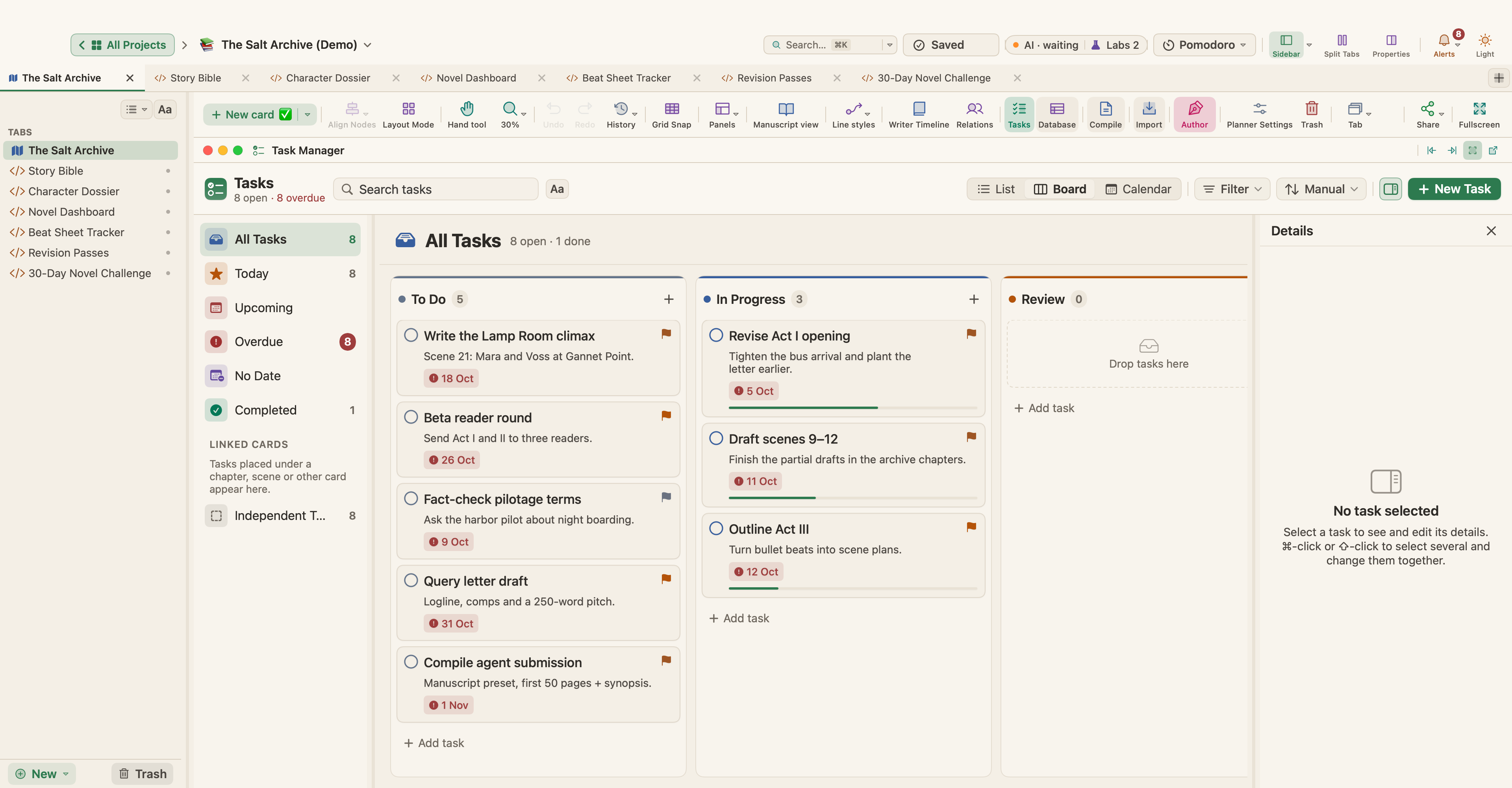
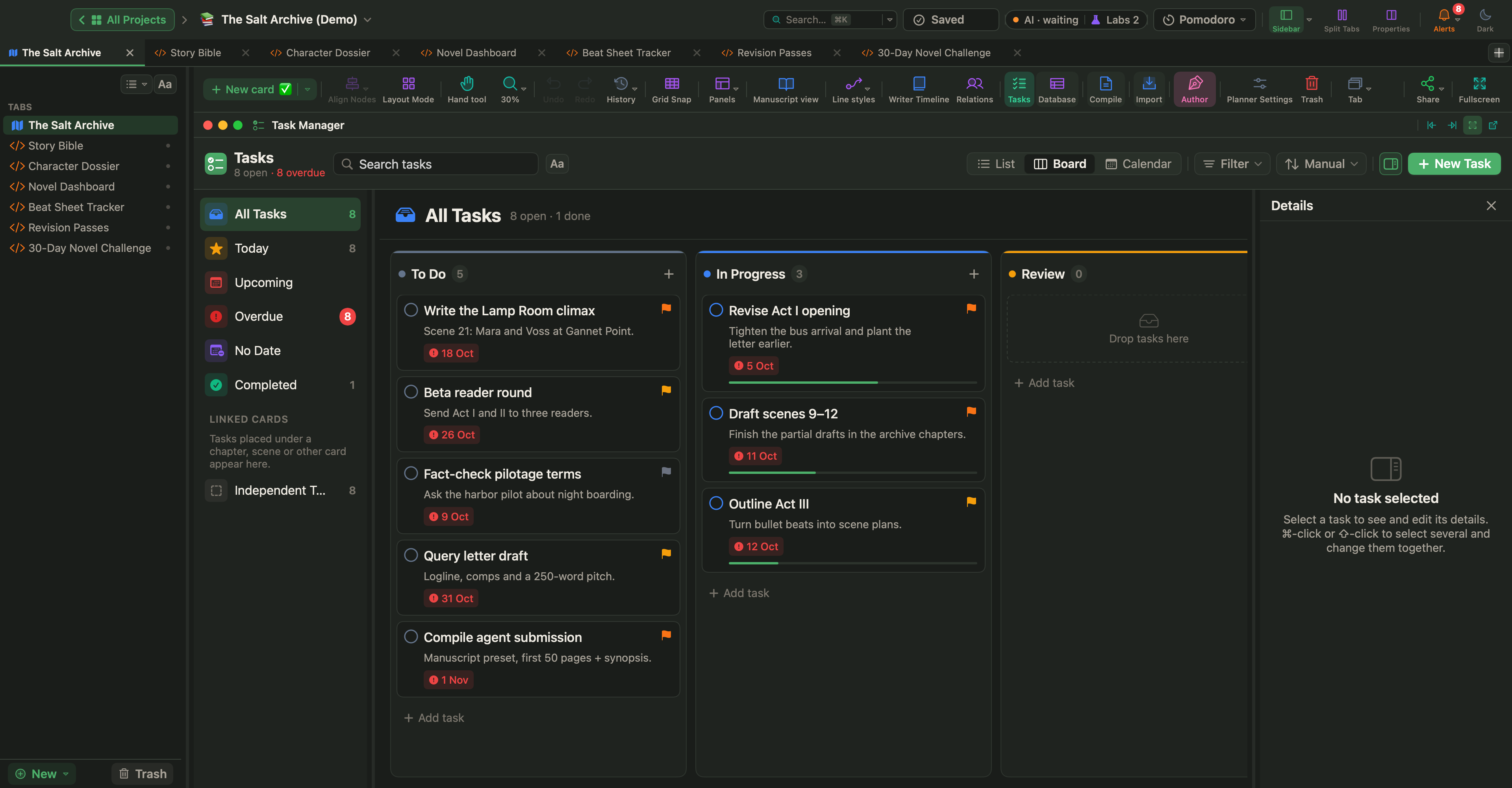
The submission package is a short list. The Salt Archive, a sample mystery in WriterMorph, keeps it as two task cards in its Task Manager: Query letter draft (a logline, comparable titles and a 250-word pitch) and Compile agent submission (the Manuscript preset, the first 50 pages and the synopsis).
For the pages, choose Project › Compile…, the Manuscript preset and Word (DOCX) or PDF. Under Contents, choose a collection or the current selection to send only the opening chapters. For the synopsis itself, select it in the binder and choose File › Export › Files…, which saves the selected documents as Word files. The guide to formatting and compiling your manuscript covers the settings.
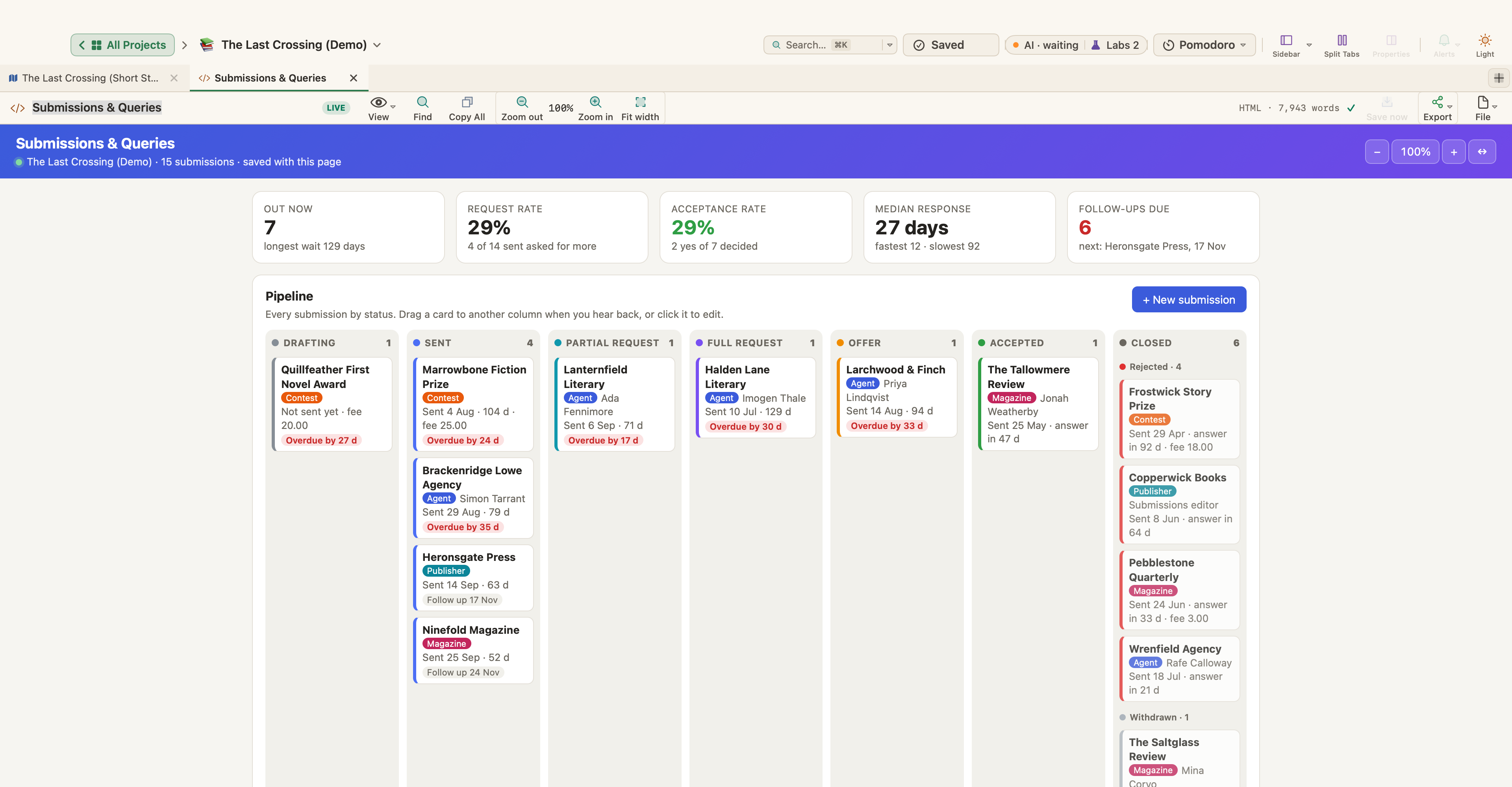
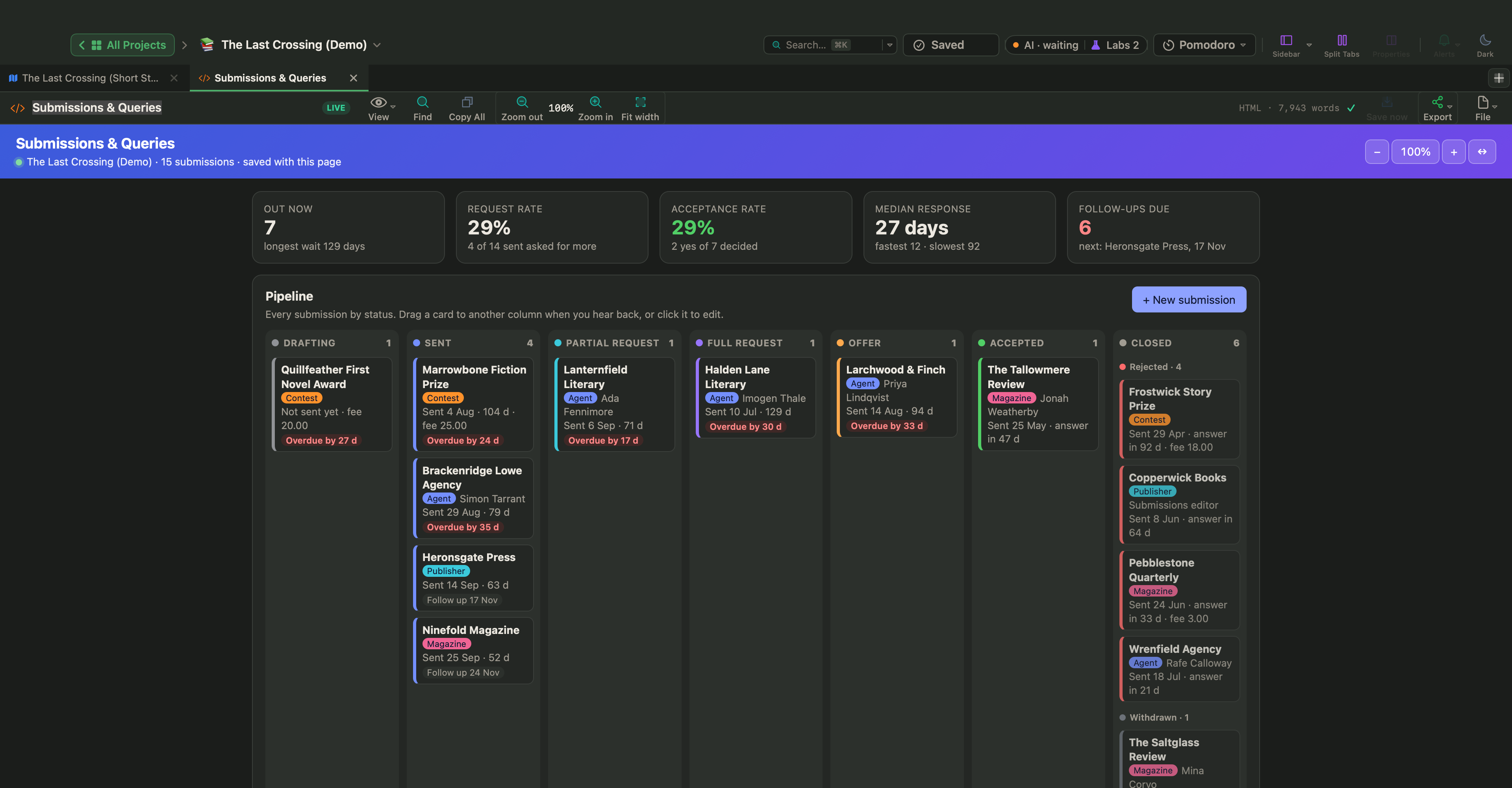
To track who has what, the Submissions & Queries Live Page keeps agents, publishers, magazines and contests on a board by status, with request rates, response times and follow-ups due. Live Pages are a Labs feature: turn on Turn HTML pages into small apps (Live Pages) in Settings › Labs, then choose New ▾ › Live Page ▸ › Examples ▸; the page is in the Writing & Publishing submenu.
Agents open and close to queries throughout the year, so check each one's current status and guidelines before you send; QueryTracker lists both. And check who you are dealing with. In May 2026 the head of one company pleaded guilty in a publishing scam that took more than $48 million from authors, many of them promised film and publishing deals. Real agents don't charge reading fees and rarely approach writers out of the blue.
Write the synopsis before the query letter, not after. Once you can tell the whole story in 450 words, the pitch in the letter is a matter of choosing its first two paragraphs.