 WriterMorph

The Hero's Journey for novelists: the twelve stages, the inner journey and how to plan them
What each of the twelve stages does, how an inner journey runs under the outer one, how to use the pattern without turning every book into a quest, and how to plan it as scene cards in WriterMorph.
The Hero's Journey describes a story in which someone leaves a familiar life, is tested in an unfamiliar one and comes back changed. Plenty of novels follow it without being quests at all: a new job, a marriage, an illness or a move can be the journey.
This guide covers the twelve stages, the inner journey under the outer one and the mistakes that make the pattern show. The last part plans it in WriterMorph.
Where the pattern comes from
Joseph Campbell described it in The Hero with a Thousand Faces (1949). In myths and folk tales from many cultures he found one underlying shape, which he called the monomyth: a departure, an initiation through trials, and a return.
Christopher Vogler reworked it for storytellers in The Writer's Journey, as twelve stages and a set of recurring roles such as the mentor, the threshold guardian and the shadow. He treats those roles as jobs a character does for a while, not fixed types, so a friend can turn enemy halfway through.
The twelve stages
The act column follows the usual three-act mapping, which WriterMorph's template also uses.
| Stage | What it does | Act |
|---|---|---|
| Ordinary World | Shows the hero's everyday life and what is missing from it | One |
| Call to Adventure | A problem, a message or an event disturbs that life | One |
| Refusal of the Call | The hero hesitates, from fear, duty or doubt | One |
| Meeting the Mentor | Someone or something gives advice, training, a tool or nerve | One |
| Crossing the First Threshold | The hero commits and enters the unfamiliar world | One |
| Tests, Allies and Enemies | The hero learns how the new world works, and whom to trust | Two |
| Approach to the Inmost Cave | Plans are made for the central danger; pressure builds | Two |
| Ordeal | The hero faces the worst, a real or symbolic death, near the middle | Two |
| Reward | The hero takes what surviving has won: an object, a truth, a reconciliation | Two |
| The Road Back | The hero turns for home, and the consequences give chase | Three |
| Resurrection | A last, highest-stakes test the old self could not have passed | Three |
| Return with the Elixir | The hero comes home changed, carrying something that matters to others | Three |
The shape has two summits. In the Ordeal the hero nearly loses; in the Resurrection they prove what they have learned. The stages between give the reader a breath, then raise the stakes again.
The outer journey and the inner journey
The outer journey is what happens: the hero leaves, fights, wins something and comes back. The inner journey is what changes in them. Plan both at once:
- In the Ordinary World, show the lack or the flaw as well as the setting.
- The Refusal is the flaw speaking: the fear or habit the story will test.
- In the Ordeal, something of the old self dies, not only the hope of winning.
- The Resurrection should be won by the person the hero has become, not the one who set out.
- The Elixir lands harder as understanding than as treasure.
Without the inner line, the book becomes a run of obstacles. Protagonist, antagonist and conflict covers the want, the need and the flaw underneath it.
Using it without writing a quest
The stages are functions, not events. Ask what each one does, then find its form in your book. The special world is wherever the old rules stop working: a new school, a courtroom, grief. A threshold is a commitment that can't be undone: signing, confessing, getting on the train. A mentor can be a book, a memory or a rival.
The order is flexible. Stages can be merged into one scene, moved or repeated; a refusal can last a line or belong to someone else. In a love story the relationship can be the special world (romance novel structure); in a mystery, the investigation (how to plot a mystery). A short story usually keeps only a few stages.
Common mistakes
- A checklist instead of a shape. If a stage does nothing in your story, merge it or cut it.
- Equal shares. The tests and the approach usually take far more room than the refusal or the mentor.
- A mentor who does the hero's work. If the mentor could solve the problem, the hero has nothing to do. Mentors often step aside before the end.
- An Ordeal with no inner cost. If only the outer stakes peak, the Resurrection has nothing to prove.
- Stopping at the climax. Without the Road Back and the Return, the reader never sees what changed. Read your first and last scenes side by side: the difference is the journey.
For other beat sheets, see story structure and turning points, three-act structure and the Save the Cat! beat sheet.
Planning the journey in WriterMorph
Start from the template
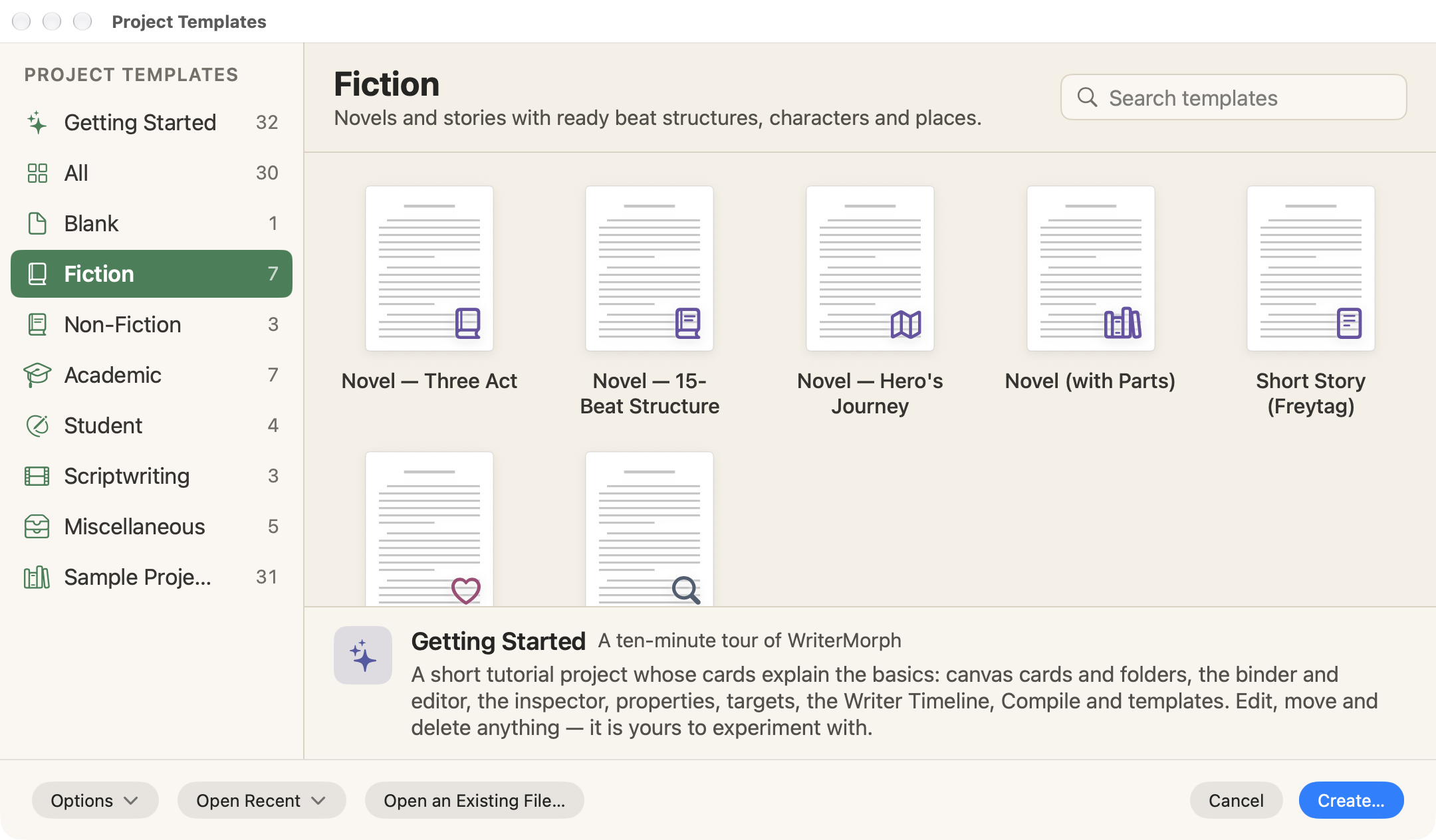
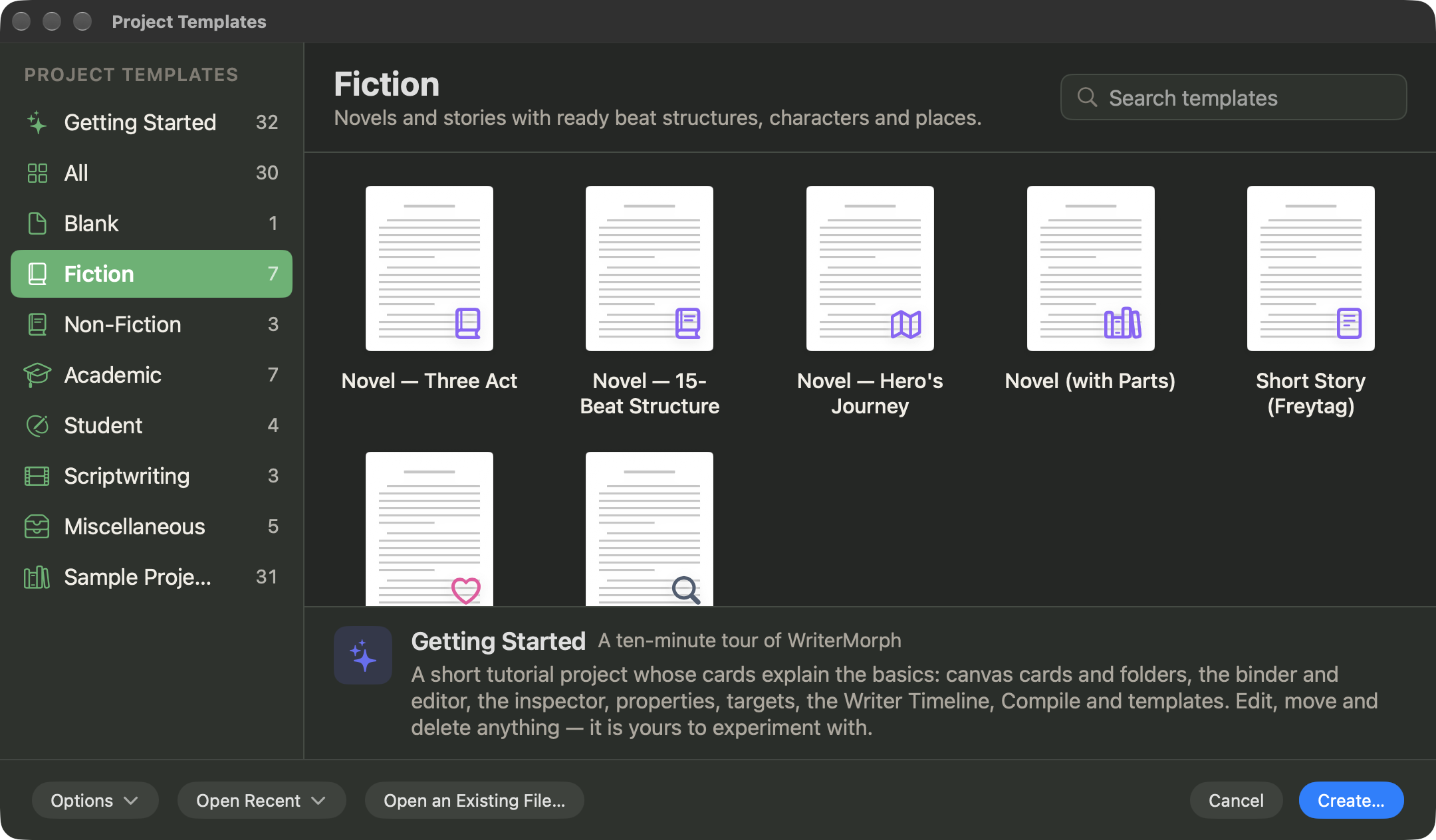
Choose File › New Project… (⇧⌘N), pick the Fiction category in the Project Templates window, select Novel — Hero's Journey and click Create…. Its binder is the third one in the picture at the top of this page.
The project opens with one scene card per stage: five in Act I, four in Act II and three in Act III. Each card has a one-line synopsis, a To Do status, its stage as its beat, a target tension and a short guide with two questions to answer. The Meeting the Mentor card, for instance, asks what the mentor cannot do for the hero.
Outside the manuscript, and never compiled, are a Synopsis page, Hero, Mentor and Shadow cards under Characters, each with a role, a want, a need and a flaw, and the Ordinary World and the Special World under Places.
In the app's beat lists a few stages have shorter names, such as Approach to Innermost Cave and Return with Elixir.
Break the stages into scenes
A stage is rarely one scene. Press ⌘N on the canvas to add a card, and give each scene its stage with Beat Assignment in the Writer Timeline section of the Properties panel (⌥⌘P). Select several cards, and Bulk edit sets the beat for all of them. In Manuscript Mode (⌃⌘M), the Corkboard (⌘2) shows the same scenes as index cards with their synopses.
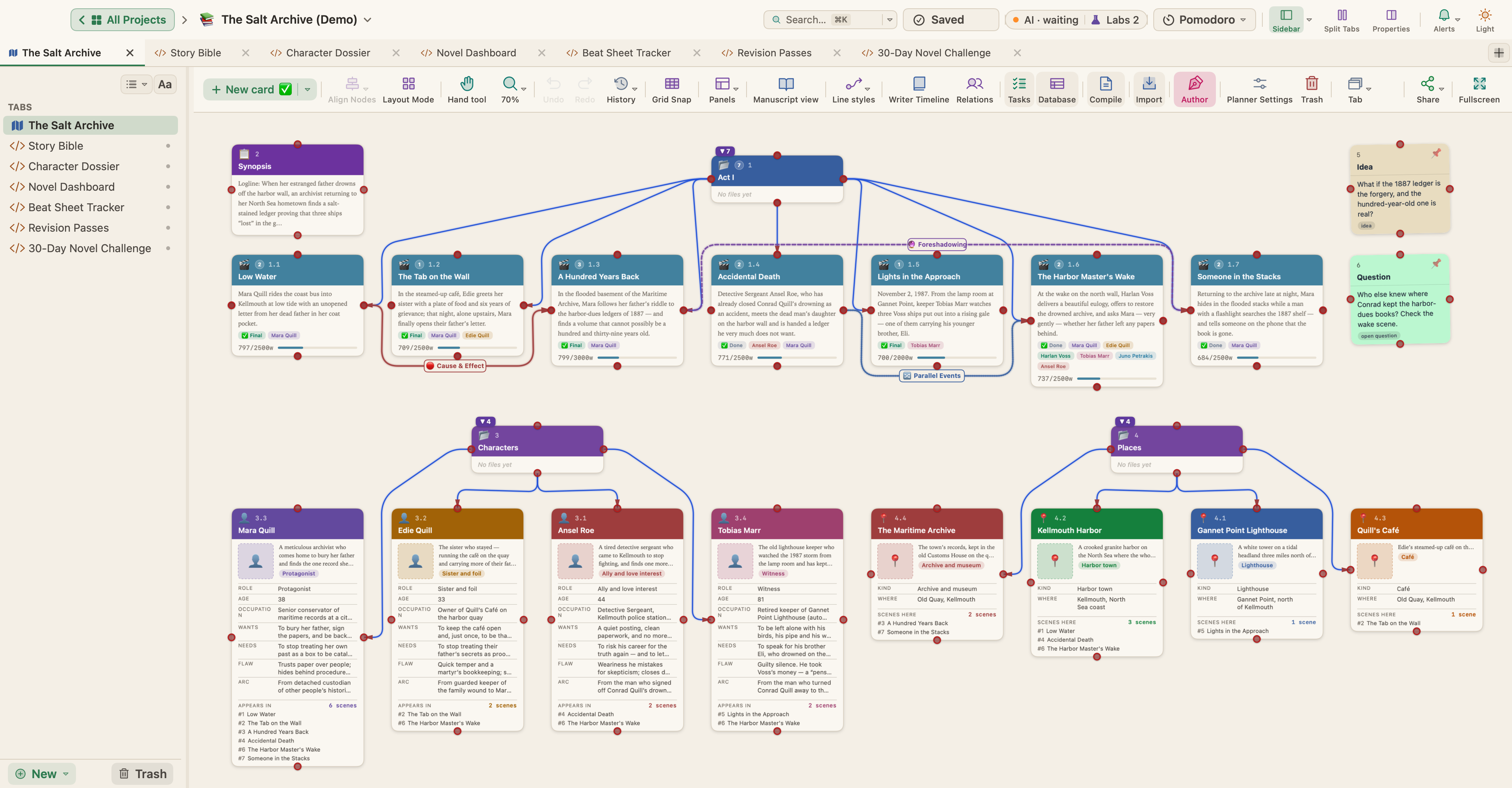
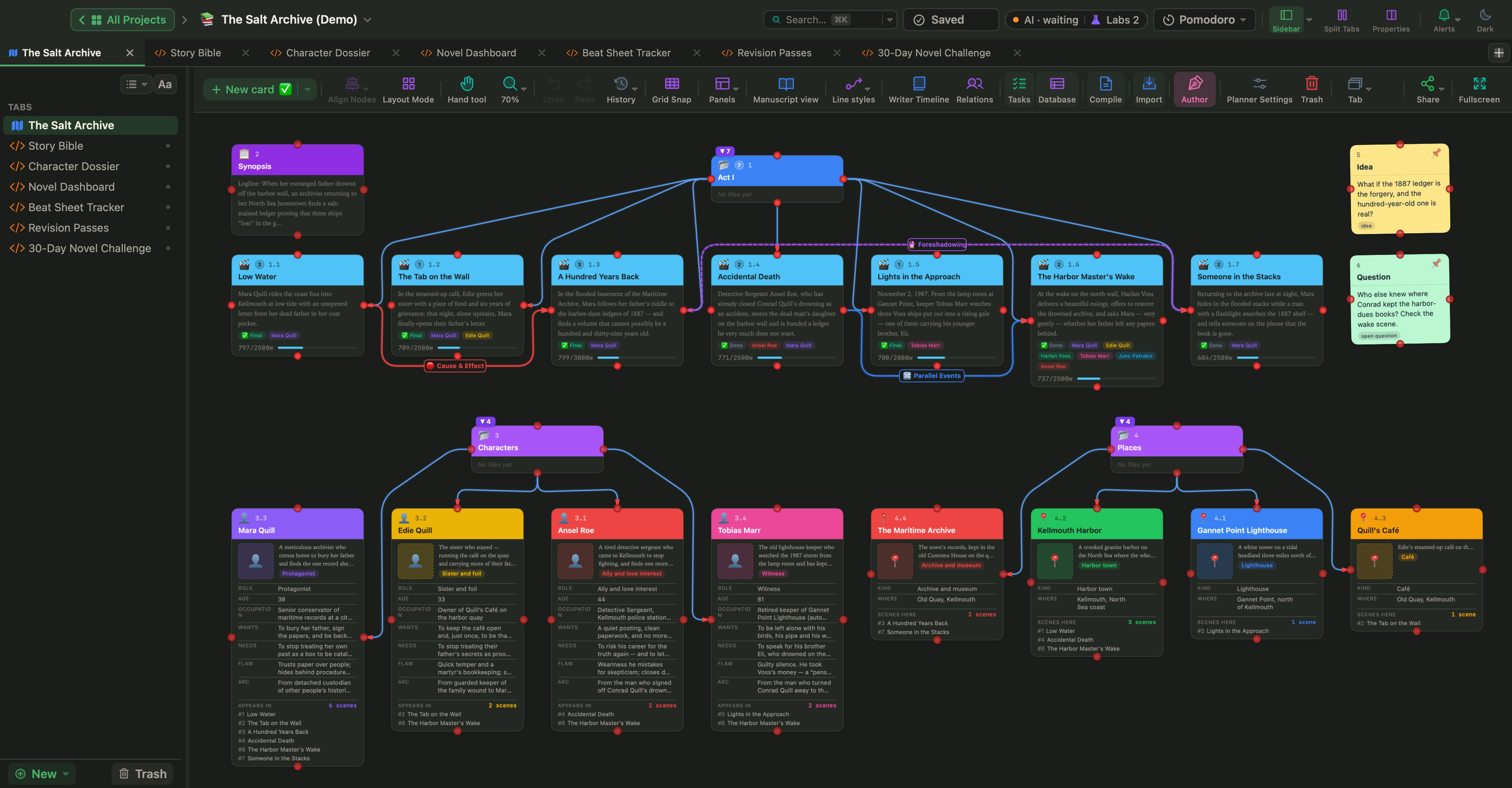
As the plan fills in, each card carries its synopsis, status, characters and word count, as on the canvas of The Salt Archive, a sample mystery under Help › Demo Projects.
See the stages on the Writer Timeline
Open View › Writer Timeline (⌥⌘T); fiction templates turn on the Author mode it needs. The Plot Board shows the acts and stages above the chapters, each stage with a count of its scenes. The Story Map gives each stage a column with the share of the book where it is expected, and draws missing stages as dashed columns: the Ordeal at 52–60%, for example, and Tests, Allies, Enemies across 30–45%.
The template's target tensions give the Tension panel the journey's shape from the start: 2 in the Ordinary World, 9 at the Ordeal, 10 at the Resurrection and 3 for the return.
If you already have a draft, choose Hero's Journey from the Plot Board's Structure menu. WriterMorph spreads your scenes over the stages by their position in the book, and switching back brings back your earlier beats.
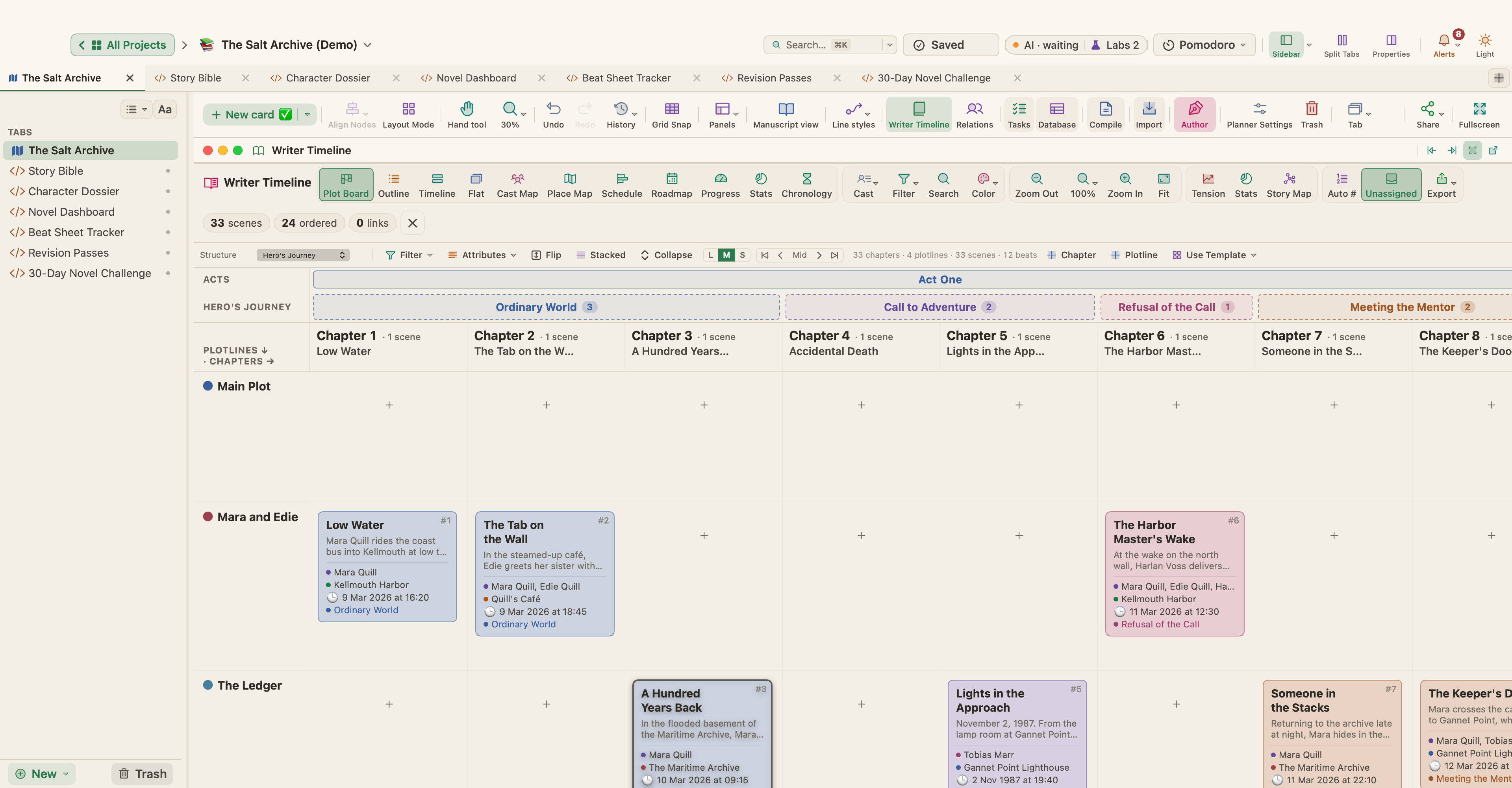
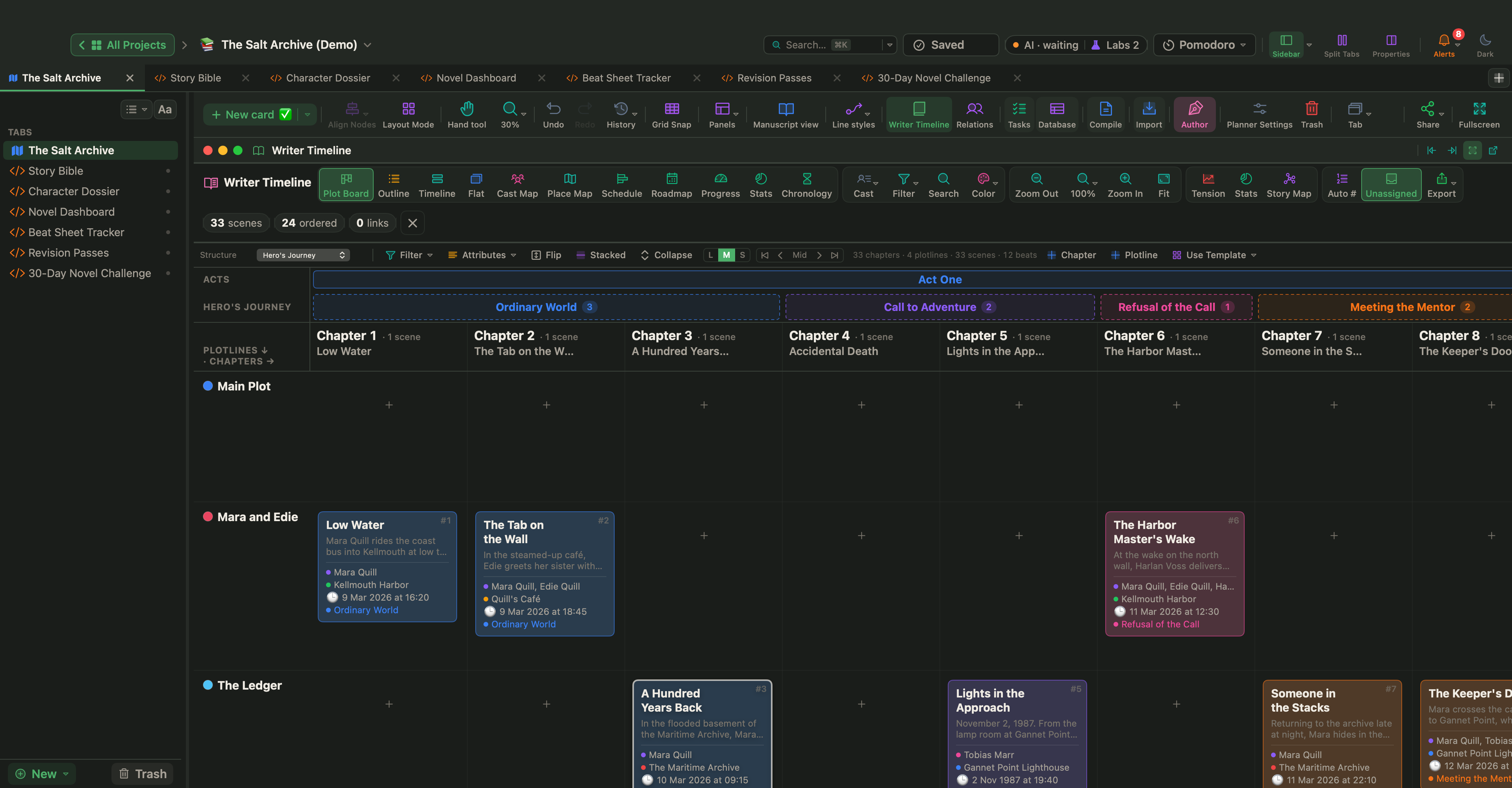
Read the spread as a first guess. It puts A Hundred Years Back under Ordinary World, yet that is the scene in which Mara finds, among the 1887 harbor ledgers, a volume that cannot be that old. That discovery starts the plot, so it is the call: change its Beat Assignment, or drag it into the Call to Adventure column of the Story Map.
Start with the two ends: what is missing in the Ordinary World, and what the hero brings home. Then plan the Ordeal that connects them, and let the stages in between show you what the story still needs.