 WriterMorph

Point of view in fiction: how to choose a POV and keep it consistent
First person, close third, omniscient or second person. How to choose a point of view, avoid head-hopping, balance several viewpoint characters and let voice carry the story, with the steps in WriterMorph.
Point of view decides whose eyes the reader borrows. It sets what the reader can know, how close they stand to a character and whose voice the narration takes on. It is one of the first choices in a novel and one of the hardest to change late, because every sentence leans on it.
The main points of view
| Point of view | Narrator | Strength | Cost |
|---|---|---|---|
| First person | "I", a character in the story | Voice and closeness; the reader learns as the narrator does | Limited to what one person sees and knows |
| Close third | "she" or "he", held close to one character per scene | Closeness, with room to change viewpoint between scenes | One head per scene, a discipline that is easy to slip |
| Omniscient | A narrator who knows every mind and can comment | Range, irony, a whole town at once | Distance; readers can lose track of whose thoughts they are in |
| Second person | "you" | Immediacy and strangeness | Hard to sustain over a whole novel |
Second person is rare in novels and more often found in short fiction or in a single strand of a book. There is also a cooler, camera-like third person, sometimes called objective, that reports only what could be seen and heard.
To choose, ask whose story it is: who changes most, who has most to lose, who is there when it matters. Then ask what the reader must not learn too soon. A mystery often stays close to its investigator, so the reader finds the clues with her. A story about a family or a town may need several viewpoints, or a narrator who can move between them.
Keeping it consistent
The most common slip is head-hopping: moving into a second character's thoughts in the middle of a scene. In first person and close third, keep one viewpoint per scene and change only at a scene or chapter break.
The viewpoint character also limits what the narration can know:
- Other minds. She can read a face; she can't know what is behind it.
- Her own appearance. She feels her face go hot; she can't see herself blush.
- Other rooms. What happens where she isn't must reach her by sound, rumor or report.
- Her own words. A harbor pilot and an archivist notice different things and name them differently.
A quick test: read a scene and mark every sentence your viewpoint character couldn't know or wouldn't think.
Several viewpoint characters
Decide whose scene it is. Give it to the character with most at stake in it, or the one who can witness what the reader needs to see. If you can't decide, draft the opening from both and keep the tenser one.
Set a rotation. Strict alternation sets a rhythm readers learn quickly. A looser pattern works too, as long as it starts early: introduce every viewpoint character in the first part of the book, so a new voice late doesn't feel like a trick.
Keep the balance. A viewpoint character who vanishes for a long stretch is forgotten, and one who gets a single scene may not need the point of view at all. Each should have a question only they can answer. Name the viewpoint character early in each scene so the reader knows whose head they are in.
Voice, dialogue and theme ride on point of view
In first person and close third, the narration takes on the viewpoint character's vocabulary, rhythm and judgments. What she notices when she walks into a room tells the reader who she is: the exits, the books, the unwashed cups.
Dialogue reaches the reader through the same filter. The viewpoint character hears what is said, half-hears what is meant and sometimes gets it wrong, and that gap is where subtext lives. Theme rides along too: whose eyes you choose, and whose you withhold, says something about the story.
Free indirect style and the unreliable narrator
Free indirect style is third-person narration that slips into a character's thoughts and idiom without a "she thought": Anna shut the door. Well, let them talk; she had done nothing wrong. The second sentence is Anna, not the narrator. Jane Austen and Gustave Flaubert are two of its best-known early masters, and it is what makes close third feel close.
Wayne C. Booth named the unreliable narrator in The Rhetoric of Fiction: a narrator whose account the reader learns not to take at face value, through self-deception, limited understanding or plain lies. Play fair: let the events show the gap between what the narrator says and what happened.
Point of view in WriterMorph
Fiction planners have a built-in POV field next to Characters, so the person telling a scene and the people in it are kept apart. Select a scene and open View › Properties Panel (⌥⌘P): the Cast section sets the POV characters, and the first one is the primary POV. The POV also sits in the property block above the text. To set it for a run of scenes, select them all and use Bulk edit.
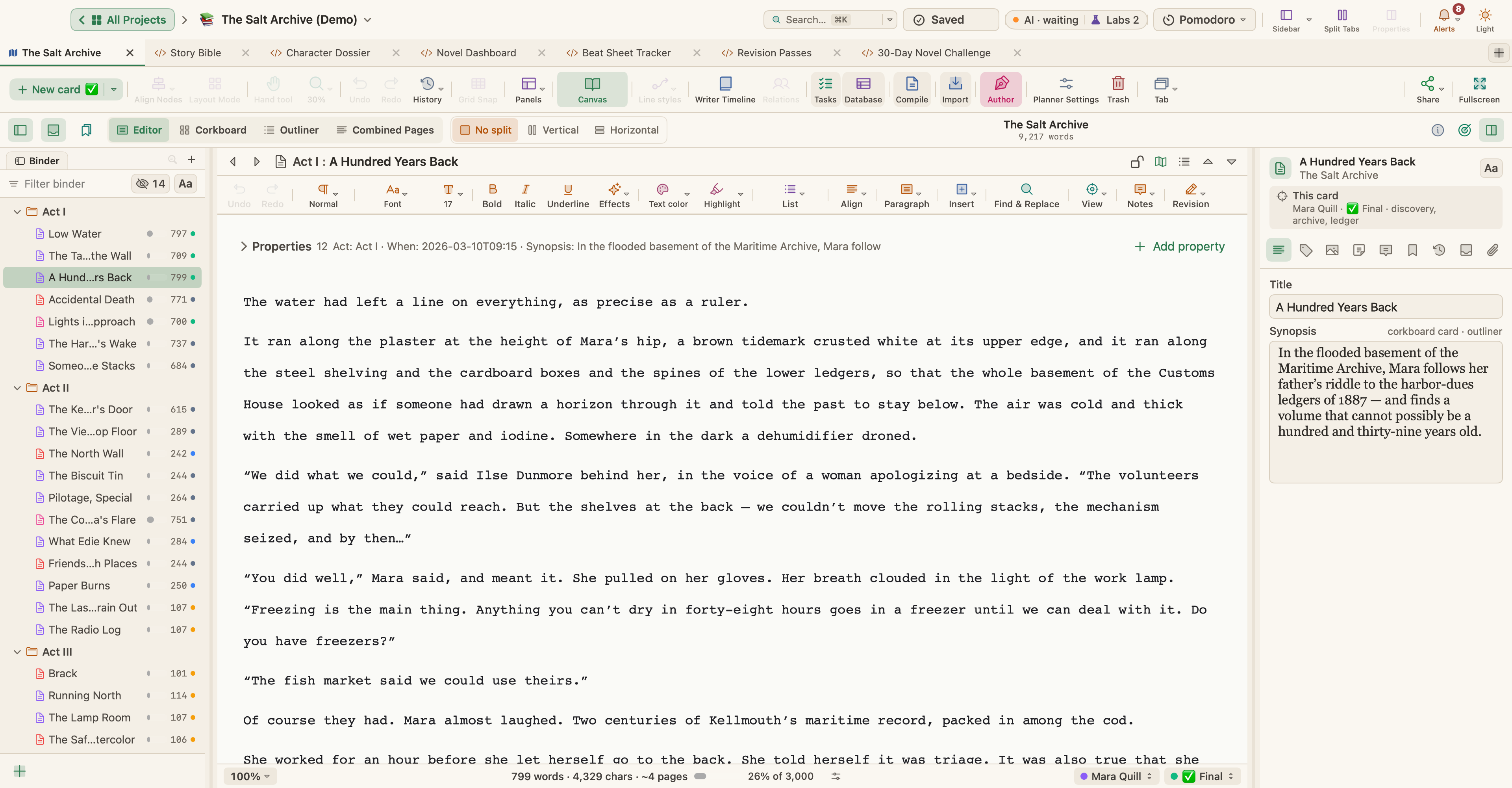
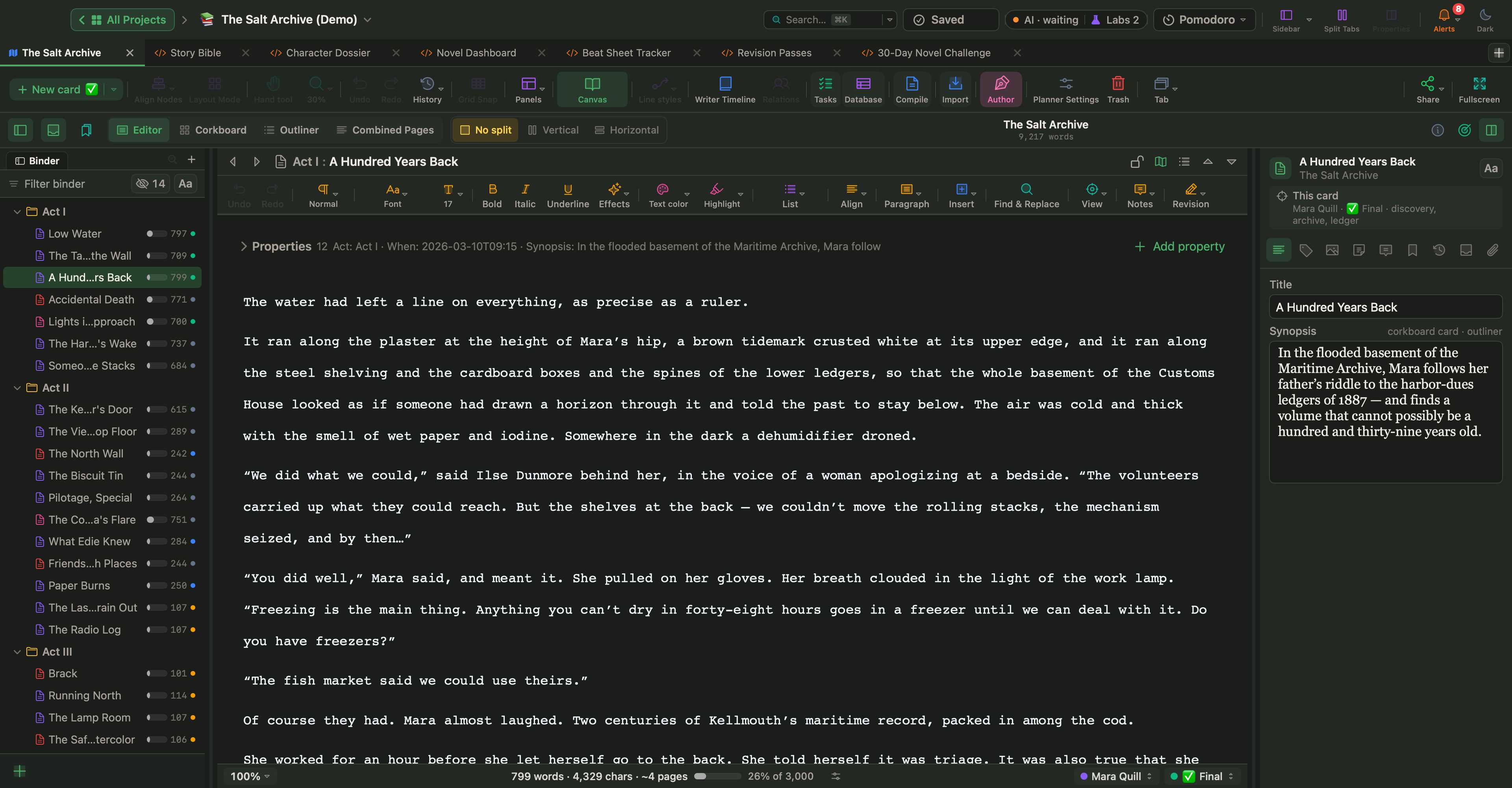
To see the pattern across the book, open the Writer Timeline with View › Writer Timeline (⌥⌘T); fiction templates turn on the Author mode it needs.
- Colour colors the scenes in the story views by POV.
- The Story Map can use POV characters as its rows, against beats, acts or chapters. Drag a scene into a cell to set its POV.
- In the Tension panel, Show can color the points of the curve by POV, so you see who carries the peaks.
- In the Outline panel (⌘L), type
pov: Marain the filter field to see only one character's scenes. - The Cast Map sets characters against chapters: every scene each one appears in, viewpoint or not.
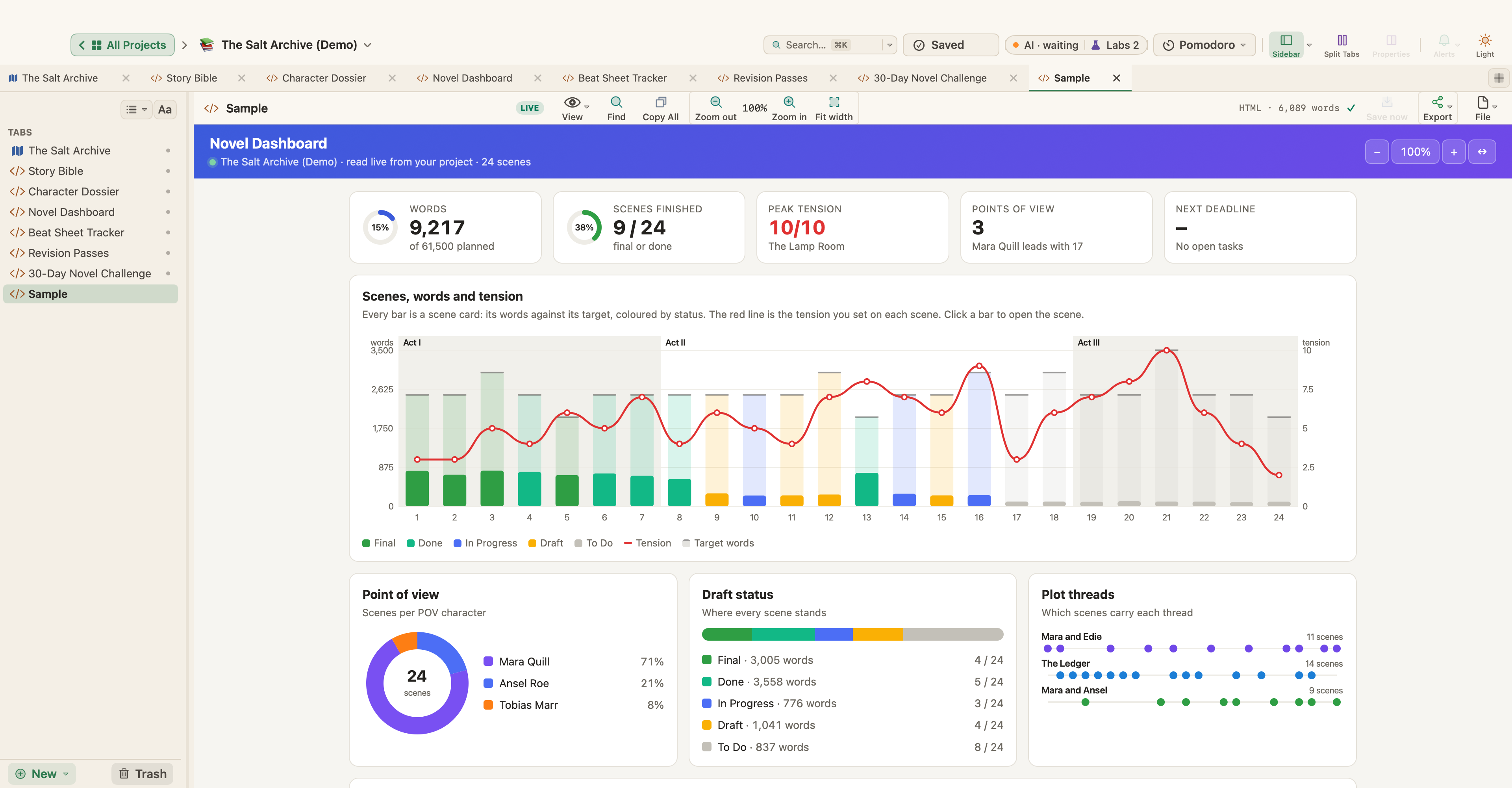
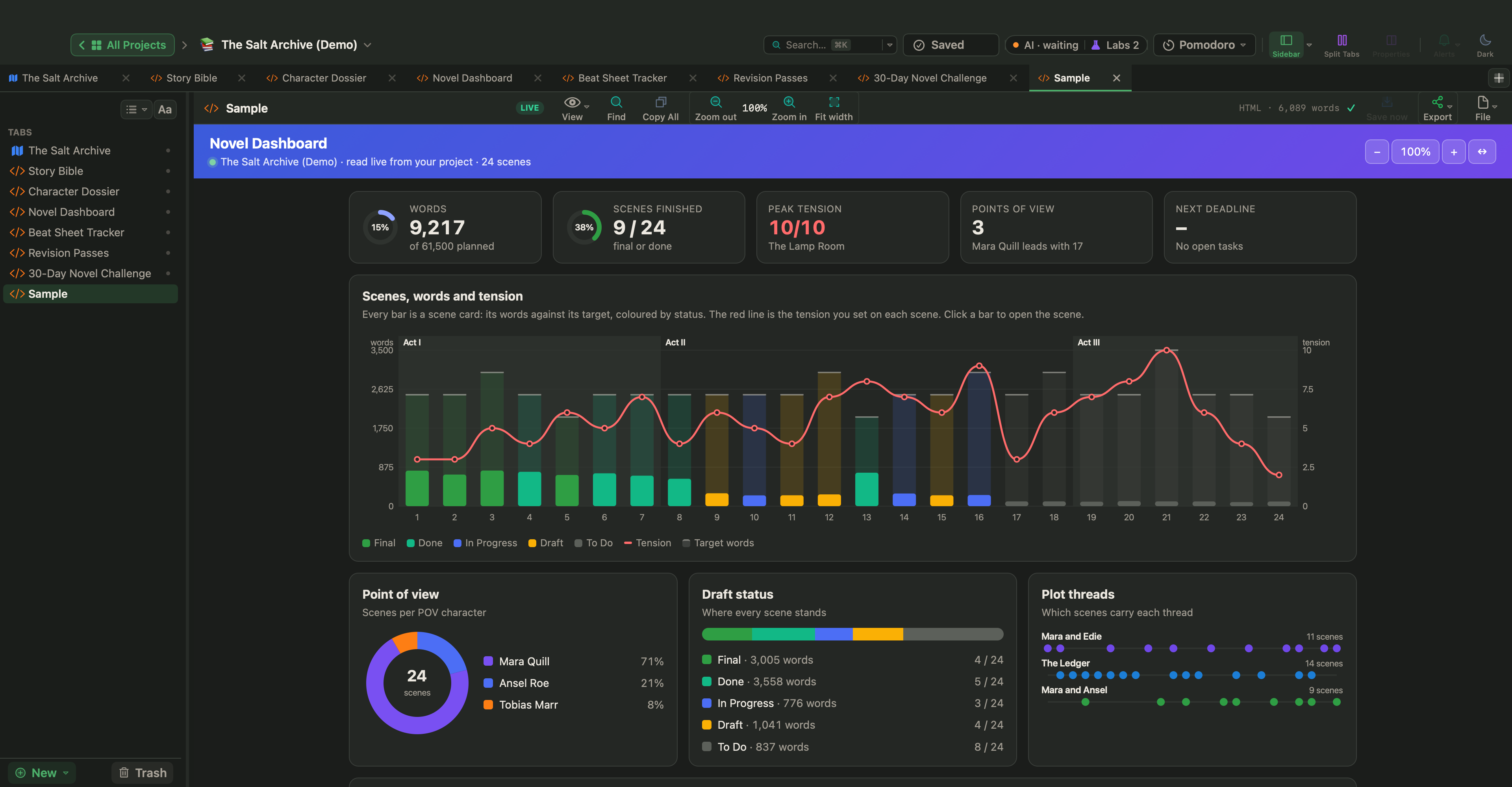
Two Labs features help with balance. Live Pages stay off until you turn on Turn HTML pages into small apps (Live Pages) in Settings › Labs; then choose New ▾ › Live Page ▸ › Examples ▸ in the sidebar. In the Fiction submenu, Novel Dashboard counts scenes per POV character, as in the picture at the top, and Continuity Checker flags POV gaps, where a viewpoint character goes missing for a long stretch. See Live Pages.
Three viewpoints in The Salt Archive
The Salt Archive, a sample mystery you can open from Help › Demo Projects or download, has three POV characters across its 24 scenes. The Novel Dashboard counts them: Mara Quill has 17 scenes (71%), Ansel Roe 21%, about five, and Tobias Marr 8%, about two.
- Mara Quill comes home to her harbor town after her father drowns. Most of the book stays with her, so the reader finds the ledger when she does.
- Ansel Roe is the detective sergeant who has already closed the drowning as an accident. His scenes put the reader on the other side of the case.
- Tobias Marr keeps the lighthouse. Lights in the Approach is set on 2 November 1987: from the lamp room at Gannet Point he watches three Voss ships put out into a rising gale. The storm night lies decades before the rest of the book, so it is told by someone who was there.
On the Story Map, the card for Lights in the Approach carries Tobias Marr's name, and the cards around it carry Mara's.
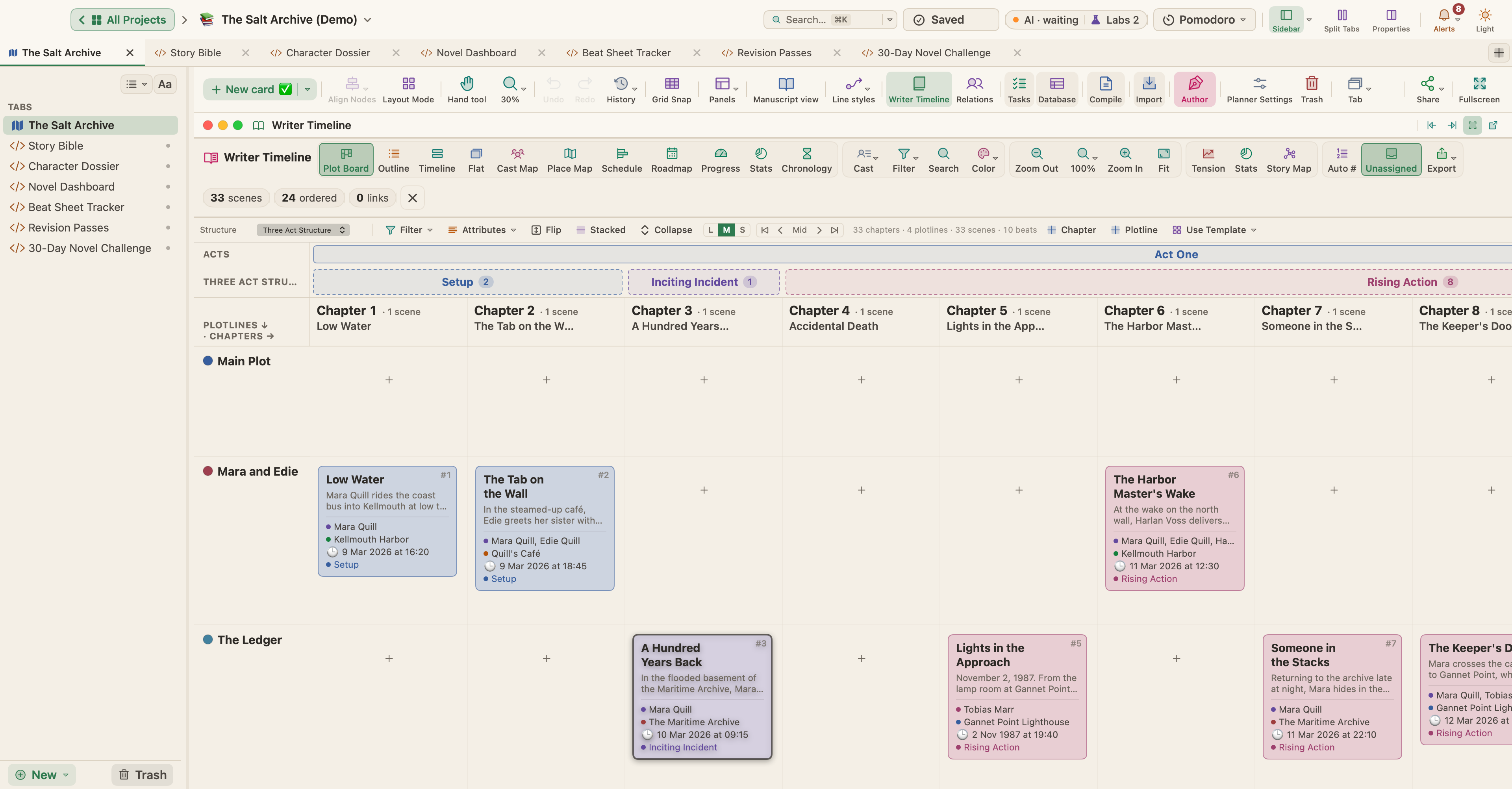
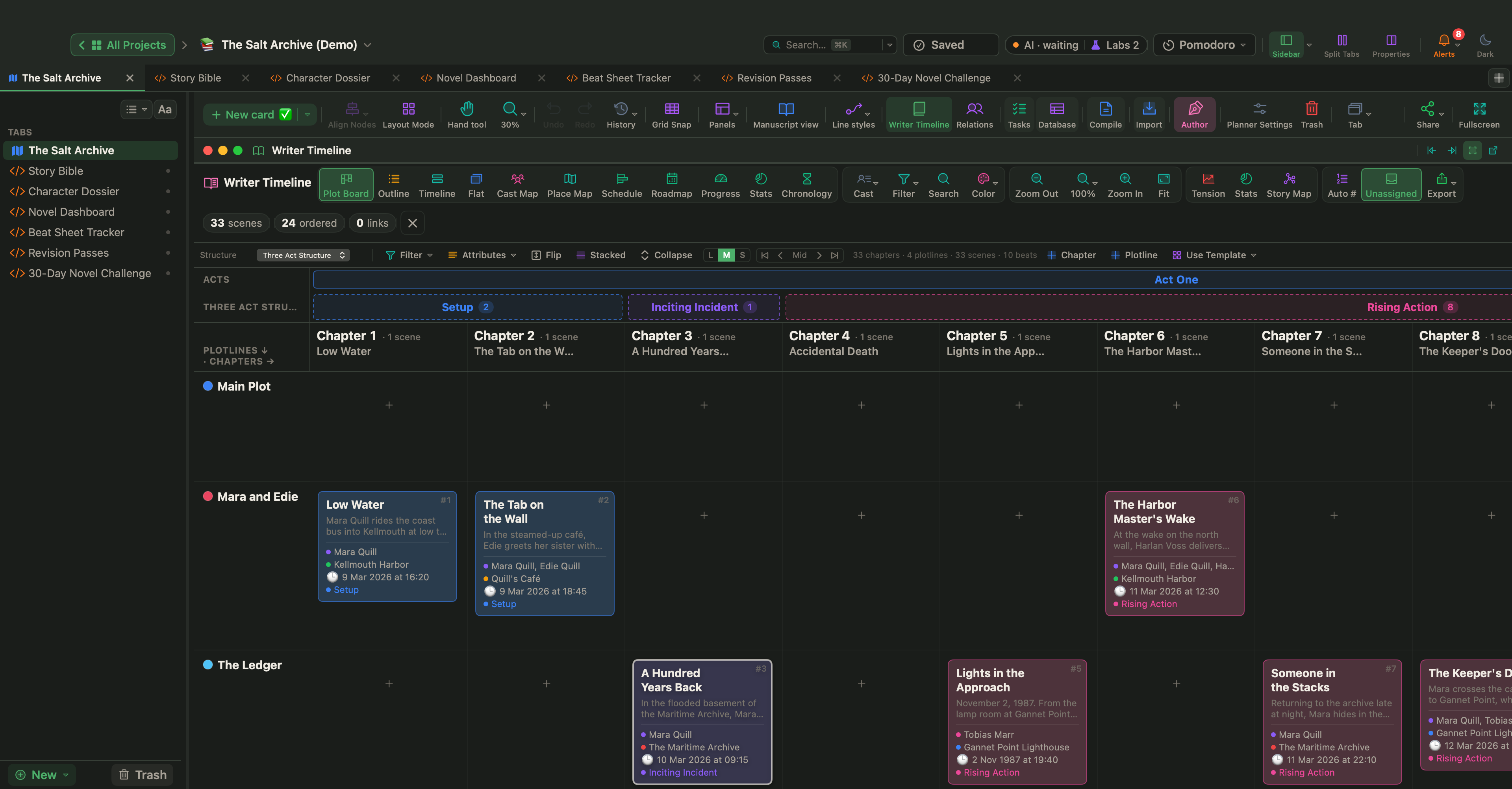
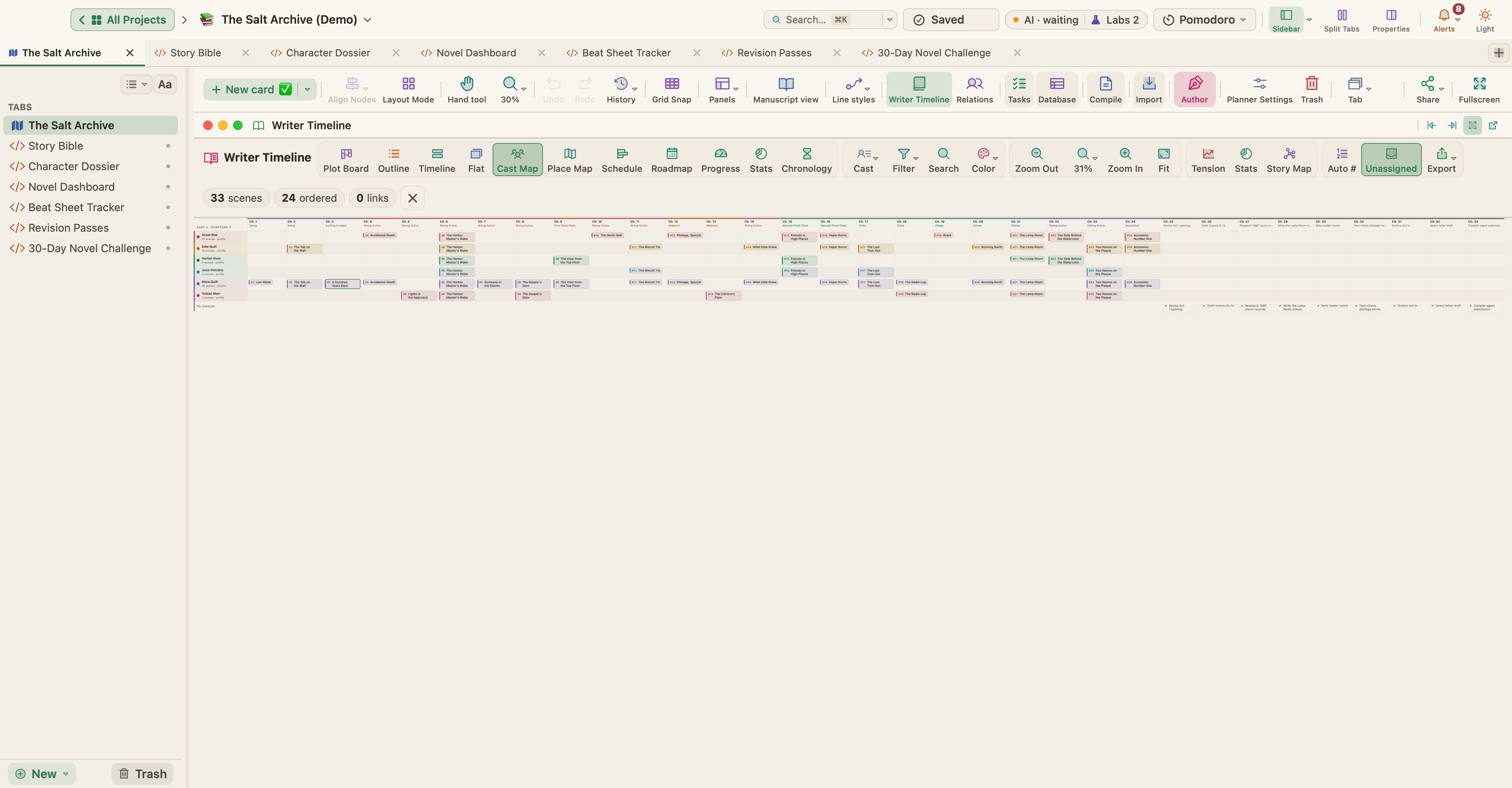
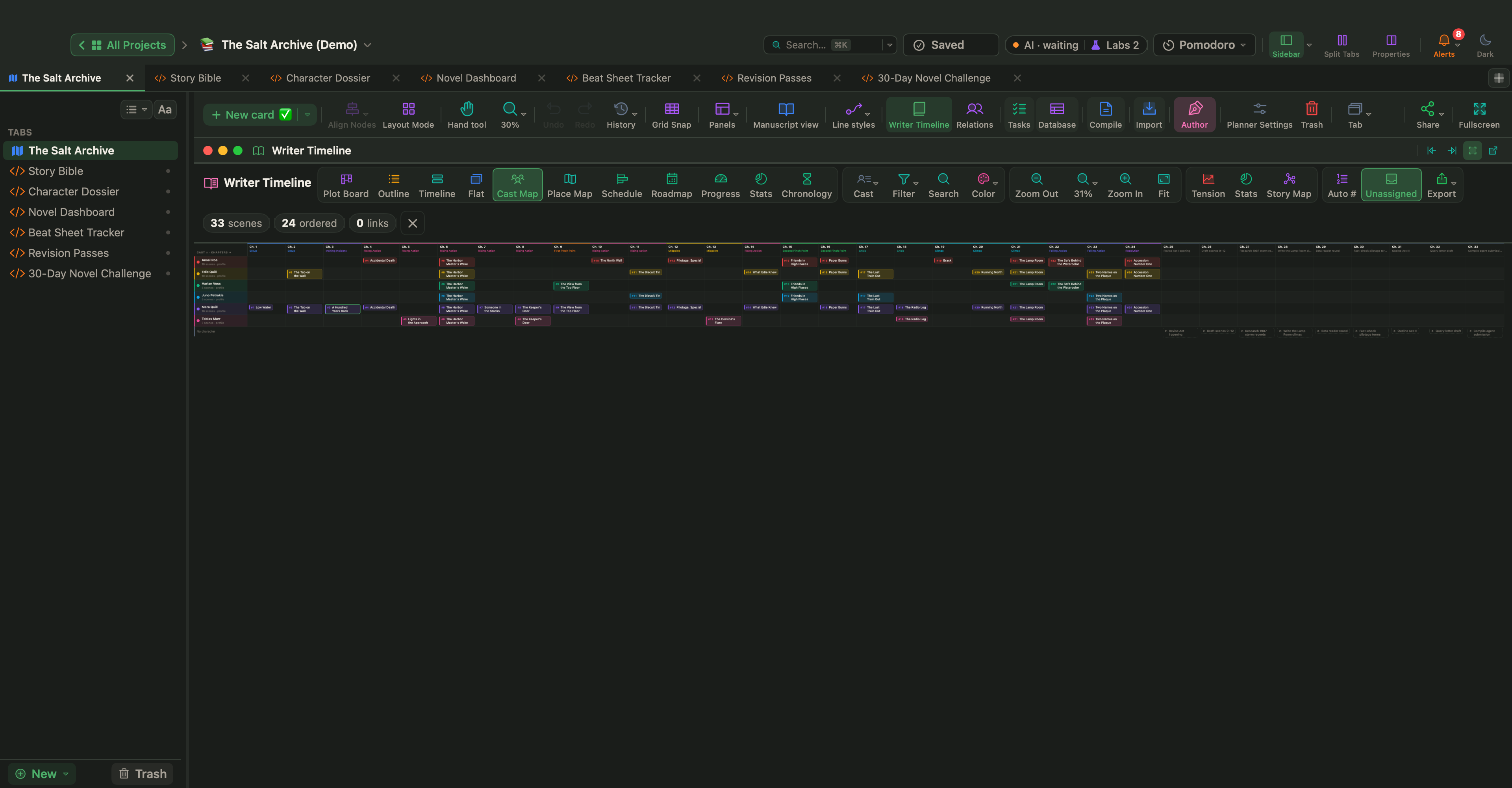
The Cast Map tells a different story from the POV count. Edie Quill, Mara's sister, appears in ten scenes but never holds the point of view, and the scene called What Edie Knew is in Mara's. Whatever Edie knows reaches the reader only when it reaches her sister. Tobias Marr appears in seven scenes but tells about two.
Decide whose book it is, write the POV on every scene card as you plan, and check the balance after each act. A viewpoint that goes missing, or a scene that would be stronger through other eyes, is far easier to fix on a card than in a finished chapter. For the scenes themselves, see how to write a scene that works.