 WriterMorph

How to write a character arc: positive, negative and flat arcs, with a worked example
A plot is what happens; a character arc is what it does to one person. Here are the four parts of an arc, the three kinds, the beats where the change shows, a worked example with Elizabeth Bennet, and how to keep every character's arc in view in WriterMorph.
Readers remember what happened in a novel for a few weeks. They remember who it happened to for years. What makes a character stay is rarely a list of traits. It is the change the story forces on them, or their refusal to change, and that line of change is the character arc.
This article explains what an arc is made of, the three kinds, where in the story the change has to show, and how to plan one. The worked example is Elizabeth Bennet in Pride and Prejudice, and the last section shows how to track arcs in WriterMorph.
What a character arc is
A plot answers "what happens next?". An arc answers "what is this doing to her?". The two are tied together: the events of the plot are the pressure, and the arc is what the pressure does.
An arc is the distance between who the character is on page one and who they are on the last page. The distance can be covered in three ways: the character changes for the better, changes for the worse, or stays the same while changing everyone around them.
The four parts of an arc
Most methods for planning an arc use the same four parts under different names. K. M. Weiland's Creating Character Arcs calls the false belief "the Lie the character believes" and separates the thing the character wants from the thing they need.
| Part | What it is | The question to ask |
|---|---|---|
| Want | The goal the character is chasing in the plot | What are they trying to get? |
| Need | The truth they have to accept to be whole | What do they not yet see about themselves or the world? |
| Flaw | The false belief or habit that keeps them from the need | What do they believe that isn't true? |
| Wound | The past event that made the flaw seem sensible | Why do they believe it? |
The want drives the plot and the need drives the arc. The story is strongest when the two pull against each other: the character can't get what they want without facing what they need, and for most of the book they try to get it anyway.
Not every character needs a dramatic wound. Sometimes the flaw comes from upbringing or from having been right too often. But there should always be a reason the flaw has worked for them until now.
The three kinds of arc
| Kind | The character | Well-known examples |
|---|---|---|
| Positive | Starts with the flaw, is forced to face it, and ends having accepted the need | Elizabeth Bennet, Ebenezer Scrooge |
| Negative | Is offered the truth and refuses it, or gives in to a worse belief, and pays for it | Macbeth, Dorian Gray |
| Flat | Already holds the truth. The story tests it, and the character changes the people and the world around them | Sherlock Holmes |
A flat arc is not a missing arc. The pressure is still there: the story has to give the character real reasons to give up what they believe. It suits detectives, mentors and the heroes of long series, where a lead who changed completely in every book would have nothing left by the third.
Choose the kind before you plot. It decides the ending: a positive arc ends with the need accepted, whether or not the want is won; a negative arc often ends with the want won and found to be worthless.
Where the arc shows: the beats
The change doesn't happen in one scene. It is prepared, tested and paid for at fixed points, and these line up with the turning points of the plot.
- The opening shows the flaw at work, and working. The reader should see why the character trusts it.
- The first turning point commits the character to the want, on the flaw's terms.
- The first half rewards the flaw. Evidence seems to confirm it, and the character acts on it with growing confidence.
- The midpoint shows the character the truth for the first time. They see it, and often push it away at first.
- The second half makes the flaw expensive. Each time they fall back on it, it costs more.
- The crisis forces a choice between the want as they first imagined it and the need.
- The climax is the proof: the character does something they could not have done in chapter one.
- The ending shows the new normal in one concrete picture.
In a negative arc the same points appear, and at the crisis the character chooses the flaw. In a flat arc, the midpoint and the crisis are where the character is most tempted to drop the truth.
A worked example: Elizabeth Bennet
Pride and Prejudice is a positive arc, and a clean one.
- Want: to marry only where she can respect and love, and to keep her independence of mind.
- Flaw: she trusts her first judgment of people completely. She is quick, she is usually right, and she has come to think she is always right.
- Need: to see that she can be as blind as the people she laughs at.
| Chapter | Beat | What it does to the arc |
|---|---|---|
| 3 | Darcy slights her at the assembly | The flaw at work: she judges him in one evening |
| 16 | Wickham tells his story against Darcy | The flaw is rewarded with what looks like proof |
| 34 | She refuses Darcy's first proposal | The midpoint of the plot: she acts on the flaw at full strength, and enjoys it |
| 35–36 | Darcy's letter | The moment of truth: she tests his account and finds it holds. "Till this moment I never knew myself." |
| 43 | Pemberley | New evidence, which she can now read correctly |
| 46 | Lydia runs off with Wickham | The cost: her old judgment of Wickham has hurt her whole family |
| 56 | She refuses Lady Catherine's demand | The proof: she stands on her new judgment against rank and pressure |
| 58 | The second proposal | The new normal |
Notice that the plot and the arc share their turning points. The first proposal is the moment the romance seems lost and the moment her flaw is strongest. That is what "the want and the need pull against each other" looks like in practice.
How to show the change
- Through decisions under pressure. A character who says they have changed has not. One who makes a choice that costs them has.
- With mirror scenes. Put the character in a situation near the end that echoes one near the start, and let them choose differently. Elizabeth refuses a proposal in chapter 34 and accepts one in chapter 58, from the same man, and the difference between the scenes is the arc.
- Through other characters. A minor character who has the same flaw and never loses it shows what the hero escaped. Mr. Bennet laughs at everyone and changes very little.
- In small things first. Before the big choice, let the reader see a smaller one go the new way.
Five common mistakes
- The change happens in one scene. A single speech can't undo three hundred pages of habit.
- The change costs nothing. If accepting the need doesn't mean giving something up, it reads as a mood, not a change.
- The arc is told in narration. "She realized she had been proud" belongs to the synopsis. In the novel it has to be a choice.
- Every character has a full arc. Two or three arcs are plenty for one book. The rest of the cast needs wants, not arcs.
- The climax of the plot ignores the arc. If the hero wins by strength alone, with nothing learned, the arc was decoration.
Tracking arcs in WriterMorph
Want, need, flaw and arc on the card
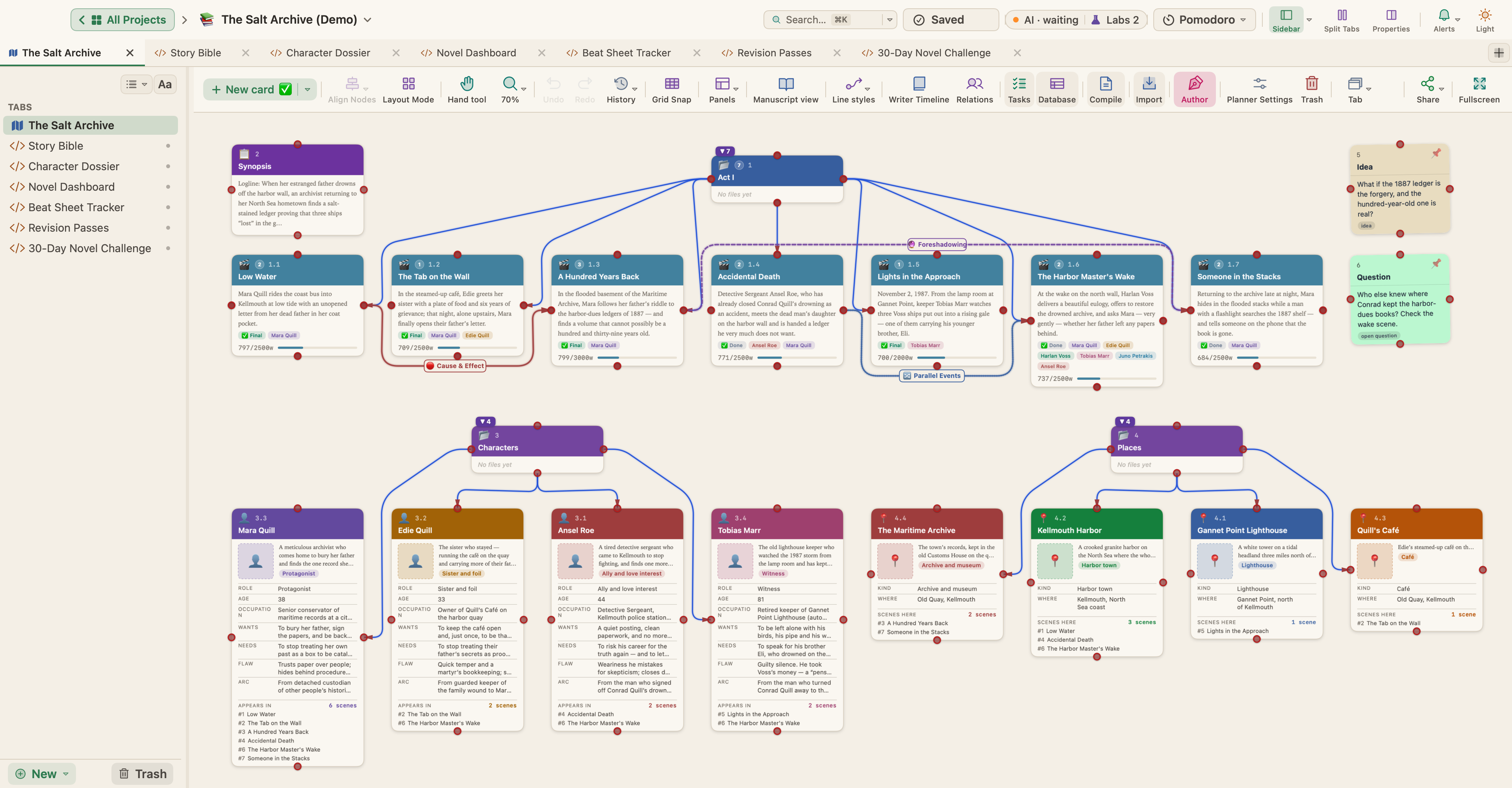
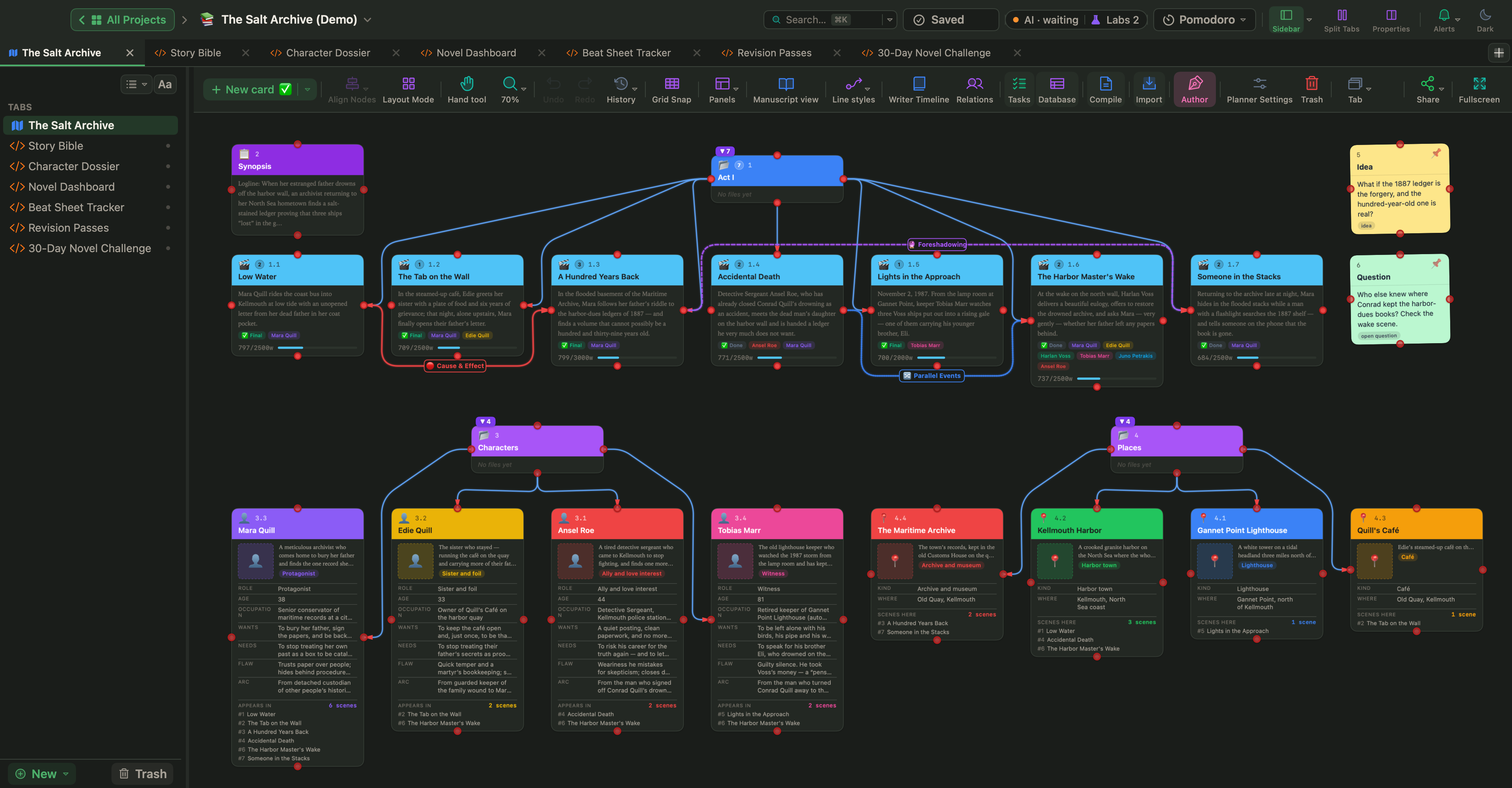
In WriterMorph every character is a card, and a character card has fields for Role, Wants, Needs, Flaw and Arc, next to the scenes the character appears in. Select a character and choose View › Properties Panel (⌥⌘P) to fill them in. Write the arc as one line with a "from" and a "to", as the sample cards below do.
Who is in the book, and where
Choose View › Writer Timeline (⌥⌘T) and click Cast Map: characters run down the side, chapters across, and each cell holds the scenes that character appears in. A character with an arc should be on the page at each of the eight beats above. If one of them is missing from the whole second act, the arc has a hole in it.
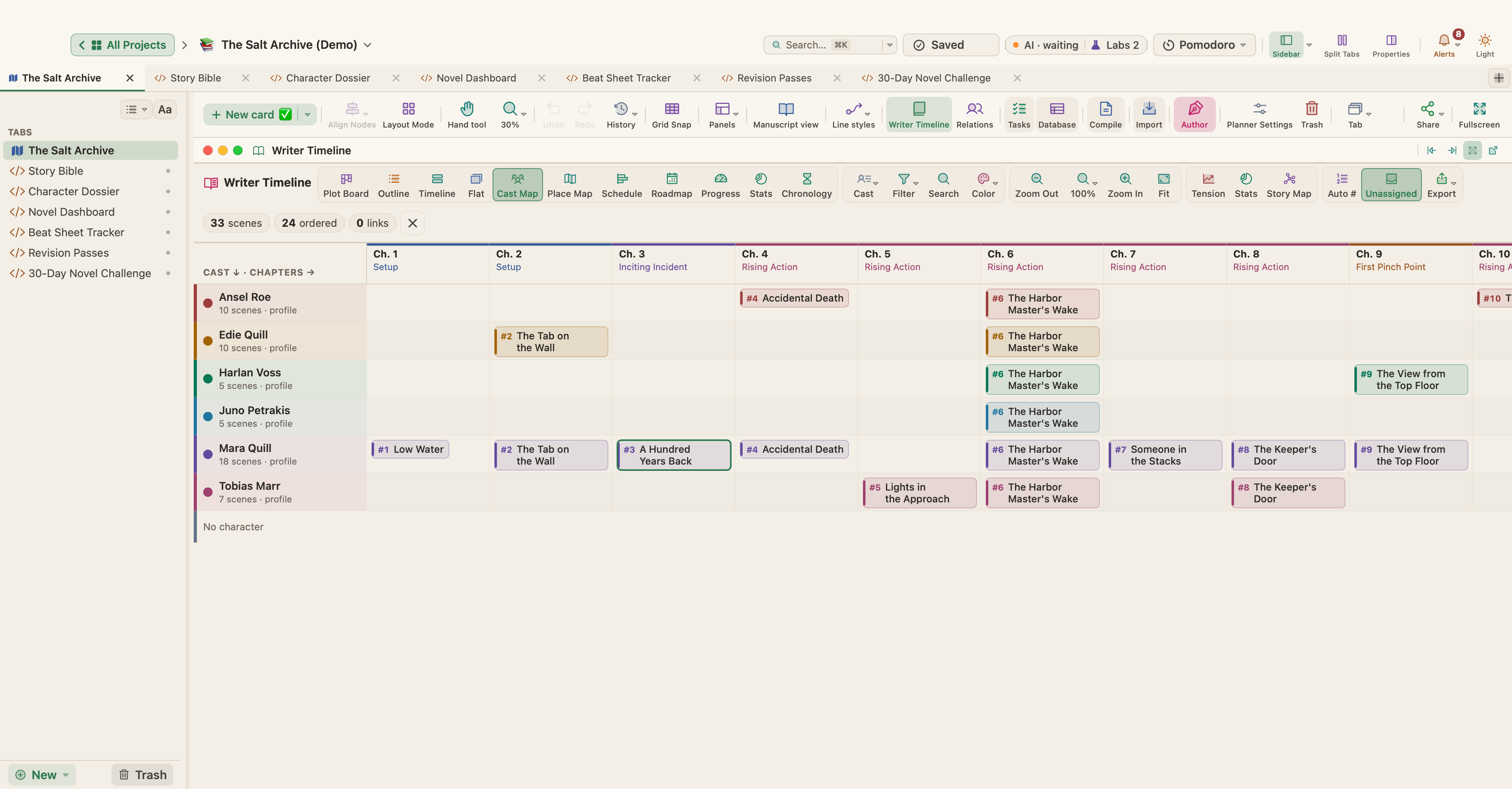
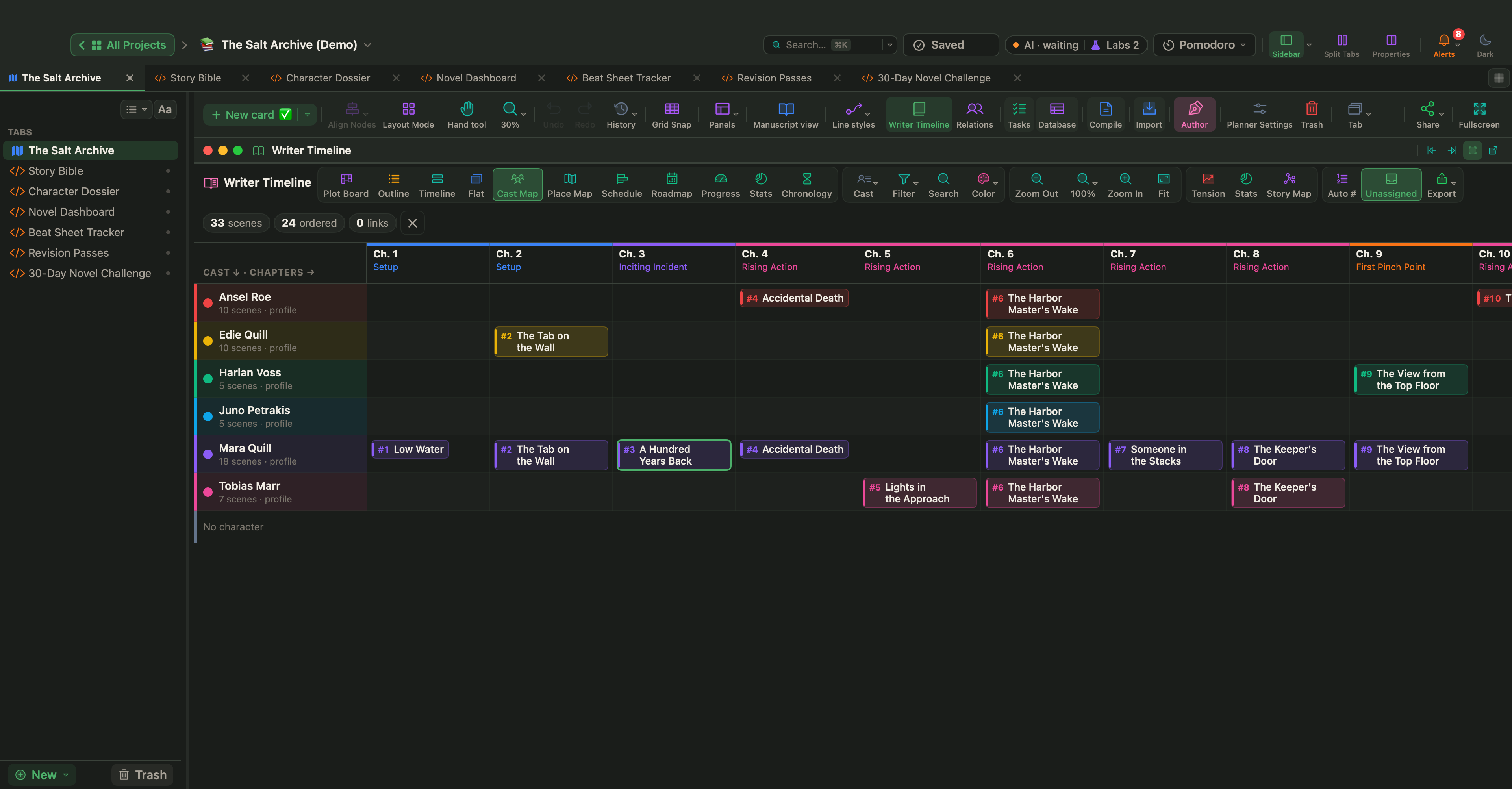
The Character Arcs page (Labs)
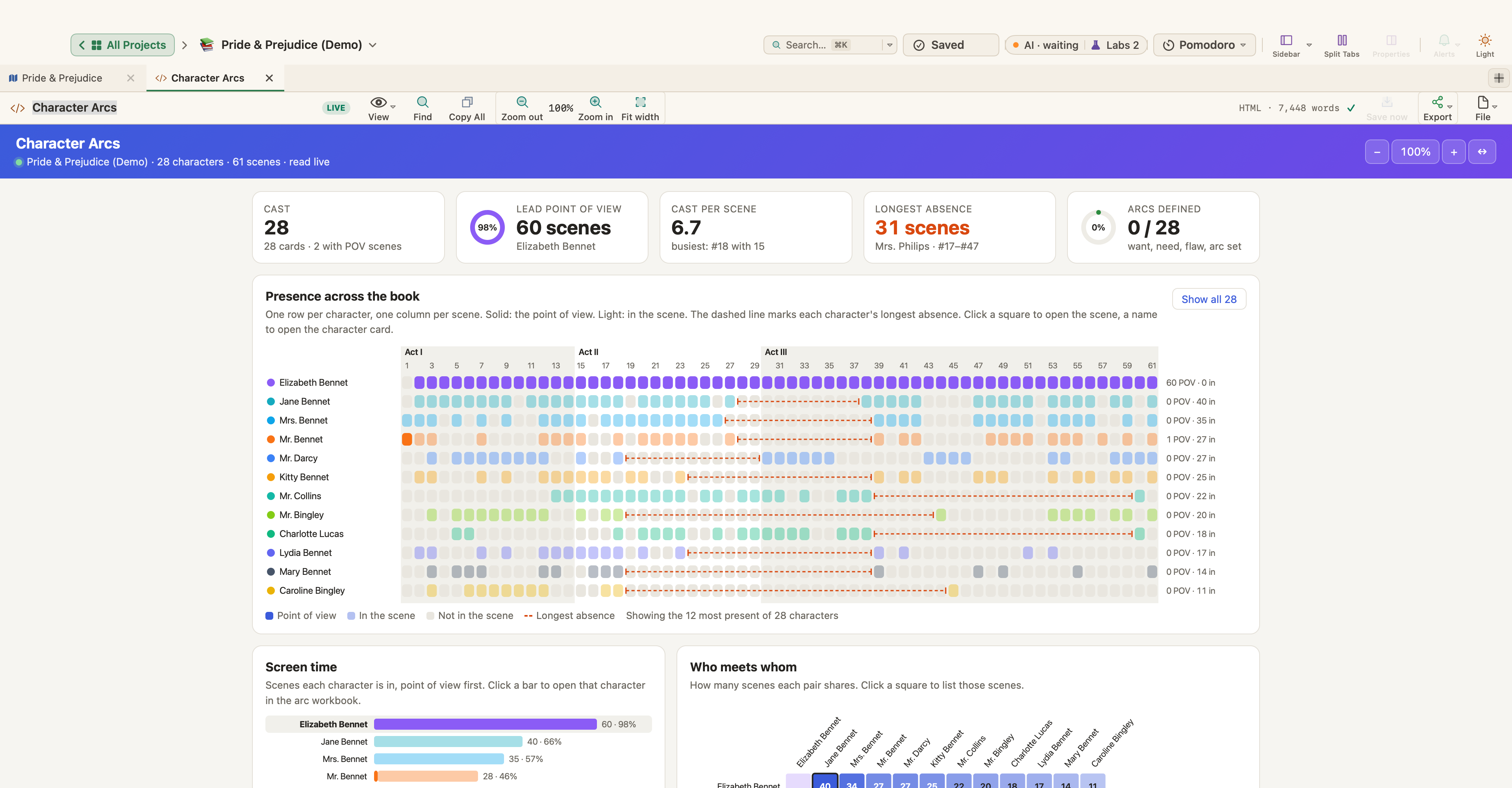
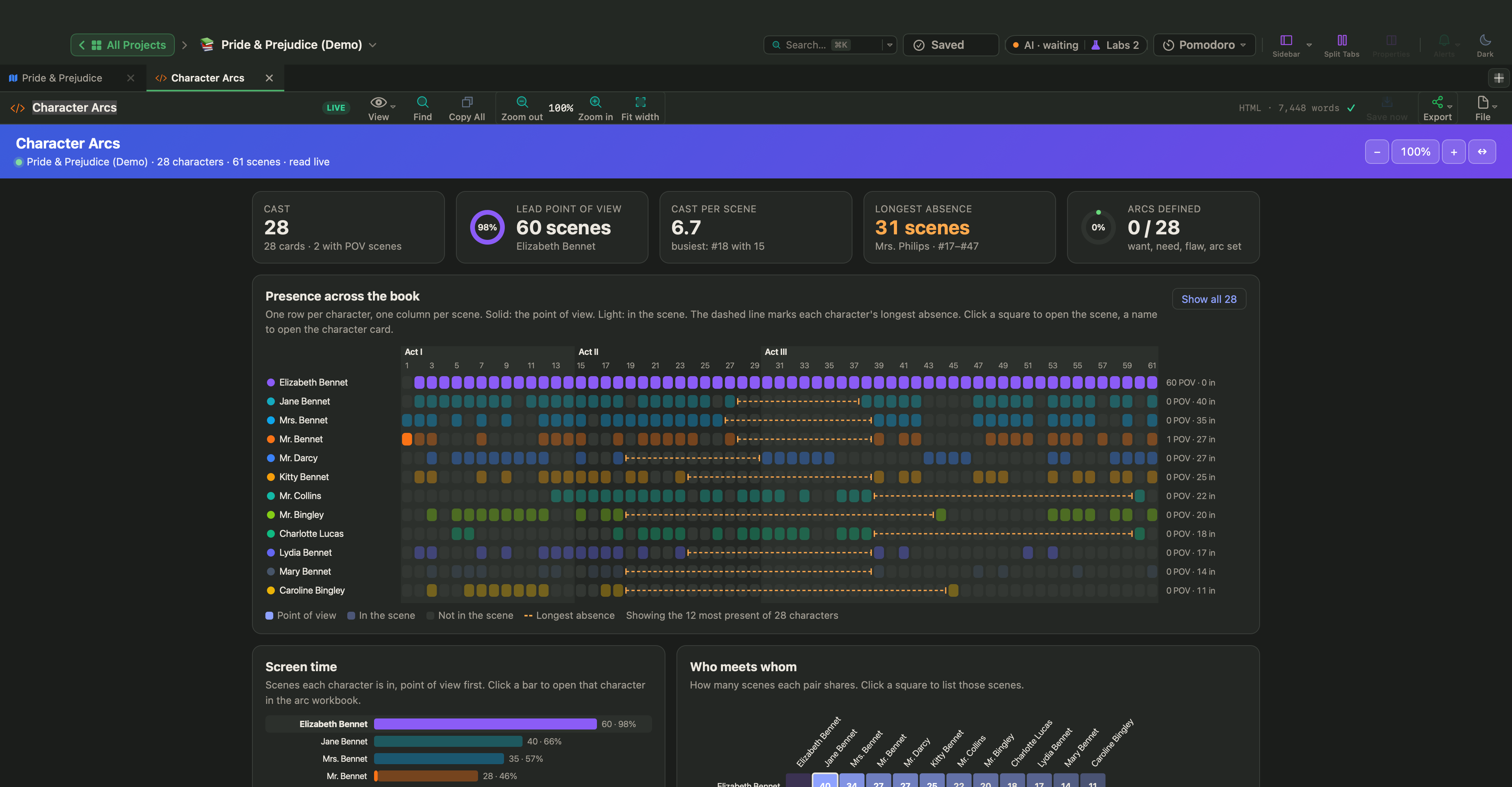
The page at the top of this article is Character Arcs, one of the built-in Live Pages. It follows every character through the book: presence across scenes and acts, the share of scenes told from their point of view, their longest absence, screen time and who meets whom. It reads the want, need, flaw and arc from each card, and you can add your own arc notes for each act. WriterMorph includes the complete Pride and Prejudice as a demo with this page set up: open it from Help › Demo Projects.
Live Pages are a Labs feature. Turn on Turn HTML pages into small apps (Live Pages) in Settings › Labs, then choose New ▾ › Live Page ▸ › Examples ▸ in the sidebar; the page is in the Fiction submenu. See Live Pages.
Link the mirror scenes
On the canvas, draw a connection from the scene that shows the flaw to the scene that shows the change. Right-click the line, choose Narrative Relation and pick Character Arc. The two scenes are now tied together, and when you revise one you will remember to check the other. The list of relations is in Project › Project Settings…. See The Visual Planner canvas.
Start with one sentence for your main character: "She believes this, and by the end she will have to accept that." Then find the eight scenes where it shows. If you can name them, you have an arc, and the plot has its spine. For how the cast pushes against each other, see Protagonist, antagonist and conflict.