 WriterMorph

How to interview your family for a memoir, and turn the answers into chapters
The holidays put the people who remember your childhood around one table. Here is how to find out what to ask them, run the conversation and file what you learn, worked through on Tidewater Years, a sample memoir.
Thanksgiving falls on Thursday 26 November this year, and Christmas and the New Year follow it closely. For a memoirist this is the season when the people who remember your childhood sit at the same table. One good conversation can fix a date you have been guessing, fill a silence in your timeline or give you the other side of a story you have only told your way.
This article shows how to get the most from that conversation: find out what to ask from the gaps in your own material, run the interview, and file what you learn so it reaches the right chapter the same evening. The interviewing method comes from StoryCorps, the oral history project. The worked example is Tidewater Years, a short sample memoir that comes with WriterMorph and that you can download. Its narrator, her family and her town are invented.
The method: a planned conversation, recorded with permission
Since 2015, StoryCorps has run the Great Thanksgiving Listen, now also called the Great Listen: an invitation to record an interview with an elder, a mentor or someone you admire, which can then be kept in the StoryCorps Archive at the Library of Congress. Its five steps come down to a few habits worth copying for any family interview:
- Prepare. Choose your questions in advance, from StoryCorps' lists or your own.
- Find a quiet place and a time when you won't be interrupted.
- Let the questions guide the talk, in StoryCorps' words "guide the discussion, not control it", and ask follow-up questions.
- Ask permission. An interview joins the archive only if the person agrees, and the same courtesy applies to a book.
A memoirist needs something a family archive doesn't: material for scenes, and facts that will survive a reader who was there. So prepare two kinds of questions. Checking questions settle a date, a name or a color. Story questions open a memory you don't have: what happened, where everyone was standing, what was said afterwards.
Step 1: Find the gaps before you ask
The best questions come from your own timeline, not from a generic list. Lay out the life you are writing year by year, mark which years each chapter covers, and look at what is missing.
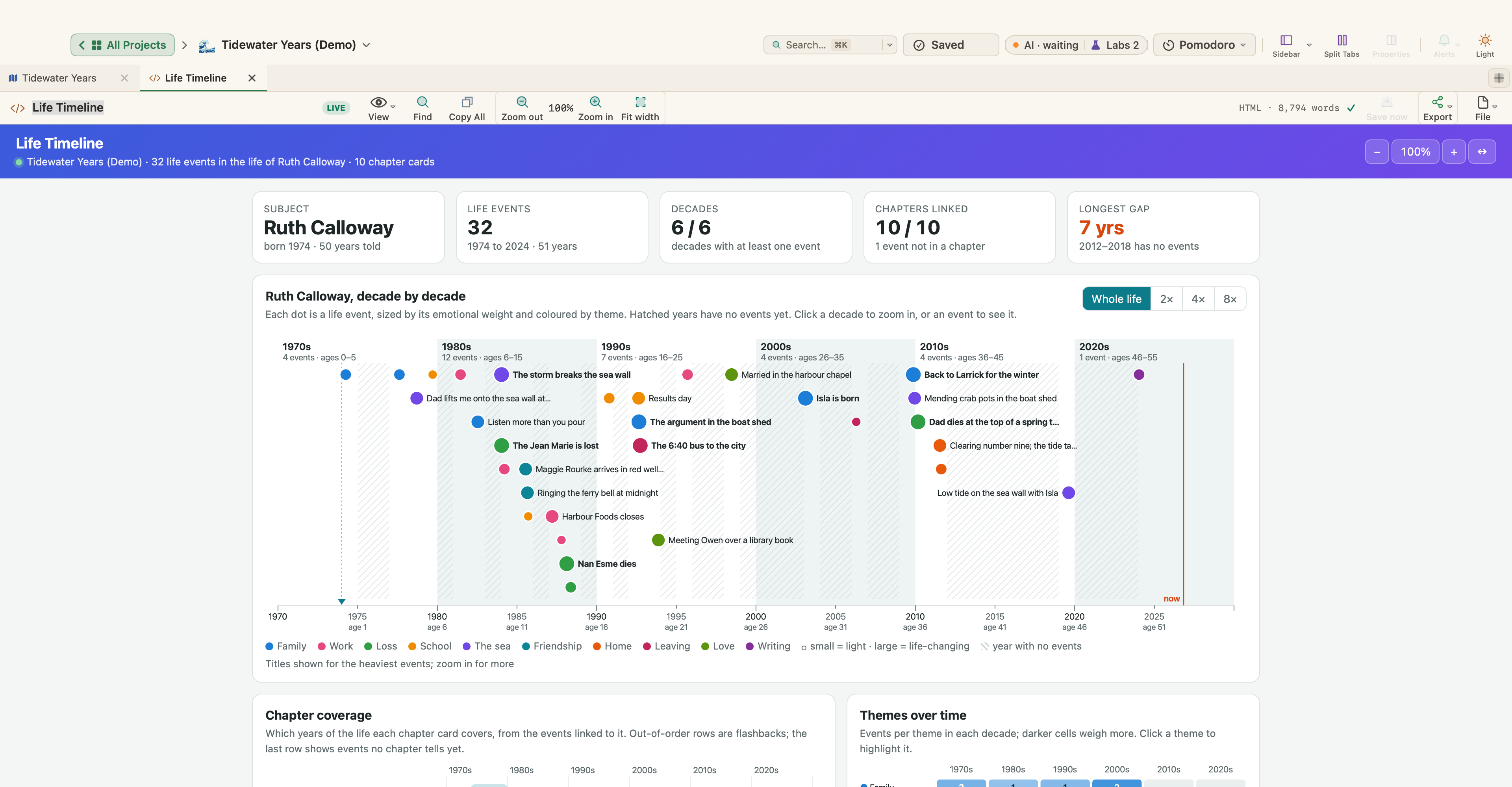
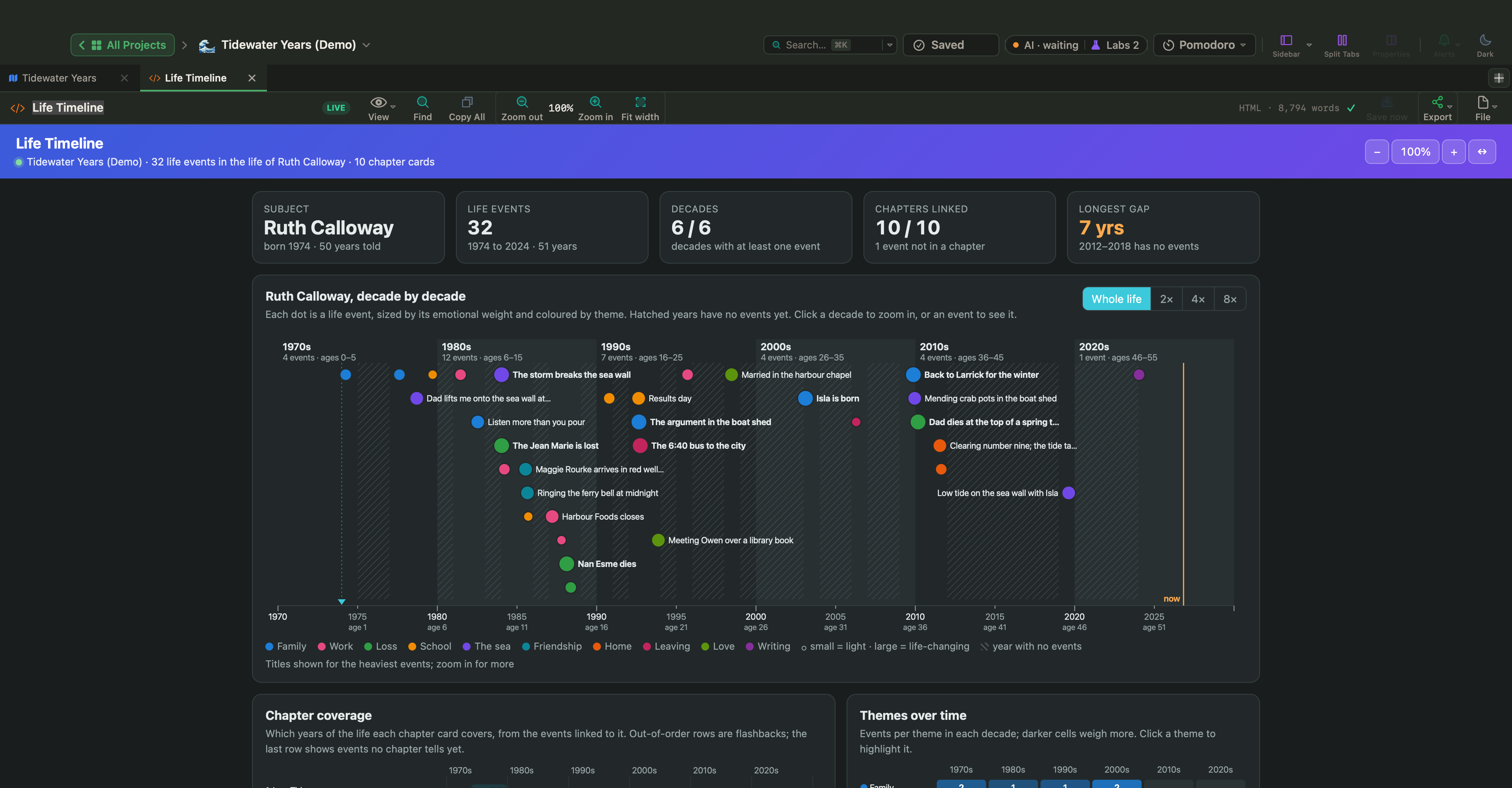
Tidewater Years tells the life of its narrator, Ruth, from a first memory on a harbor sea wall in a small estuary town to the sale of the family house: ten chapters in two parts, Part One: The Town and Part Two: Leaving. Its Life Timeline page, shown at the top, maps 32 events from 1974 to 2024 and links each one to the chapter that tells it. Three gaps stand out:
| What the timeline shows | What it means for the book |
|---|---|
| The chapter Phone Calls on Sundays covers 1993 to 2006 on its own: five events in thirteen years | The city years are told in summary. Either that is the point, or the book has a hole |
| Nothing at all between 2012 and 2018, the longest gap | No chapter tells the years after the house was sold |
| One event, starting to write the book, is in no chapter | A possible frame, or a note for the acknowledgements |
The project's own planning note, Structure and Voice, asks the right question about the first gap: are those silences the point or a hole? An interview can't answer that, but it can supply what the narrator didn't see: what her mother was living through during all those Sunday calls.
To set up the same page for your own memoir, turn on Live Pages, a Labs feature: Turn HTML pages into small apps (Live Pages) in Settings › Labs. Then choose New ▾ › Live Page ▸ › Examples ▸; the Life Timeline is in the Life & Home submenu. Enter a name and a birth year, then add events: a year is enough to start. Link each event to a chapter card, and the page shows which years each chapter covers and which years no chapter tells yet.
Step 2: Write the questions where the chapters live
Put the questions in the project, next to the chapters they serve, not in a notebook you won't have at the table. Tidewater Years keeps them in a Notes folder in the binder, outside the book, in a note called Questions for Mum:
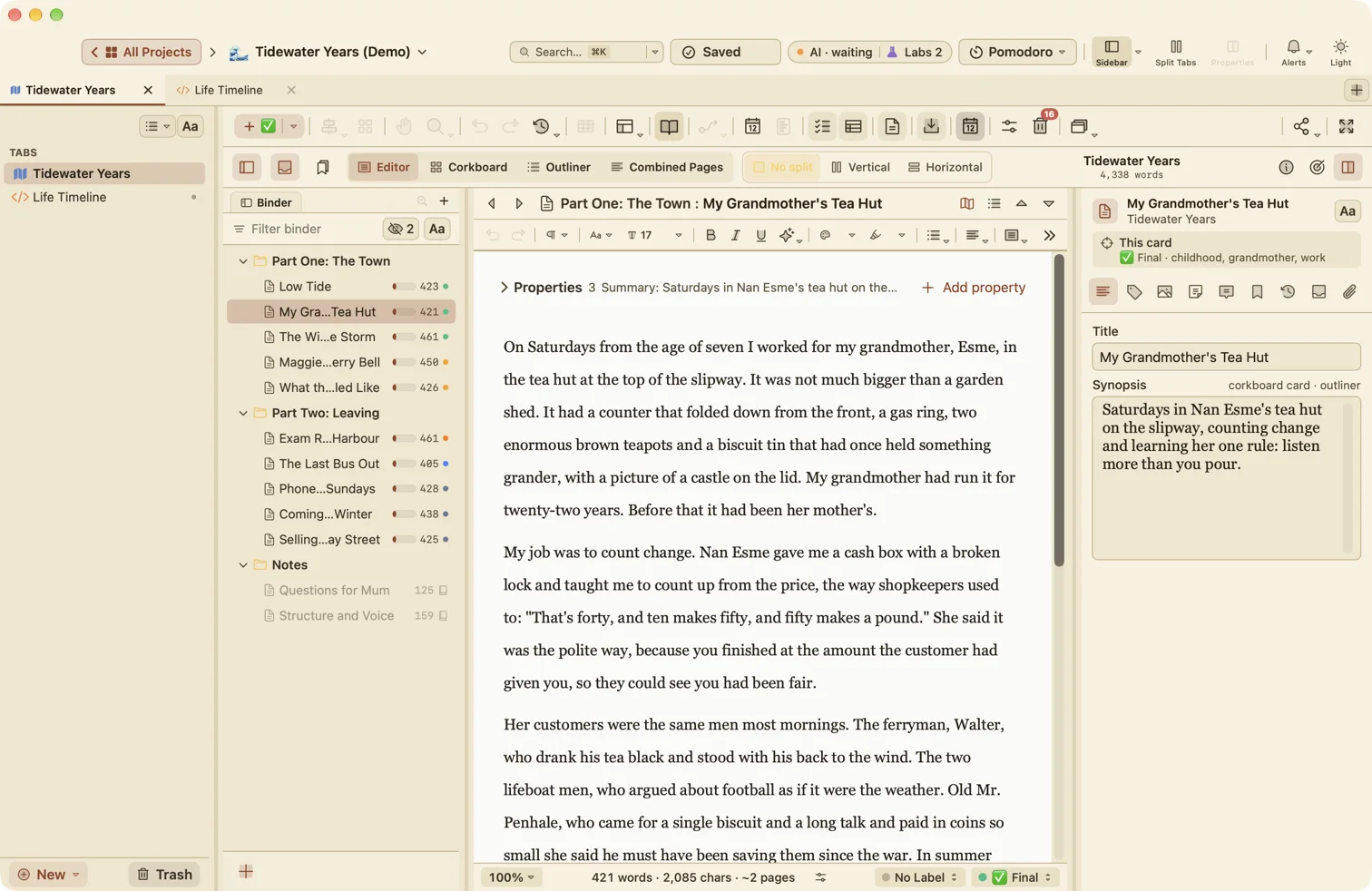
Its questions are a good model because each one is specific and names who can answer it:
- Was the storm in January, or the December before? The lifeboat station keeps a log: ask whether anyone can look.
- What color was the hull of her father's boat, the Jean Marie? The narrator remembers only the blue rail.
- Who ran the tea hut before her grandmother's mother? Her mother thinks a man called Trewin, but isn't sure.
- Did her father really buy a new tide table every year, or were some given to him? Ask her brother, Danny.
- Did she and her best friend ring the ferry bell the summer the friend arrived, or the year after? The note adds that the friend will say the year after, because she always does.
The first four are checking questions. For the gaps you also need story questions. For the city years, for example, you might ask the narrator's mother: "What didn't you tell me on those Sunday calls?" and "What happened in town in the years I was away that you never mentioned?" Questions like these start a story instead of asking for a fact.
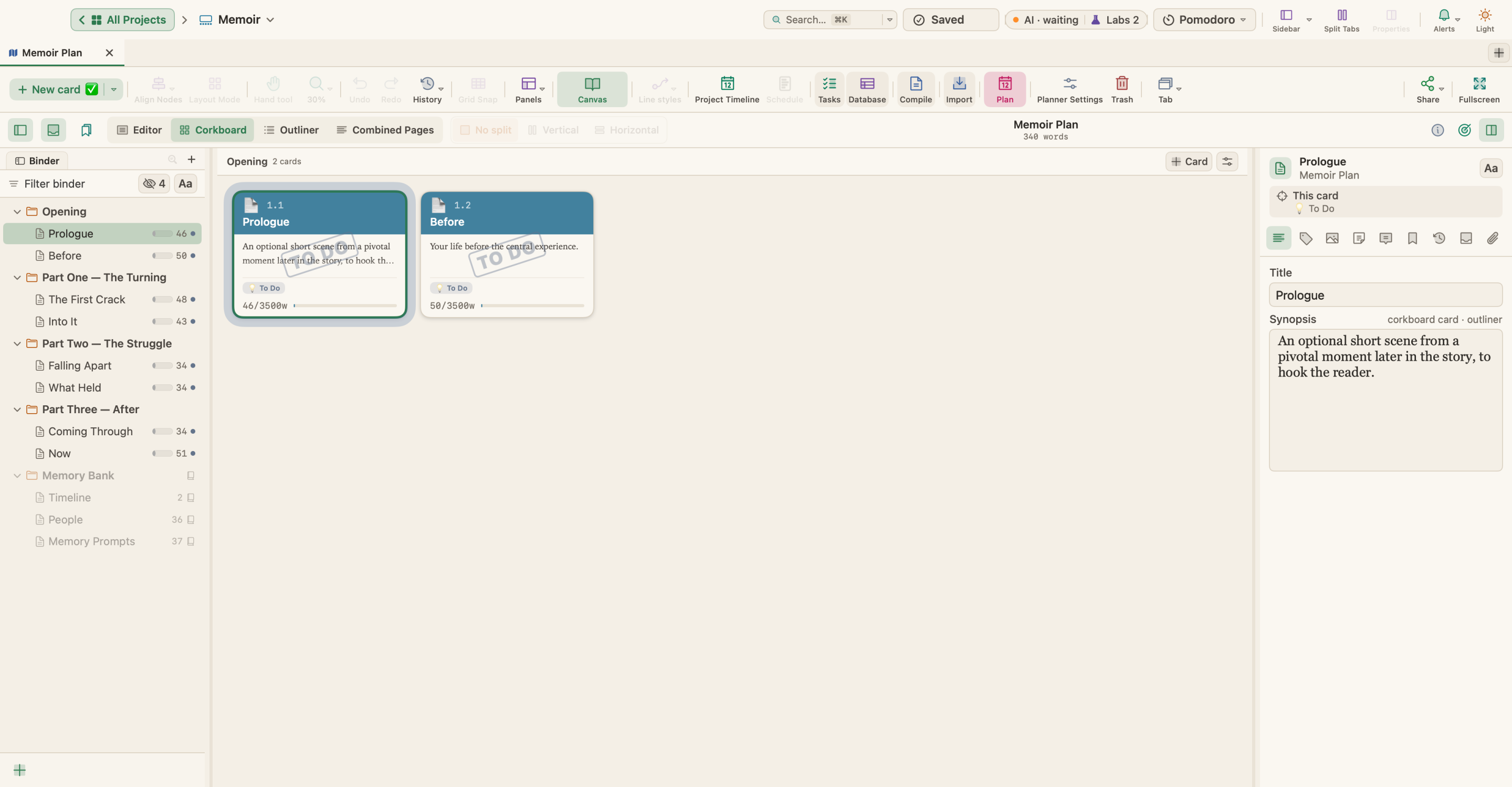
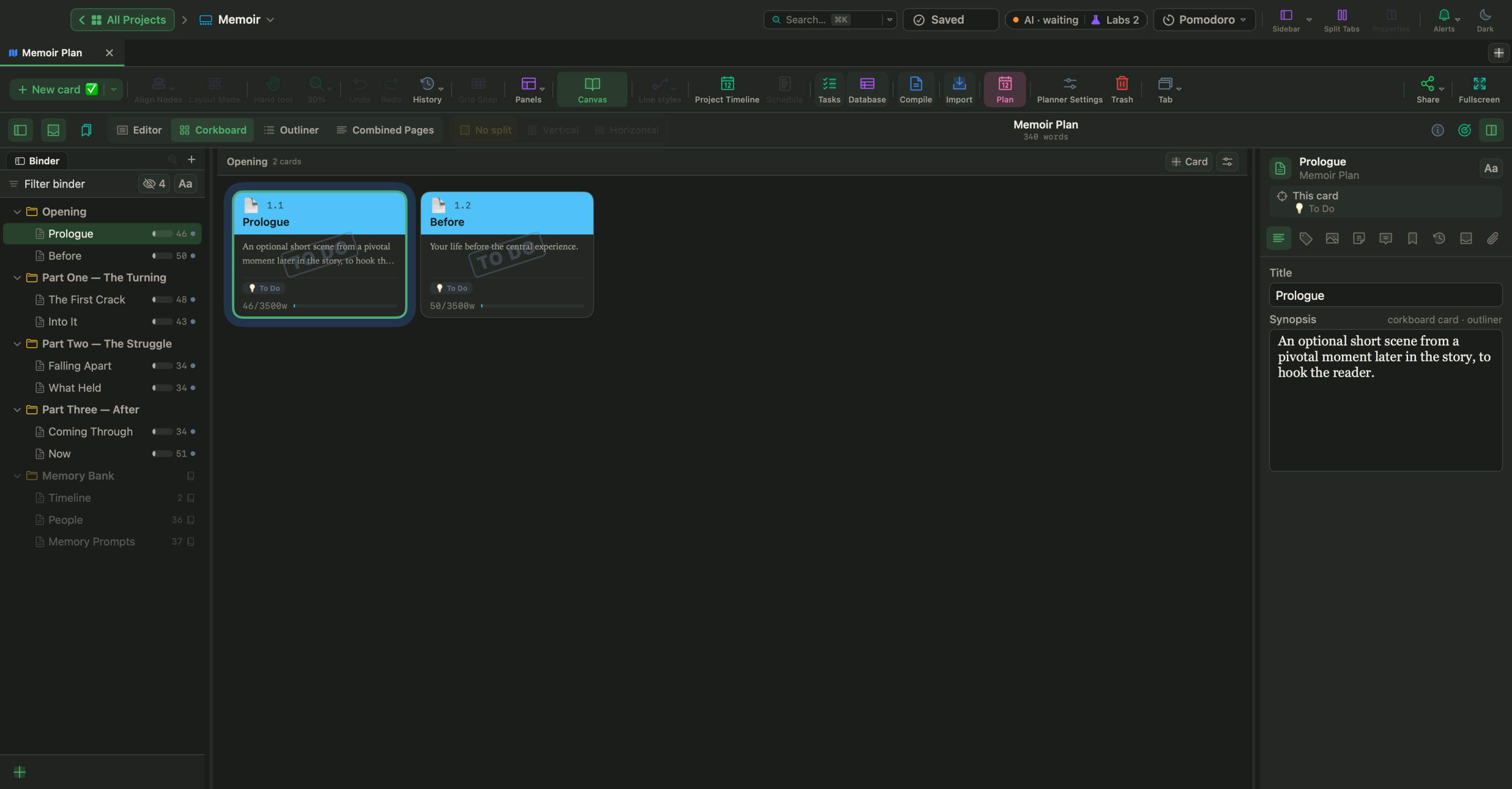
If you are starting a memoir now, the Memoir template sets this up for you. Choose File › New Project… and pick Memoir in the Non-Fiction category: the binder has an Opening and three parts, the last ending in the present day, and a Memory Bank folder that is not part of the book, with notes for a real-life Timeline, the People in your story and Memory Prompts.
Step 3: Run the interview
A few practical points make the difference between a pleasant chat and material you can use:
- One person at a time. At a full table, everyone corrects everyone and nobody finishes a story. Ask for half an hour in a quiet room.
- Say what it is for. Tell them you are writing about the family and ask before you record. Most phones have a voice recorder; StoryCorps also has its own app.
- Start easy. Open with a question they enjoy answering, then move to the ones that matter to you.
- Bring an object or a photograph. A picture of the boat or the house gives both of you something to look at besides each other.
- Ask for the scene. When a memory comes, ask where they were, what the weather was, who else was there, what happened next. These are the details a chapter needs.
- Leave silences alone. The best answer often comes after a pause you didn't fill.
Step 4: File the answers the same evening
Memory fades on both sides of the table, so file what you learned before you go to bed.
- The recording. Choose File › Import Files › Research Files into the Binder… and pick the audio file. It becomes a research item: kept in the project, never compiled into the book.
- The facts. Answer each checking question in the note where you asked it, with who told you and when. A date that changes a chapter goes into that chapter's Notes tab in the Inspector, where it is never compiled.
- The timeline. Add each new event to the Life Timeline and link it to a chapter, or leave it unlinked if no chapter tells it yet. Watch the gap tile: if the conversation filled the years between 2012 and 2018, the longest gap changes.
- The new scenes. A story you didn't know becomes a scene to write. Add a document for it in the right part with Documents › New Text (⌘N), and write one line in its synopsis saying what happens.
Step 5: When the memories disagree
They will. In Tidewater Years the narrator expects her friend to date the ferry bell a year later than she does. You have three honest options: check a record if one exists, like the lifeboat log; choose one version and tell the reader you aren't sure; or put both versions in the scene, which often says more about the people than either version would.
Decide early how you will name the living. The Memoir template's People note suggests changing names and identifying details of private people, and Tidewater Years makes the same kind of choice: the company man at a town meeting stays unnamed, as the grey suit. Write such decisions down with the questions, so the next draft keeps them.
You don't need a dozen interviews this season. Pick the one gap in your timeline that bothers you most, choose the person who can fill it, and write three questions tonight.