 WriterMorph

How to write a query letter: a worked example with Pride and Prejudice
A query letter has one page to make an agent ask for your novel. Here are its four parts and their lengths, then a complete letter built step by step for a book everyone knows, and a way to keep track of every version you send.
A query letter is the first thing an agent reads from you, and often the only thing. It is one page, sent before any of the manuscript, and it has a single job: to make the agent ask for pages. Writers who finish a draft in the autumn and revise through the winter usually send theirs in the new year, so December is the month to write it.
This article builds a query letter from nothing, for a novel you already know: Pride and Prejudice. Imagine it is unpublished and its author is querying today. The same steps work for your book, and the last section shows how to keep the letter, its versions and your list of agents next to the manuscript in WriterMorph.
A query is not a synopsis
Agents usually ask for both, and writers often mix them up. They do opposite jobs.
| Query letter | Synopsis | |
|---|---|---|
| Job | Make the agent want to read the book | Show that the whole story works |
| Length | One page, about 200 to 450 words in all | One to two pages |
| The ending | Left out | Always included |
| Tone | Close to the back cover of a paperback | A plain account of what happens |
| Also contains | Title, category, word count, comparable titles, a note about you | Nothing but the story |
If you have not written the synopsis yet, do that first: How to write a novel synopsis works through the same novel. Once the whole story fits in 450 words, the pitch in the query is mostly a matter of choosing where to stop.
The four parts of a query letter
In her guide to query letters, the publishing expert Jane Friedman lists four elements and suggests a length for each. The whole letter should fit on one single-spaced page.
| Part | What it holds | Length |
|---|---|---|
| The story description | Who the main character is, what they want, what stands in the way and what is at stake | 150 to 300 words |
| The housekeeping | Title, genre or category, and word count | One sentence |
| Comparable titles | Two or three recent books whose readers would like yours | One sentence |
| The bio | Something about you | 50 to 100 words, often much less |
A personal line to the agent is optional, and worth including only when it is specific. Always read the agency's own submission page first: if it asks for something different, do what it says.
Step 1: Write the story description
This is the part that decides everything, so write it first and give it most of your time. It answers four questions:
- Who is the main character, in a few words that matter to the plot?
- What do they want, or what do they believe?
- What gets in the way?
- What do they stand to lose, and what choice does that force?
Then it stops. A query does not give the ending, and it rarely goes past the middle of the book. Use the present tense and the third person, even if the novel is in the first person, and name as few characters as you can. Three names is a good limit.
For Pride and Prejudice, the answers are: Elizabeth Bennet, clever and without a fortune; she trusts her own judgment of people; Mr. Darcy, whom she has judged wrongly; her family's future and her own idea of herself. That gives a description of about 170 words:
Elizabeth Bennet is twenty, quick-witted, and one of five sisters whose home will pass to a male cousin on the day their father dies. Her mother's answer is to marry the girls off, and fast. Elizabeth's is to trust her own judgment of people, which has never yet let her down.
When the wealthy Mr. Darcy arrives in the neighbourhood and declines to dance with her because she is only "tolerable", she knows exactly what he is: proud, cold and not worth a second thought. A charming officer's account of how Darcy ruined him confirms it. So when Darcy, of all men, proposes, and insults her family as he does it, she takes real pleasure in refusing him.
Then a letter arrives that takes her certainty apart, fact by fact. With her youngest sister about to disgrace the whole family, and the one man who could prevent it the man she has just humiliated, Elizabeth must decide what her judgment is worth and how much pride she can afford.
Notice what is missing. There is no Jane, no Bingley, no Mr. Collins, no Lady Catherine and no second proposal. The synopsis needs them; the query does not. Notice also where it ends: on a choice the reader wants to see made.
Step 2: Add the housekeeping
One sentence gives the title, the category and the length. Titles are often set in capitals in a query.
PRIDE AND PREJUDICE is a historical romance, complete at 122,000 words.
Give the word count as a round number, and check it against what agents expect for your category. How long should a novel be? has the ranges. Our example is a useful warning: Friedman notes that a novel beyond 120,000 words is a harder sell, so this author should put the housekeeping after the story, once the agent is interested, and be ready to cut.
Step 3: Choose the comparable titles
Comparable titles, or comps, tell the agent where the book would sit in a bookshop and who would buy it. Most agents now expect them. Good comps are:
- Recent: published in the last few years.
- In your category, and for the same readers.
- Successful but not gigantic. Comparing your book to the best-known novel of the decade tells the agent nothing.
- Chosen for a reason you can state: the same kind of heroine, the same tone, the same setting.
We leave the titles open in the example, because the right ones are whatever has been published in your genre recently, and that list changes every season:
It will appeal to readers of [COMP 1] and [COMP 2], who enjoy a sharp-tongued heroine and a romance that grows out of an argument.
If you can't find comps, read more widely in your category before you query. An agent may take a missing comp as a sign that you don't know the shelf your book is going to.
Step 4: Write the bio
Keep it short and relevant: earlier publications, a prize, training, or a job or experience that bears on the book. If you have none of these, one plain sentence is enough. Most novelists who query have never been published, and agents know it.
I live in Hampshire. My first novel, Sense and Sensibility, was published in 1811.
Step 5: Decide how to open
There are three sound ways to begin, in this order of strength:
- A real connection. If the agent asked for your pages at a conference, or one of their clients referred you, say so in the first line.
- The story. With no connection, start with the story description. This is the classic opening.
- The facts. The housekeeping sentence can also come first. It works well when the category and length are exactly what the agent is looking for.
A personal line such as "I am writing to you because you represent…" helps only if it could not be sent to anyone else. A sentence that fits fifty agents is better left out.
The finished letter
Put together, with the story first:
Dear Ms. Egerton,
Elizabeth Bennet is twenty, quick-witted, and one of five sisters whose home will pass to a male cousin on the day their father dies. Her mother's answer is to marry the girls off, and fast. Elizabeth's is to trust her own judgment of people, which has never yet let her down.
When the wealthy Mr. Darcy arrives in the neighbourhood and declines to dance with her because she is only "tolerable", she knows exactly what he is: proud, cold and not worth a second thought. A charming officer's account of how Darcy ruined him confirms it. So when Darcy, of all men, proposes, and insults her family as he does it, she takes real pleasure in refusing him.
Then a letter arrives that takes her certainty apart, fact by fact. With her youngest sister about to disgrace the whole family, and the one man who could prevent it the man she has just humiliated, Elizabeth must decide what her judgment is worth and how much pride she can afford.
PRIDE AND PREJUDICE is a historical romance, complete at 122,000 words. It will appeal to readers of [COMP 1] and [COMP 2], who enjoy a sharp-tongued heroine and a romance that grows out of an argument.
I live in Hampshire. My first novel, Sense and Sensibility, was published in 1811.
Thank you for your time and consideration.
Jane Austen
That is about 240 words, well inside one page. The agent's name is invented for the example. Use the real name of the person you are writing to, spelled correctly.
Seven common mistakes
- Telling the ending. That is the synopsis's job.
- Opening with a question. "What would you do if…?" invites the answer "nothing".
- Praising the book. "A gripping, unforgettable story" is the agent's line to say, not yours.
- Too many names. Every extra character is one more thing to keep track of on a single reading.
- Describing themes instead of events. "A novel about pride and class" says less than one proud man refusing to dance.
- Quoting your first readers. Your friends liking the book is not evidence an agent can use.
- Ignoring the guidelines. If the agency wants the letter in the body of an email and the first ten pages below it, send exactly that.
Writing and tracking the query in WriterMorph
Keep the letter in the project
Add the letter to the project it belongs to: choose Documents › New Text (⌘N), title it Query Letter, and choose Documents › Include in Compile (toggle) so it never prints inside the novel. Give it a word target of 350, and a progress bar shows how close you are to the limit. Project › Text Statistics & Word Frequency… with Current Document counts the words and shows which names you use most. To hear how the letter reads, choose Edit › Speech › Start Speaking.
To follow the worked example, open the novel itself with Help › Demo Projects; Pride and Prejudice is in the Fiction & Screen group, with a one-line synopsis on each of its 61 chapters.
One snapshot for each version
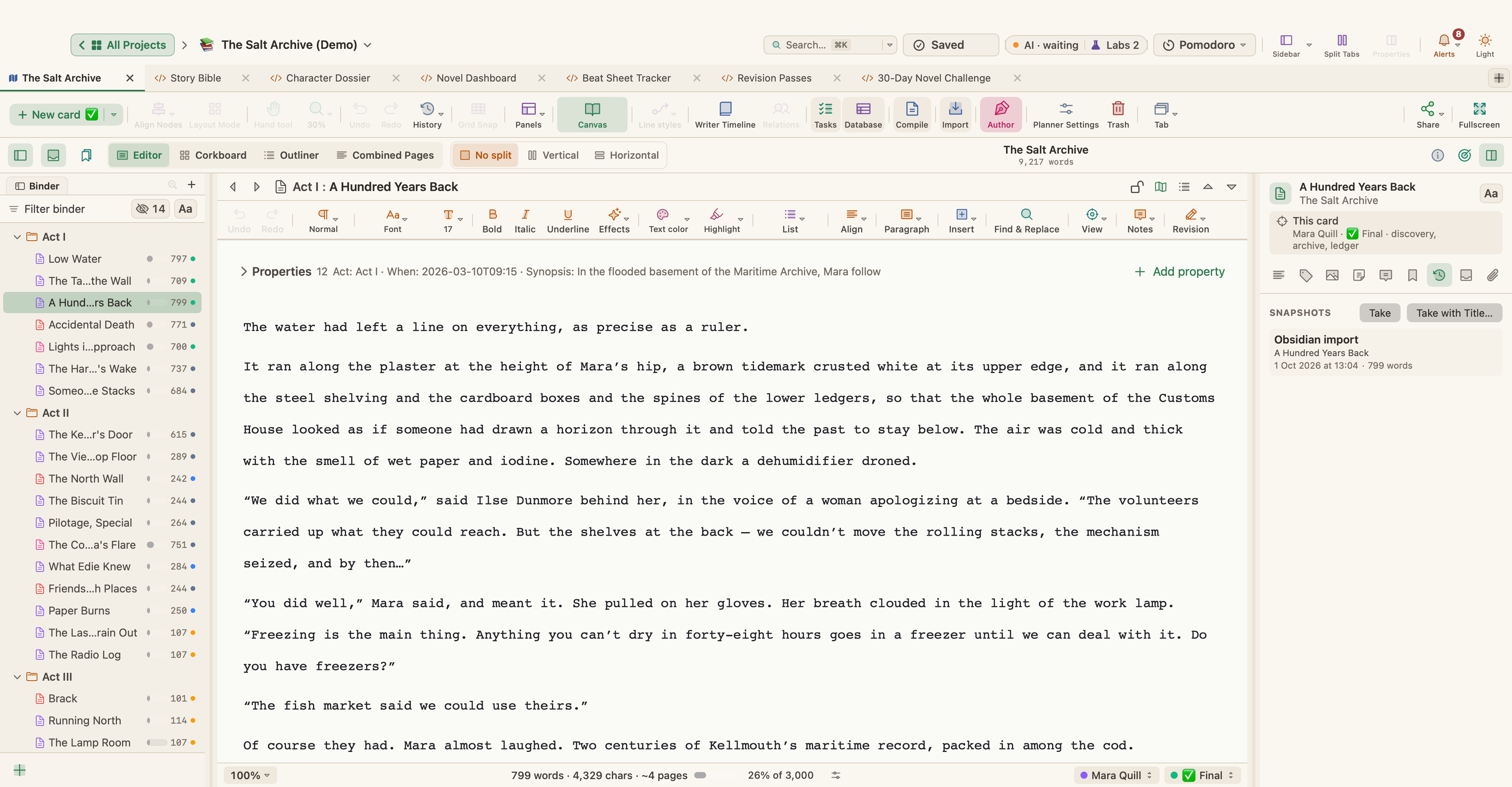
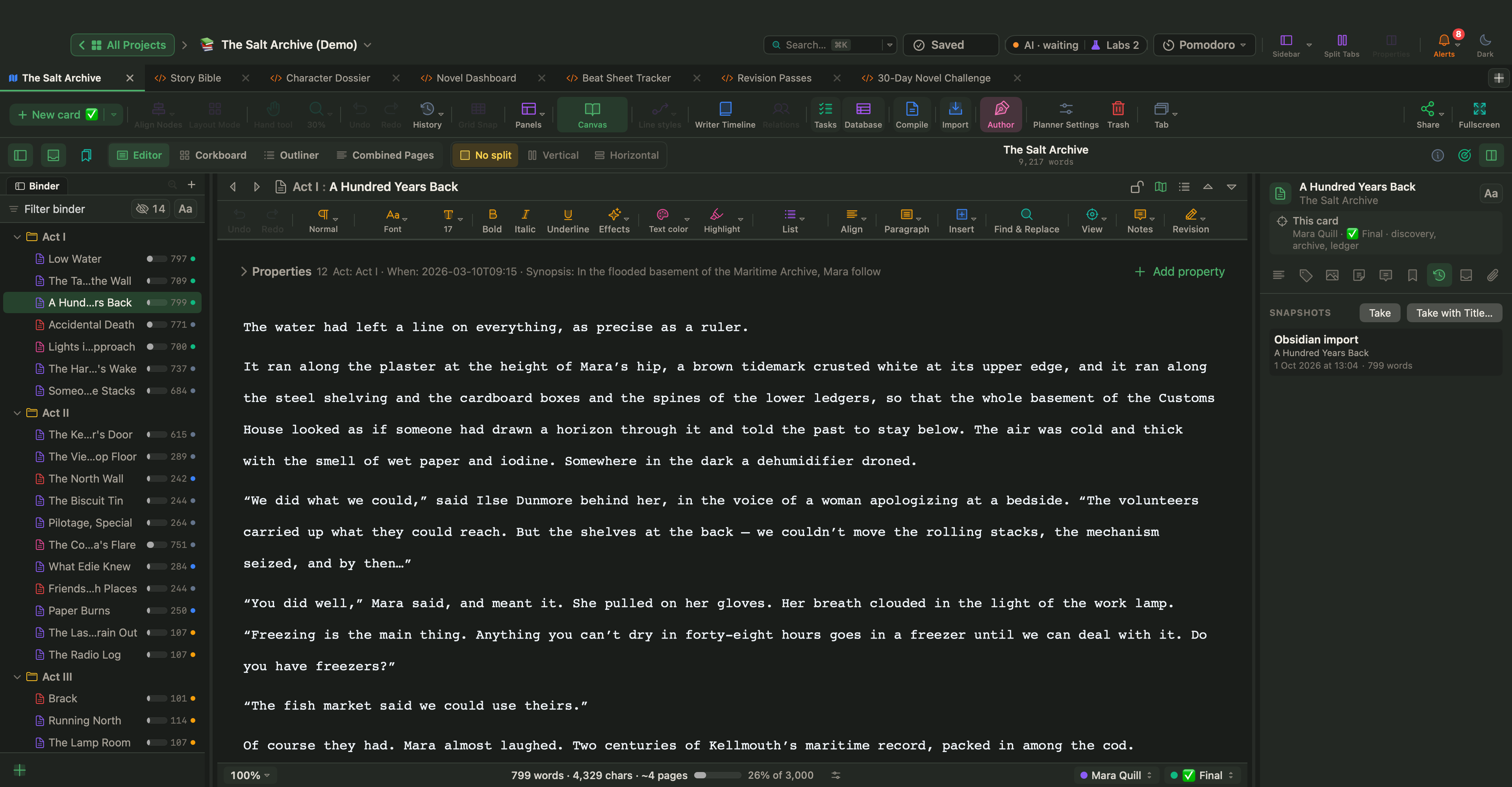
A query is rewritten many times, and you will send different versions to different agents. Before each change, choose Documents › Snapshots › Take Snapshot with Title… (⇧⌘5) and name the copy, for example "Version 2, story first". The Inspector's Snapshots tab lists every version, and you can compare one with the current text or restore it. When an agent replies months later, you can see exactly what you sent.
The package as tasks
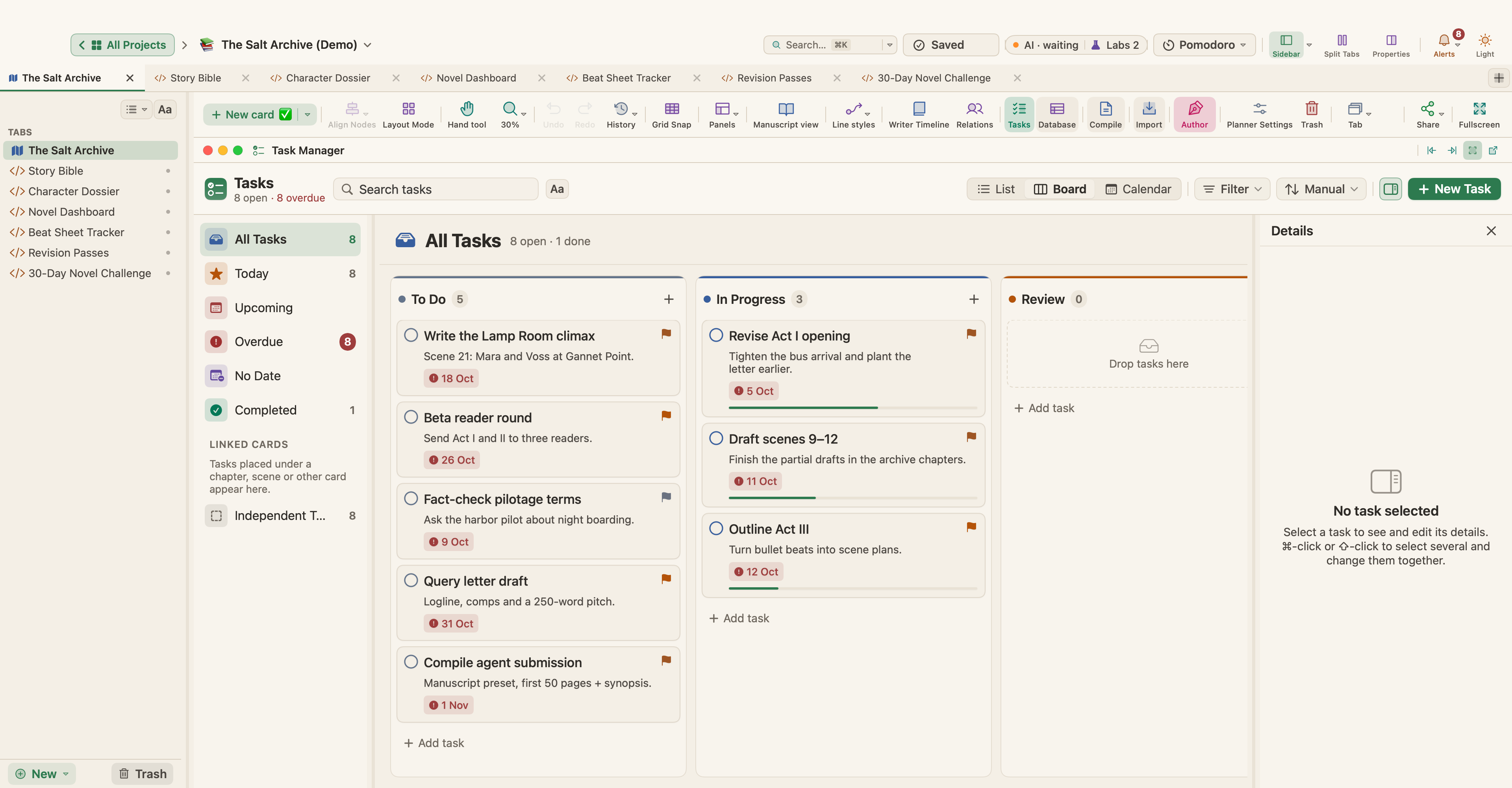
A submission is the letter, the opening pages and the synopsis. The Salt Archive, a sample mystery in WriterMorph, keeps them as task cards in its Task Manager (View › Task Manager, ⌃⌘K): Query letter draft and Compile agent submission. Add your own with Insert › New Task Card and give each a due date.
For the pages, choose Project › Compile… (⌥⌘E), the Manuscript preset and Word (DOCX) or PDF. Under Contents, choose a collection or the current selection to send only the opening chapters. To save the letter and the synopsis as files, select them in the binder and choose File › Export › Files…. The settings are explained in How to format and compile your manuscript.
Who has which version
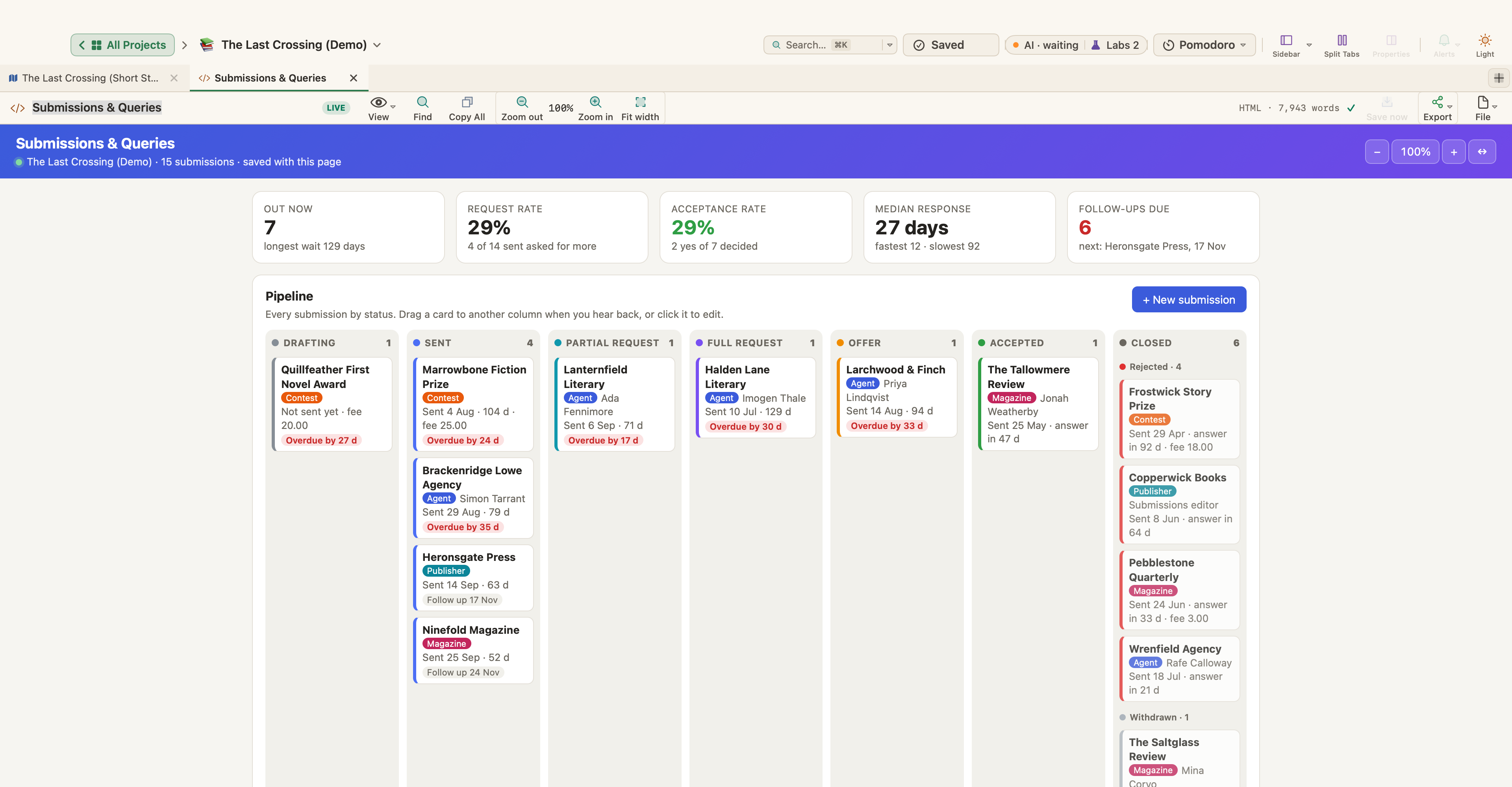
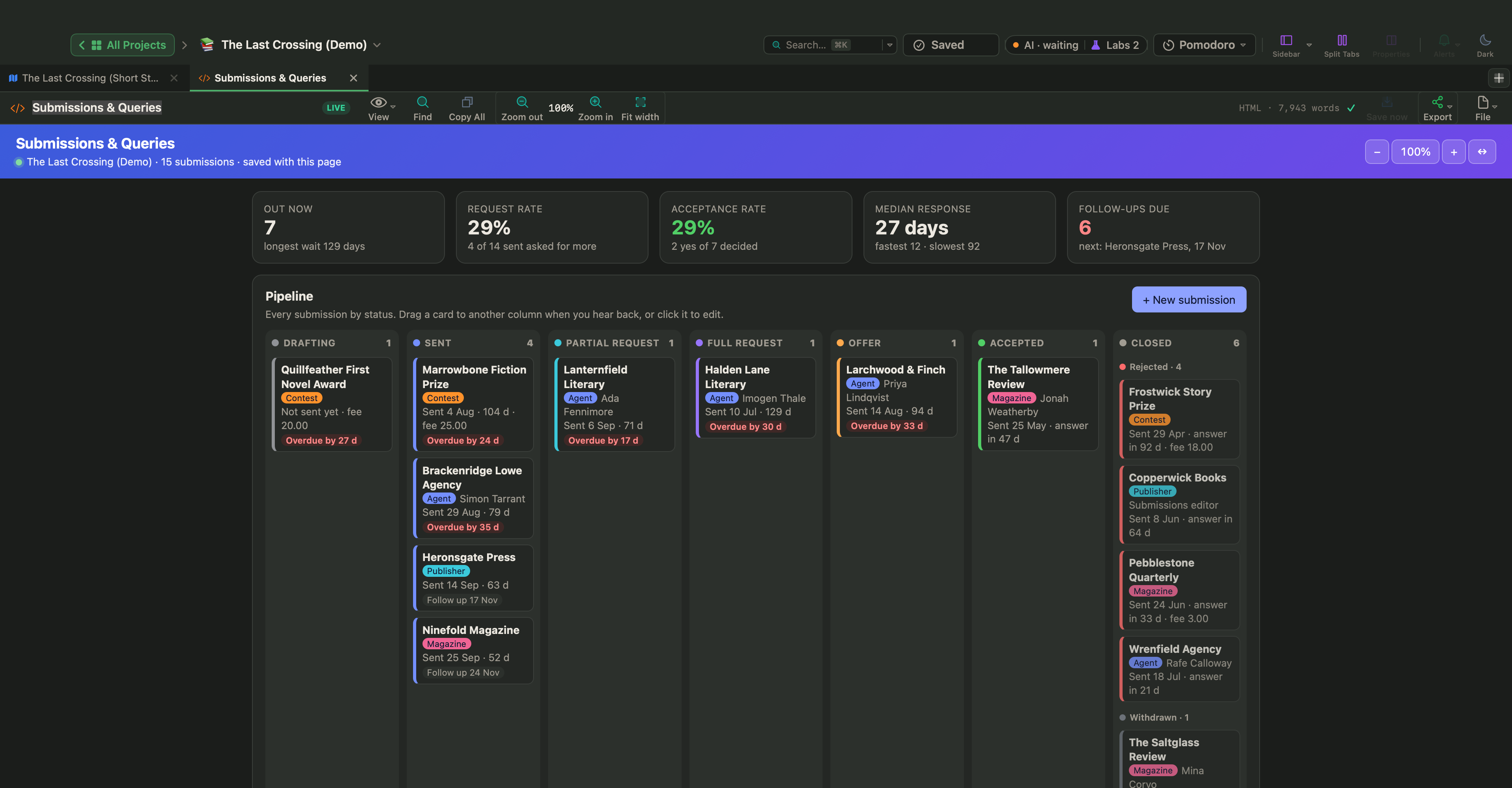
The Submissions & Queries Live Page, pictured at the top, keeps agents, publishers, magazines and contests on a board by status, with request rates, response times and follow-ups due. Live Pages are a Labs feature: turn on Turn HTML pages into small apps (Live Pages) in Settings › Labs, then choose New ▾ › Live Page ▸ › Examples ▸ in the sidebar; the page is in the Writing & Publishing submenu.
Agents open and close to queries through the year, so check each one's status and guidelines on the day you send; QueryTracker lists both. Send the letter to a few agents at a time. If the first group brings no requests for pages, the letter is what needs work, and you still have agents left to send the better version to.