 WriterMorph

How to write a plot twist: seven kinds, and how to foreshadow them fairly
A good twist surprises the reader and then feels as if it could not have gone any other way. Here are the seven kinds, the three things every twist needs, how to hide a clue in plain sight, how to test a twist before readers do, and how to link each clue to its payoff in WriterMorph.
A plot twist is a moment that changes what the reader thought the story was. The best ones do two things at once. They surprise, and a second later they seem obvious: of course it was him, the signs were all there. A twist that only surprises is a trick. A twist the reader saw coming a hundred pages ago is a delay.
This article covers the kinds of twist, the three things every twist needs, how to plant clues that readers see without noticing, and how to check your twist before anyone else reads it. The last section shows how to link each clue to its payoff in WriterMorph.
What makes a twist work
Aristotle described the two movements in the Poetics: a reversal, when events turn the opposite way from what was expected, and a recognition, when a character passes from ignorance to knowledge. He thought the best plots made the two happen together, as in Oedipus Rex, where the man hunting the murderer learns that he is the murderer.
More than two thousand years later the test is the same. A twist works when it is:
- Surprising. The reader believed something else, for good reasons.
- Inevitable. Looking back, the new explanation fits every fact better than the old one.
- Fair. The facts were on the page. The reader could have worked it out.
- Meaningful. It changes what the main character must do next. A twist that changes nothing is trivia.
Seven kinds of twist
| Kind | What turns | A classic example |
|---|---|---|
| Hidden identity | Someone is not who they seemed | The hunter is the hunted in Oedipus Rex |
| The wrong benefactor | Help came from a different source, for a different reason | Pip's fortune in Great Expectations |
| The secret in the house | Something was there all along, kept out of sight | The locked rooms of Thornfield in Jane Eyre |
| The false ally | A trusted character has been working against the hero | Wickham in Pride and Prejudice |
| The unreliable teller | The narrator has been leaving something out | Agatha Christie's most famous solution depends on who is telling the story |
| The reframed past | New information changes the meaning of earlier scenes | Darcy's letter turns every earlier chapter around |
| The false victory | The goal is reached and turns out to be the wrong goal | Macbeth gets the crown |
Most twists combine two of these. Notice also that several of them are not shocks at the very end. A twist at the midpoint, such as Darcy's letter, gives the second half of the book a new question to answer, and is often more useful than a twist on the last page.
The three things you plant
Every twist is built from three things placed long before the reveal.
- The clue. A fact that is true and visible, and that only makes full sense after the reveal.
- The misdirection. A second explanation, simpler and more attractive, that accounts for the clue for now.
- The echo. A reminder shortly before the reveal, so the clue is in the reader's memory when it is needed.
The clue and the misdirection must both be honest. The narrator may let a character draw the wrong conclusion. The narrator may not state something false.
Plant the clue at least twice, in different forms. Once is easy to miss, and a reader who missed it will feel cheated. Three times in the same form and they will guess.
How to hide a clue in plain sight
Readers notice what a scene points at. To hide a clue, put it where the scene is pointing somewhere else.
- In the middle of a list. The first and last items are remembered. The second of three is not.
- Just before something louder. A fact given one line before an argument, a kiss or a gunshot is read and forgotten.
- As character. "She never took the lift" reads as a quirk in chapter two and as evidence in chapter thirty.
- Through the wrong eyes. A viewpoint character who misreads what she sees gives the reader the fact and the wrong meaning together.
- Early. A clue in the first fifty pages is read before the reader knows what the questions are.
- As a joke. Readers don't examine what made them laugh.
Work backwards from the reveal
A twist can't be improvised into a finished draft. Plan it from the end.
- Write the truth in one paragraph. What really happened, in order, with nothing hidden.
- Write what the reader believes before the reveal, in one paragraph. The gap between the two is your twist.
- List the facts that differ. Each one needs a clue on the page.
- Give each clue its cover story: the misdirection that explains it for now.
- Place the clues, early and spread out, and place the echo within a chapter or two of the reveal.
- Decide who learns the truth, and how. A twist discovered by the main character through her own effort is stronger than one that somebody simply tells her.
If your book is a mystery, the same method runs the whole plot: see How to plot a mystery or thriller.
The rule of the gun on the wall
Anton Chekhov's advice to playwrights was that a gun shown in the first act must go off by the last. For twists the rule works in both directions. Everything you plant has to be used, or readers will wait for it. And everything that goes off has to have been planted, or the ending comes from nowhere.
When you revise, check both lists: every clue has a payoff, and every reveal has a clue.
Test the twist
You can't read your own twist for the first time, so borrow someone who can.
- Ask first readers where they guessed. If most guessed early, add misdirection. If nobody could say afterwards where the clues were, add a clue.
- Reread from the reveal backwards. Every earlier scene with the secret-keeper in it should still make sense, and ideally read differently, now that you know.
- Check the liar's behaviour. A character with a secret still has to act in their own interest in every scene, including the scenes written before you decided on the twist.
- Ask what the hero does next. If the answer is "the same as before", the twist is in the wrong story.
Five common mistakes
- The twist contradicts the page. If an earlier scene can't be true any more, readers will go back and find it.
- It depends on information kept from the reader for no reason. A viewpoint character who knows the secret and never thinks about it is a cheat.
- It is the only good idea in the book. A novel has to be worth reading twice, the second time knowing everything.
- It comes too late to matter. A reveal on the last page leaves no room for anyone to act on it.
- There are too many. After the third reversal, readers stop believing anything, and stop caring.
Planting and paying off in WriterMorph
Link the clue to the payoff
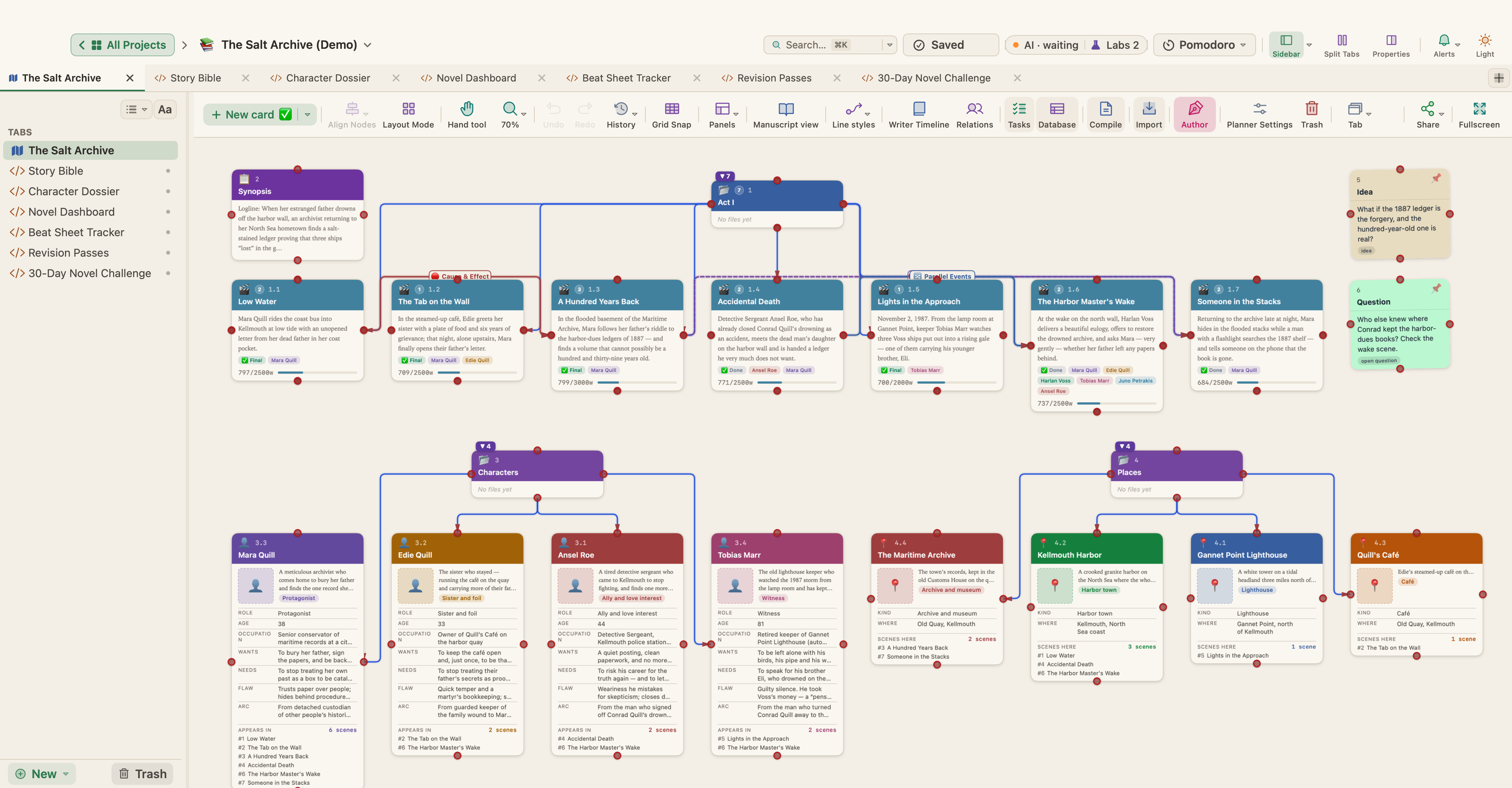
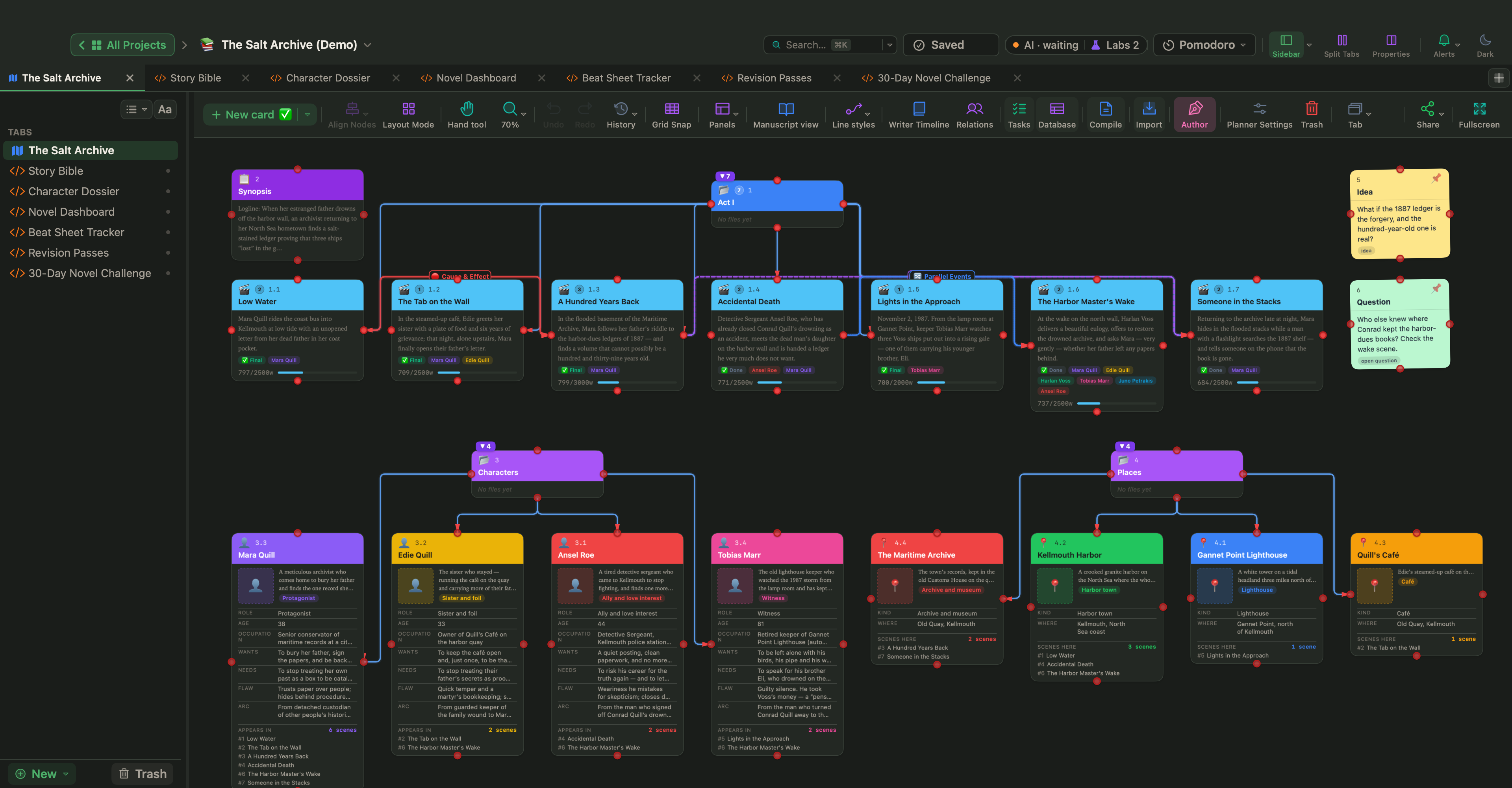
On the canvas, every scene is a card. Draw a connection from the scene where a clue is planted to the scene where it pays off, right-click the line, choose Narrative Relation and pick Foreshadowing. The other relations are Cause & Effect, Callback, Parallel Events and Character Arc, and the list is managed in Project › Project Settings….
The Salt Archive, a sample mystery that comes with WriterMorph, links its scenes this way: a foreshadowing link runs from A Hundred Years Back, where the heroine finds a ledger that can't be as old as it should be, to Someone in the Stacks, and a cause-and-effect link runs from the opening scene to that discovery. You can download the project and open it.
A connection can also have a Line Style. WriterMorph starts you with styles such as Cause → effect and Foreshadowing, each with its own color, line type and label, and the toolbar's line styles menu shows or hides each style. Hide every style but Foreshadowing and the canvas becomes a map of your clues: a clue with no line to a payoff is a gun still on the wall. See The Visual Planner canvas.
The truth and the telling
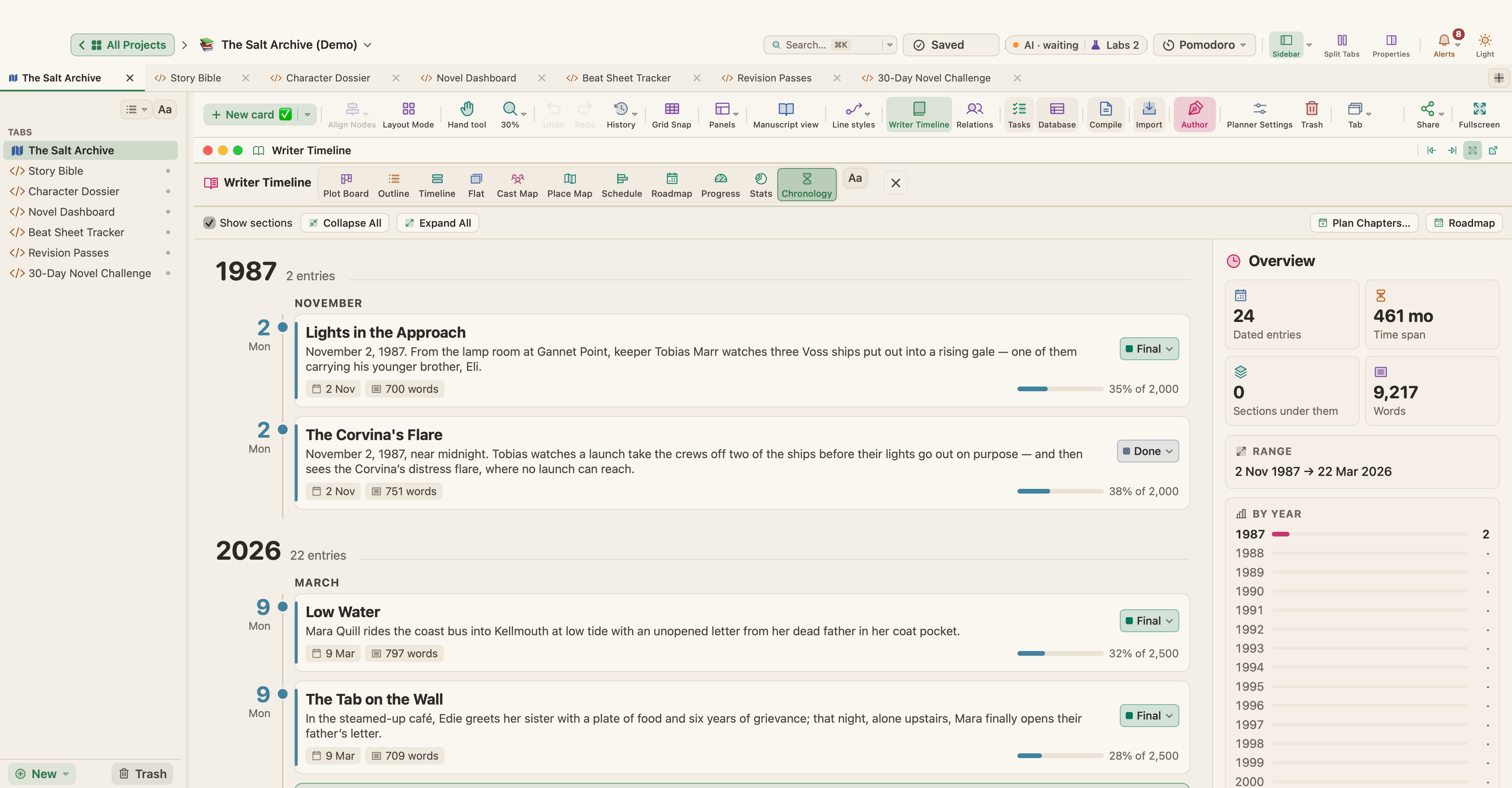
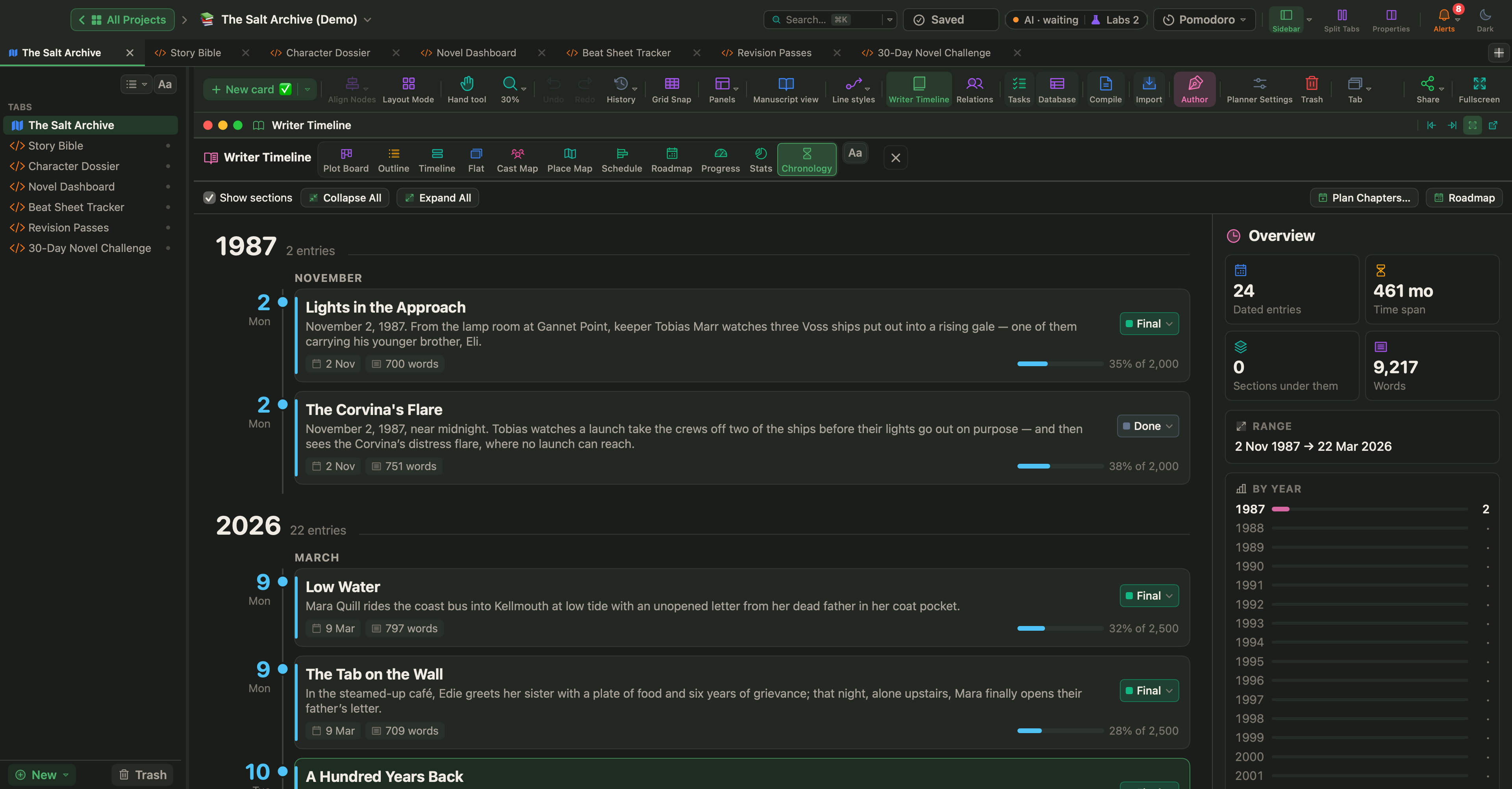
A twist has two timelines: what really happened, and the order in which the reader learns it. Give each scene its story time in the Properties panel, then choose View › Writer Timeline (⌥⌘T) and click Chronology to see the scenes in the order they happened, while the binder keeps the order in which they are told. How to keep your novel's timeline straight covers flashbacks and story time in detail.
Keep the clue scenes together
Select the scenes that carry a clue in the binder and choose Documents › New Collection from Selection…. With View › Collections on, the collection appears as a tab above the binder, and you can read your clues in a row without moving a scene. To record what the reader knows at each point, add a field to your scene cards: choose Documents › Add Property (⌥⌘;), name it Reader believes, and pick Long text.
Before you change the ending
A twist added in revision changes scenes all through the book. Before you start, select your scenes in the binder, right-click and choose Take Snapshots, so that every scene keeps a copy of its text as it was. See Revisions, History and Snapshots.
Write the truth in one paragraph and the reader's belief in another. If the gap between them changes what your main character does next, you have a twist worth planting. Then go back to the first fifty pages and hide it.