 WriterMorph

Worldbuilding for a fantasy novel: what to decide, what to leave out, and a magic system with a price
A fantasy world has to hold together for four hundred pages, and most of what you build will never be on the page. Here is what to decide before you write, how to design a magic system that makes plot, the mistakes that stop a draft, and a world bible that keeps it all straight in WriterMorph.
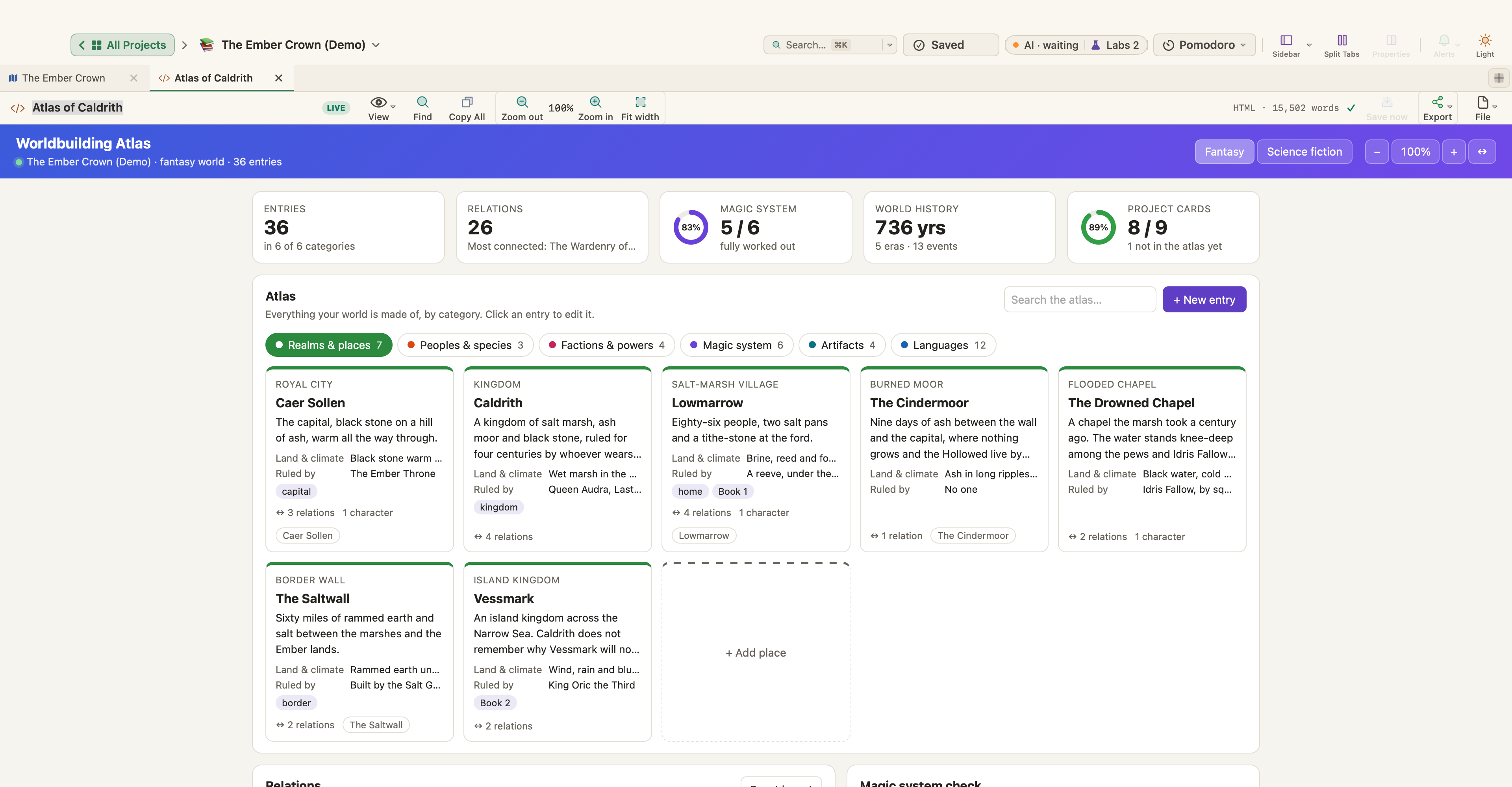
Fantasy is where a great many new novelists start, and romantasy has brought another wave of them. The pleasure of the genre is that the world is yours to invent. The risk is the same thing. A world can swallow years of planning without producing a chapter, or it can be invented in a hurry and fall apart when a reader asks how far the capital is from the border.
This article is about the middle way: enough world to carry the story, built in the order the story needs it. It covers what to decide, how to design magic that creates plot, what to leave off the page, and how to keep a world bible in WriterMorph.
Start from the story, not the map
There are two ways in. You can build from the top down: the continents, the gods, three thousand years of history, and then look for a story inside it. Or you can build from the bottom up: start with one character in one place with one problem, and invent outwards only as far as each scene needs.
Top-down gives a consistent world and a long delay before page one. Bottom-up gives pages quickly and contradictions later. Most finished novels use both. Decide a small number of large things first, the ones that everything else depends on, and build the rest from the story outwards.
A useful test for anything you are about to invent: will a character have to make a choice because of it? A trade law that forces your smuggler through the mountain pass is worldbuilding. The names of the eleven moons are decoration, unless a tide matters.
The seven things to decide
| Area | Decide at least | It matters because |
|---|---|---|
| Places | Where the story happens, the distances between those places and what the land is like | Travel time is plot. A week's ride can't become a day when you need it to |
| Peoples | Who lives there, how they differ and what they think of each other | Prejudice, alliance and misunderstanding are free conflict |
| Powers | Who rules, who wants to, who has the money and who has the weapons | Your characters need someone to obey, defy or serve |
| Magic | What it can do, what it costs, what it can't do and where it comes from | A world with magic has to explain why its problems aren't already solved |
| Things | The objects that matter: a crown, a sword, a book, a ship | They carry history and can be lost, stolen and inherited |
| Words | Names, titles, oaths, and a few words of your own | Sound gives a culture its texture. A short list kept consistent beats a full language |
| History | The few past events people in the story still argue about | The present conflict almost always began there |
You don't need all seven in the same depth. A court intrigue needs powers and history; a quest needs places and things. Go deep where your plot lives and stay shallow elsewhere.
A magic system with a price
The hardest question in a fantasy plot is "why don't they just use magic?". The answer has to be built in from the start.
Brandon Sanderson's three laws of magic, which he has set out in essays and lectures, are the most quoted guidance on this. In short:
- An author's ability to solve problems with magic depends on how well the reader understands that magic.
- Limitations are more interesting than powers.
- Expand what you already have before you add something new.
In practice that gives four questions for every kind of magic in your book:
- The rule. What exactly does it do?
- The cost. What does the user lose every time?
- The limit. What can it never do, and what stops it?
- The source. Where does it come from, and who has access?
The cost and the limit matter most. A cost makes every use a decision, and a limit gives your characters problems magic can't solve.
A worked example
The Ember Crown, a sample fantasy novel that comes with WriterMorph, has a magic called kindling. Its entry in the project's world bible reads:
| Kindling | |
|---|---|
| Rule | A kindler burns one of their own memories to make heat and flame. A small memory makes a small fire; a heavy one can light a hall |
| Cost | The memory is gone for good, and the kindler never knows exactly which memory the fire took |
| Limit | The fire dies on salt and lasts no longer than the memory was long. You can't burn a memory you no longer have |
Look at what that cost does for the story. Every fire is a loss, so a character who uses magic freely is someone who is forgetting her own life. The limit creates a second craft, saltwarding, and a wall of salt sixty miles long, with the weakness that wet salt wards nothing. And the kingdom's law, the Tithe of Remembering, turns the cost into politics: each household gives up a memory a year to feed the Crown's fire, and after twenty years of heavy tithes a village forgets its own name.
One rule with a real price has produced a border, a trade, a tax, a villain's motive and the heroine's dilemma. That is what a magic system is for.
Soft magic and hard magic
Not every book needs the rules on the page. Hard magic has rules the reader knows, so characters can solve problems with it and the reader feels the cleverness. Soft magic stays mysterious, which keeps the sense of wonder, but it shouldn't be what gets the hero out of trouble: an unexplained rescue feels like cheating.
You can mix them. The magic your heroes use can be hard, and the old magic of the world can stay soft. What matters is that you know the rules even when the reader doesn't.
What to leave off the page
Plan to use about a tenth of what you build. The rest is still doing work: it is why the tenth feels solid. What reaches the page should arrive in these ways.
- Through need. A character explains the toll gate because she is about to cheat it, not because the reader is curious.
- One new thing at a time. A scene that introduces a new word, a new people and a new rule teaches none of them.
- Never to someone who already knows. Two soldiers don't explain their own army to each other.
- By consequence. Show a village that has forgotten its name before anyone explains the tax.
If you catch yourself writing three paragraphs of history, cut it to one sentence and keep the rest in your notes.
Five common mistakes
- Building instead of writing. If the world has grown for six months and the draft hasn't, set a rule: nothing new unless the next scene needs it.
- One culture per people. A whole nation of honorable warriors is a costume. Real peoples disagree among themselves.
- Magic without cost. It removes every difficulty you try to set up.
- Travel that bends. Write the distances down once and keep to them.
- Names nobody can tell apart. If three characters' names begin with the same letter and end with the same sound, readers will merge them.
A world bible in WriterMorph
The Worldbuilding Atlas (Labs)
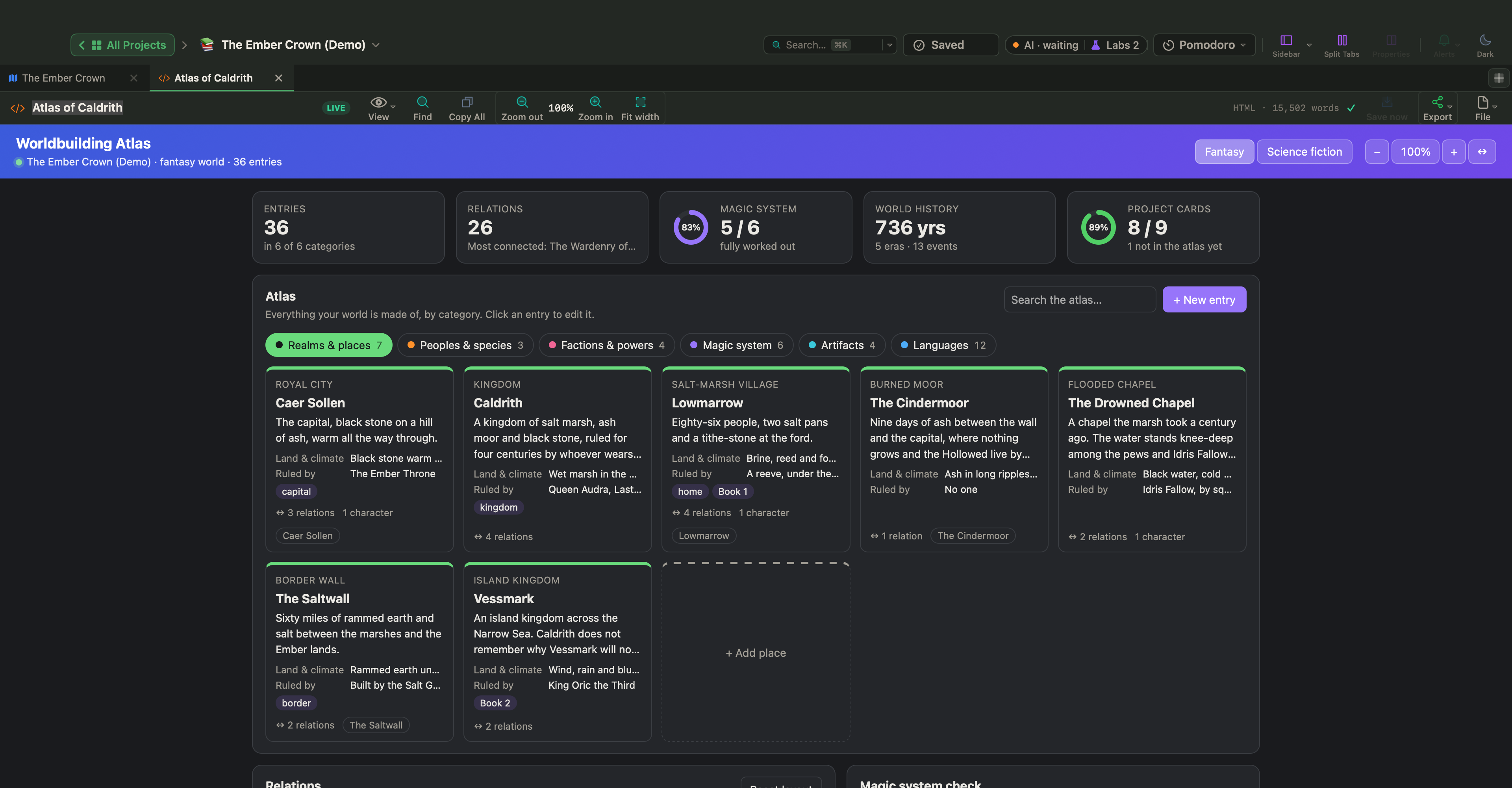
The page at the top of this article is the Worldbuilding Atlas, one of the built-in Live Pages. It is a world bible for fantasy or science fiction: places, peoples, factions, magic or technology rules, artifacts or ships and invented words, with a relations network, eras, a glossary, and your cast and places read from your cards. Each magic entry has the four fields used above, and the page shows how many are fully worked out.
To see it filled in, open The Ember Crown from Help › Demo Projects, or download it. Live Pages are a Labs feature: turn on Turn HTML pages into small apps (Live Pages) in Settings › Labs, then choose New ▾ › Live Page ▸ › Examples ▸ in the sidebar; the page is in the Fiction submenu. See Live Pages.
Places as cards
Every place in the story can be a card on the canvas, with the scenes that happen there listed on it. In the Writer Timeline (View › Writer Timeline, ⌥⌘T), Place Map shows places down the side and chapters across, so you can see where the book spends its time and which places appear once and never again.
For a world with its own customs, add a set of fields made for it: the Worldbuilding starter set is one of 34, in the Creative group. See Card properties and custom fields.
Story time and the long view
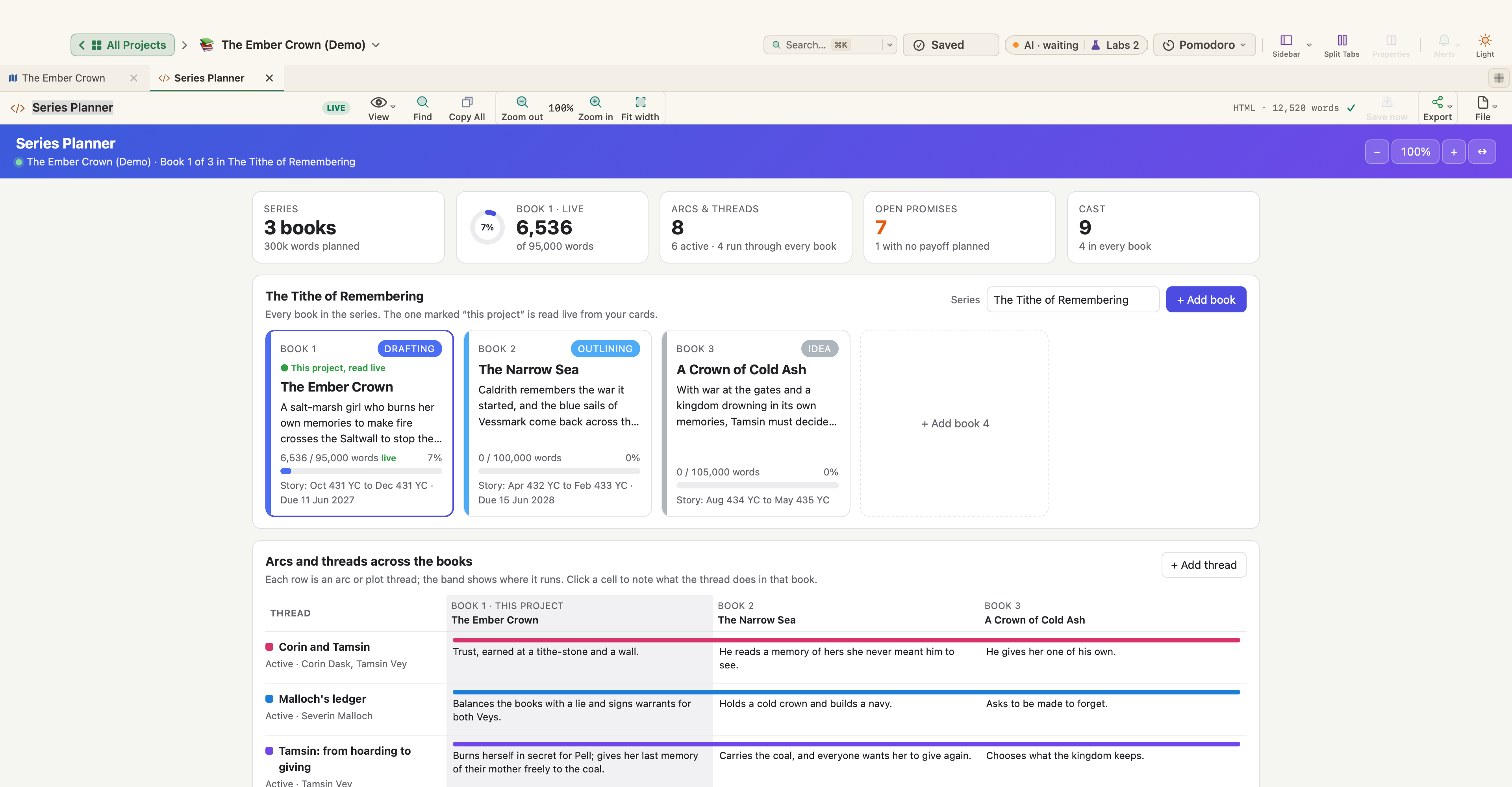
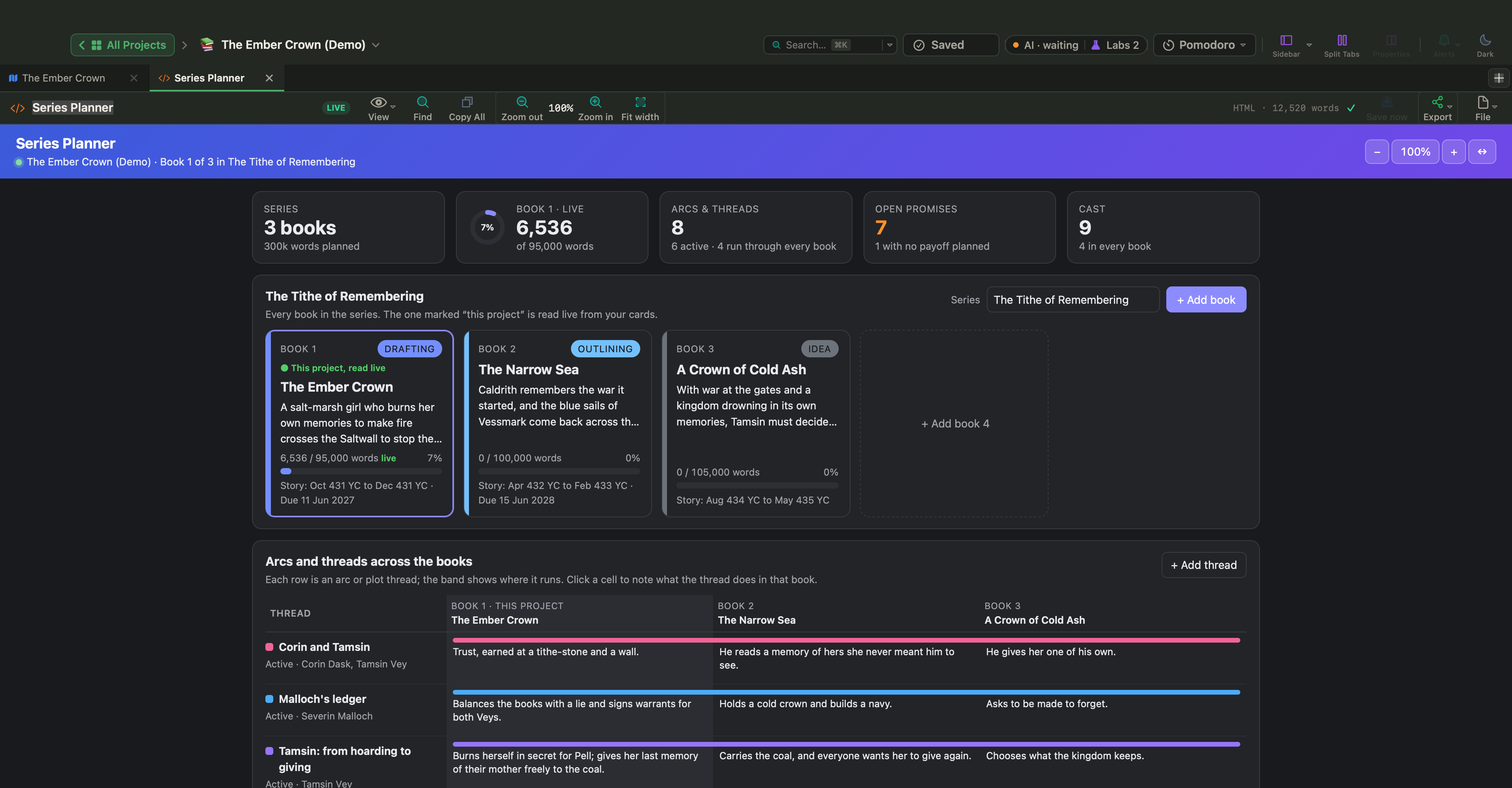
Give each scene its story time in the Properties panel, as a real date, a year or free text such as "Day 3", and the Chronology view sorts the scenes by when they happen. For a trilogy, the Series Planner Live Page keeps the books, their threads and the promises still to be paid off in one grid.
For a novel in any genre, the same job is done by a story bible: see How to build a story bible.
Decide the few large things, give your magic a price, and write the first chapter. The world will tell you what else it needs, one scene at a time.