 WriterMorph

Protagonist, antagonist and conflict: how to build characters who drive the plot
Give your protagonist a want, a need and a flaw, give the antagonist a goal of their own, and let conflict press on more than one level. Then set up the cast in WriterMorph.
Plot is what happens when a character wants something and someone, or something, won't let them have it. Get the wanting and the opposing right and scenes begin to suggest themselves.
The examples come from The Salt Archive, a sample mystery you can download; the last part shows the work in WriterMorph.
Want and need
The want is the goal a character can name: solve the case, keep the shop, get out of town. The need is what the character lacks inside, usually without knowing it.
The gap between the two is where the story lives. In The Salt Archive, the archivist Mara Quill comes home to Kellmouth after her father drowns. She wants to bury him, sign the papers and be back on the evening train within the week. She needs to stop treating her own past as a box to be catalogued and shelved, and to forgive the people who stayed. Every scene that keeps her in town pulls the two further apart.
The flaw, or the lie the character believes
A need goes unmet for a reason: a flaw, a wound, or, in K. M. Weiland's work on character arcs, a lie the character believes about themselves or the world. The lie has usually protected them so far, which is why they keep it.
Mara trusts paper over people and hides behind procedure whenever feeling gets close. For an archivist chasing a ledger, that is also a strength, and a flaw that serves the character is harder to give up.
Positive, flat and negative arcs
Weiland describes three basic shapes:
- Positive arc. The character lets go of the lie and ends more whole. Mara's runs from detached custodian of other people's histories to a woman who claims her own, and chooses to stay.
- Flat arc. The character already holds the truth and changes the people around them. The test is whether they keep holding it.
- Negative arc. The character clings to the lie, or trades it for a worse one, and ends lower. The antagonist's arc in The Salt Archive runs from untouchable benefactor to a man undone by his own instinct to preserve.
An antagonist with a goal of their own
An antagonist is someone whose goal blocks the protagonist's, who has reasons, and who acts between the protagonist's scenes. Give them a want, a need and a flaw too.
Harlan Voss, chairman of Voss Shipping, wants to be remembered as the man who kept Kellmouth alive. He needs to admit what the town's prosperity cost, and who paid for it. He believes his own legend and cannot bring himself to destroy anything that bears his family's hand, evidence included, so his own nature keeps alive what can bring him down. In The View from the Top Floor he offers Mara the directorship of a rebuilt archive, and mentions that her sister's café is mortgaged to his firm: an offer and a threat in one scene.
Forces of antagonism beyond a villain
Robert McKee, in Story, calls the sum of what stands against the protagonist the forces of antagonism. They can come from other people, institutions, nature or the protagonist's own flaw. In The Salt Archive they include the sea, a town that would rather not count what its prosperity cost, and a drowning the police have already closed as an accident.
Relationships that create pressure
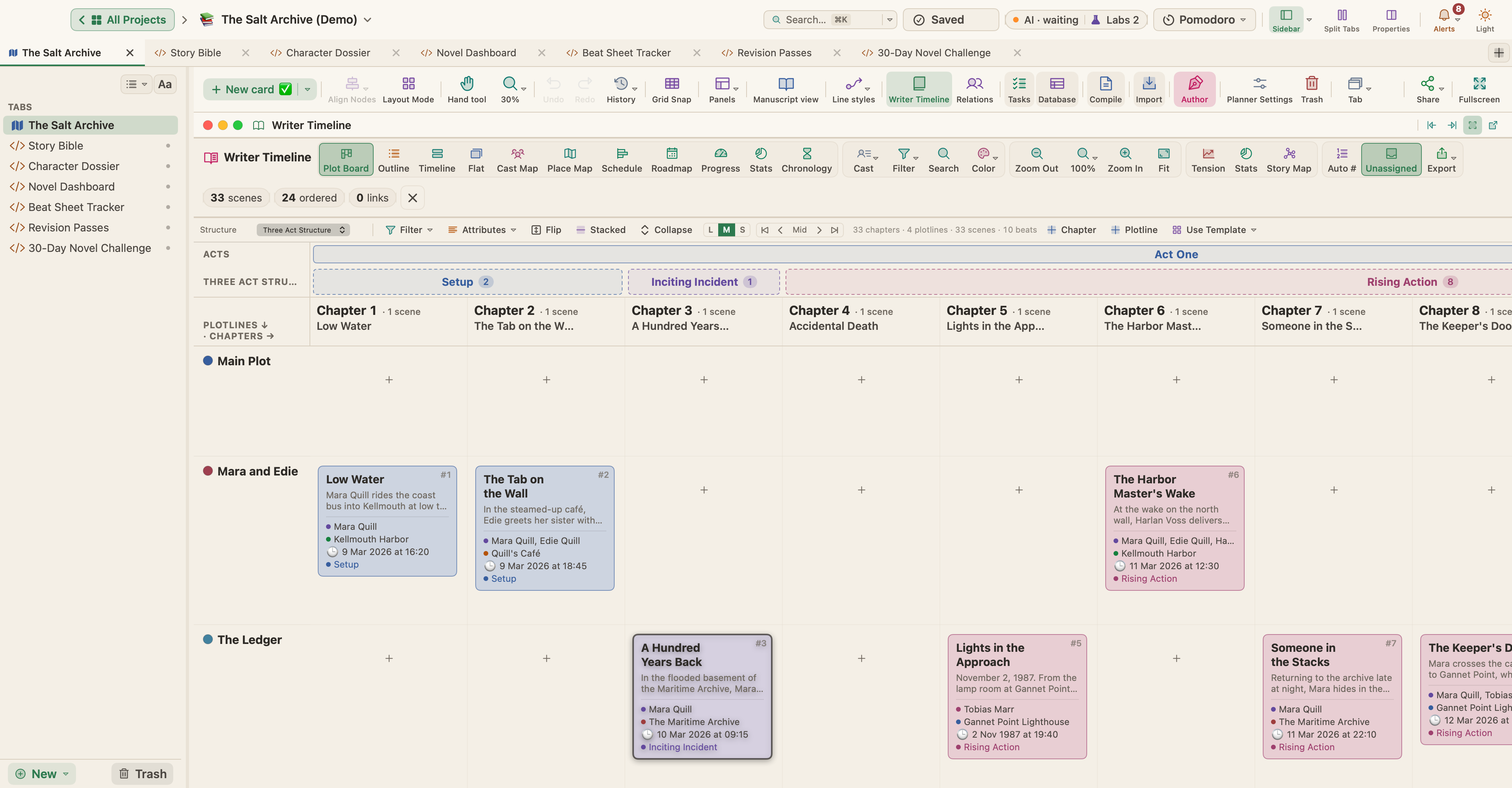
The most useful allies want something that cuts across the protagonist's goal. Edie Quill, Mara's sister and foil, is the one who stayed, and she wants, just once, to be thanked for staying. Ansel Roe, ally and love interest, is the detective sergeant who signed off their father's drowning as an accident; he wants no more inquiries with his name on them. Neither is an enemy, and both make every step harder. The book gives each relationship a plotline of its own, Mara and Edie, and Mara and Ansel, next to the ledger plot.
Conflict on three levels
McKee also describes conflict on three levels, and the strongest scenes press on more than one at once:
- Inner: want against need, the flaw against the truth. Mara wants to be gone within the week, and needs to make peace with the people who stayed.
- Personal: between people who matter to each other. Two sisters, one who left and one who stayed.
- Outer: against an antagonist, an institution, society or nature. Voss, a closed case, the sea.
When one choice costs a character on all three levels, the scene becomes a decision.
A character sheet that drives plot
Each line should be something a scene can test:
| Field | The question it answers | Mara Quill |
|---|---|---|
| Want | What do they knowingly chase? | To bury her father and leave within the week |
| Need | What do they lack without knowing it? | To stop shelving her own past, and forgive the people who stayed |
| Flaw or lie | What keeps them from the need? | Trusts paper over people |
| Arc | Who are they at the start, and at the end? | From custodian of other people's histories to a woman who claims her own |
| Opposition | Who or what blocks the want? | Harlan Voss; a case already closed |
| Pressure | Who makes every step harder? | Edie, the sister who stayed; Ansel Roe |
| Presence | Where are they in the book? | 18 scenes, 17 of them in her point of view |
A field that never shows up in a scene is decoration. Cut it, or write the scene that tests it.
Building the cast in WriterMorph
In WriterMorph a character is a card in the same project as the scenes. For names, places and world rules, see the story bible article.
Character cards, fields and connections
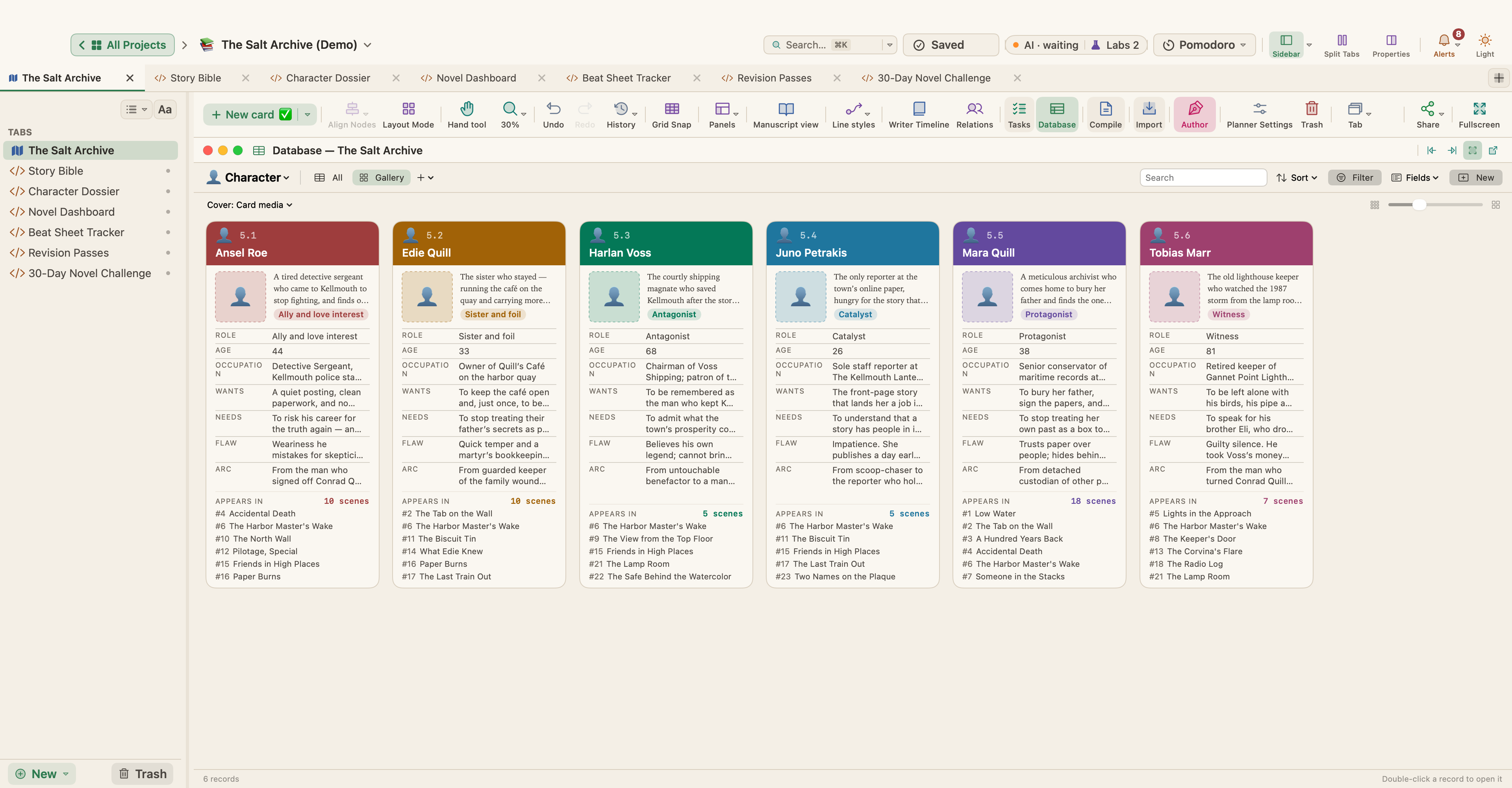
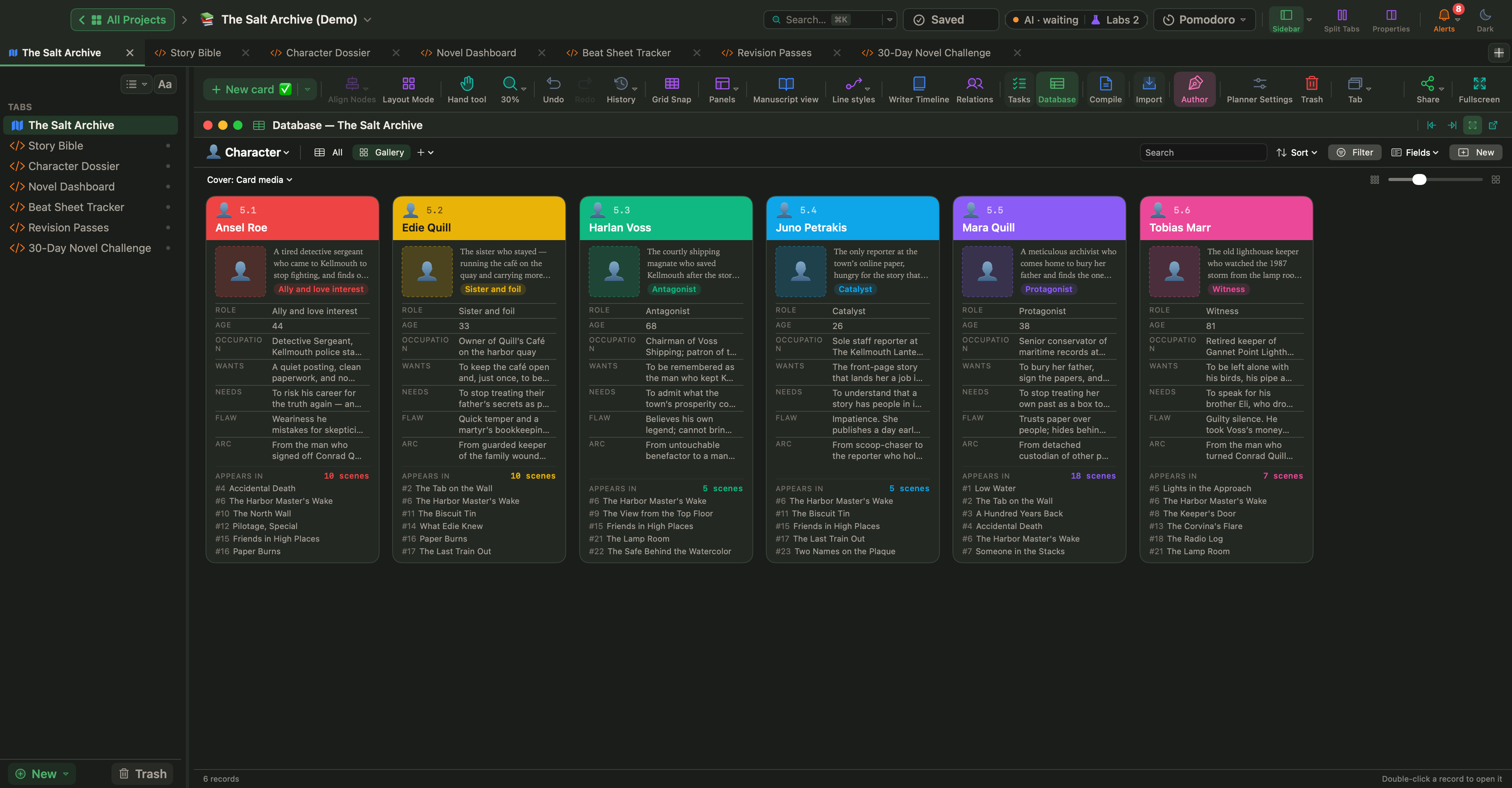
On the canvas, press ⌘N and choose Character from the card type picker, or use Documents › New Card of Type. In fiction planners, character cards come with Role, Gender and Appears in, which lists the character's scenes. The cards in The Salt Archive also hold age, occupation, wants, needs, flaw and arc, as the picture at the top shows.
For anything else, such as the lie or a secret, select a character card and choose Documents › Add Property (⌥⌘;), pick a type such as Long text or Link to cards, and apply it to cards of one type. To give every new character the same fields, open Project › Project Settings… (⌥⌘,), choose Cards › Node Types and click Design…: its Property template sets the properties each new card of that type starts with. See Card Properties and Custom Fields.
Drag from a card's connection port to another card to connect them. Right-click the line to Edit Label…, so the arrow says what binds two people, or to pick a Line Style: the starting styles include Conflict.
Who is in which scene
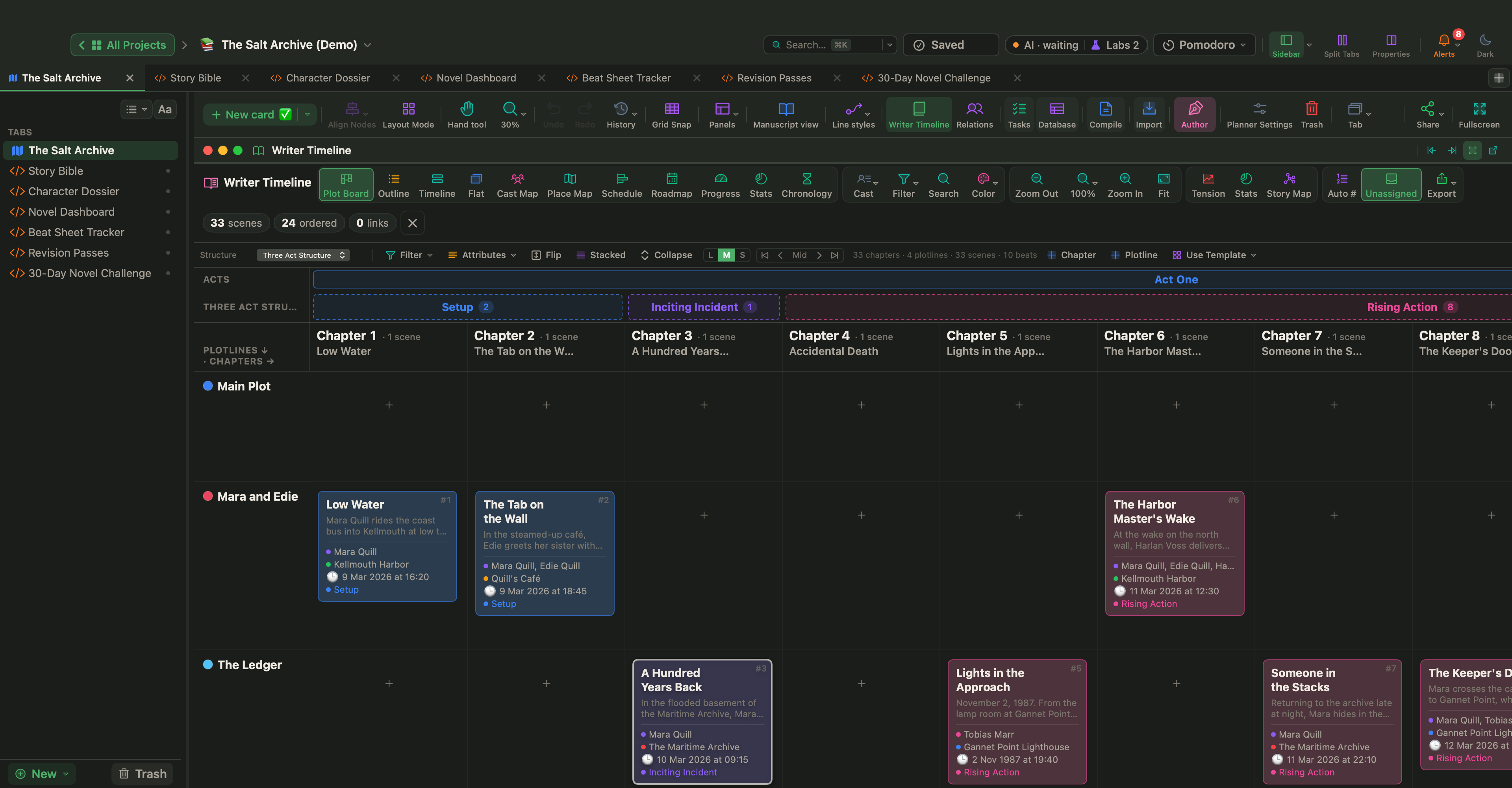
Scene cards have built-in Characters and POV fields. Open View › Writer Timeline (⌥⌘T); fiction templates turn on the Author mode it needs. The Cast Map shows which characters appear in which chapter. On the Plot Board, Filter by character follows one person through the book, and the Plotline button adds a plotline, for a relationship as much as a subplot.
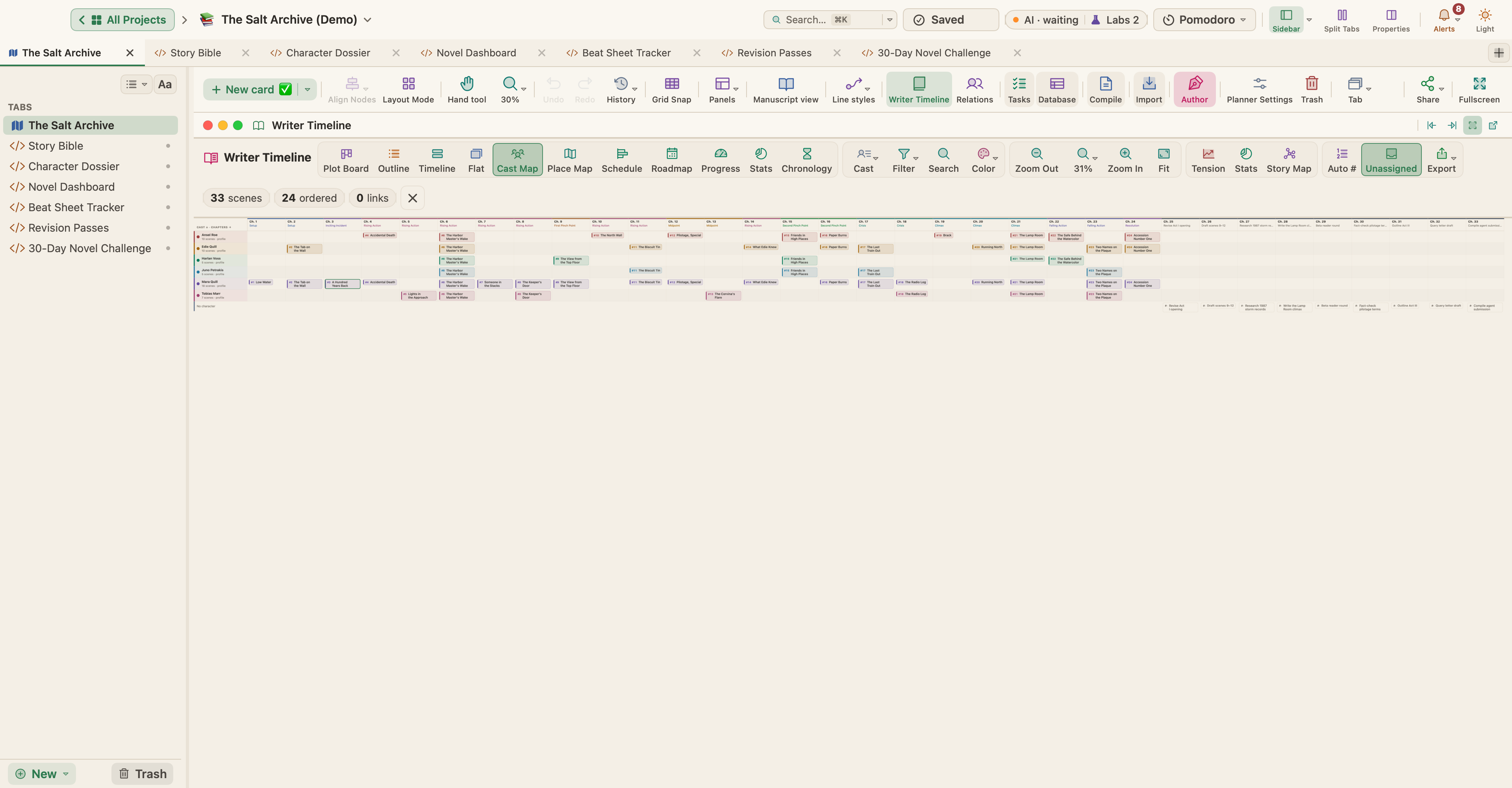
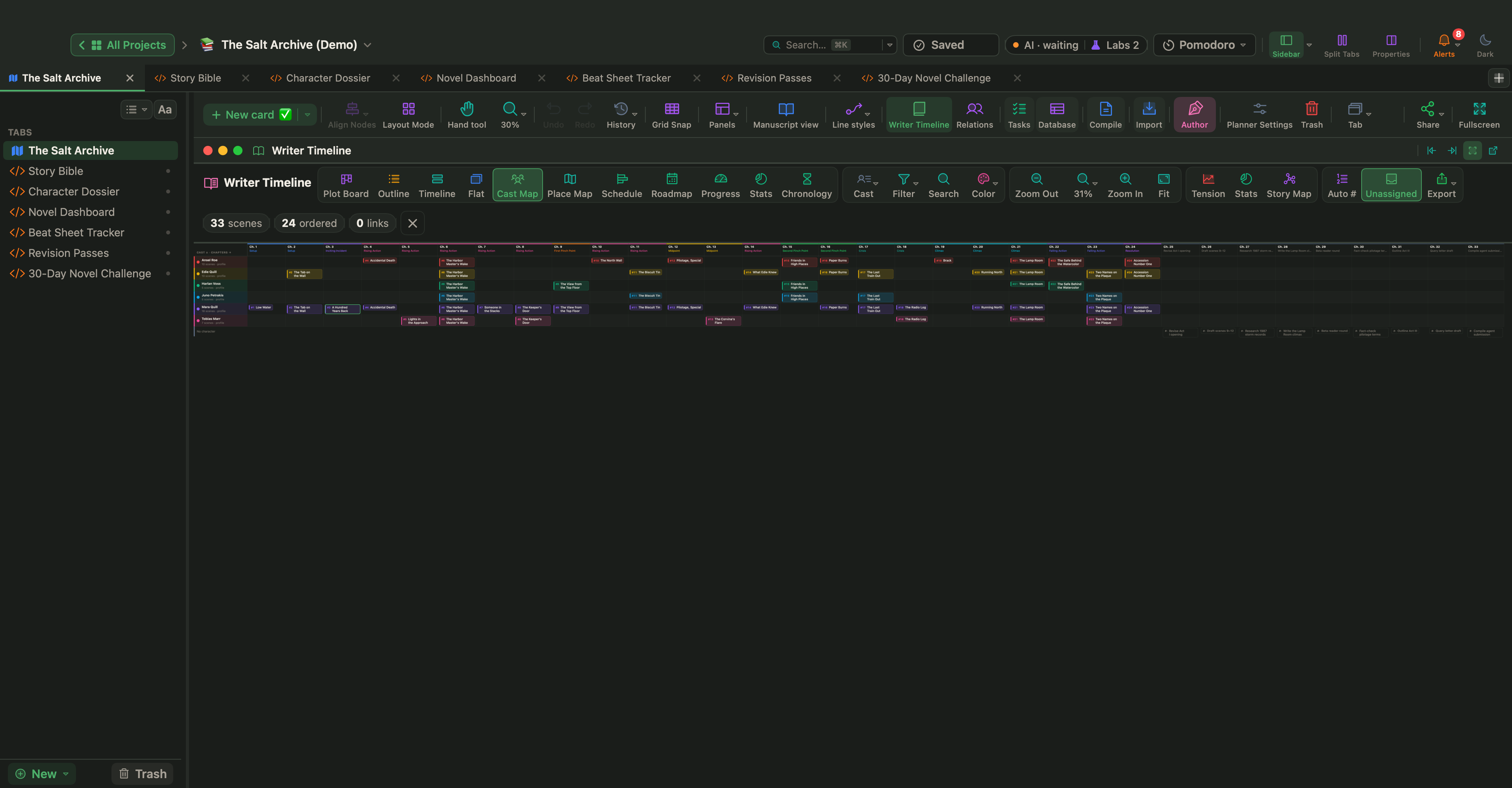
Character Arcs and Relationship Net (Labs)
Live Pages are a Labs feature: turn on Turn HTML pages into small apps (Live Pages) in Settings › Labs, then choose New ▾ › Live Page ▸ › Examples ▸ in the sidebar. Two templates in the Fiction submenu follow a cast:
- Character Arcs: presence across scenes and acts, share of the point of view, longest absence, screen time and who meets whom, with want, need, flaw and arc from the card and your own arc notes for each act.
- Relationship Net: a network of your characters from card connections, relation fields and shared scenes. Drag, zoom, filter and open cards.
The database at the top of this page is the other Labs feature: turn on Show card types as databases (Table · Gallery · Board · Calendar) in Settings › Labs, then choose View › Database. See Live Pages and Databases and Data Cards.
Start with two cards: the protagonist and whoever stands in the way. Give each a want, a need and a flaw, put them in a scene together, and check which of the three levels of conflict that scene touches. If the answer is none, that is the scene to rethink first.