 WriterMorph

How to plan a book series: the series arc, each book's story and the promises between them
A series tells two stories at once, the one in each book and the one across all of them. How to choose the kind of series, close each book while the series stays open, and track threads, promises, characters and time across the books.
A series tells two stories at once: the one each book tells, and the one the whole series tells. Most series problems come from mixing them up. A first book ends on a cliff with nothing resolved, and readers feel cheated. A third book has to invent a reason to exist, because the series story was used up in the first.
This article covers the kinds of series, the two questions to settle before anything else, how to track threads, promises, characters and time across the books, and how much to plan before you write book one. The worked example is The Ember Crown, a fantasy novel in progress that comes with WriterMorph as a sample, planned as the first book of a trilogy.
Choose the kind of series
| Kind | Each book | Across the series | Familiar examples |
|---|---|---|---|
| Episodic | A complete story | The same detective, town or world, with little lasting change | Agatha Christie's Hercule Poirot novels |
| Serial | Ends a stage, not the story | One long story in volumes | The Lord of the Rings, written as one novel and published in three volumes |
| Hybrid | Closes its own main plot | A larger arc that moves a step with each book | Many fantasy, crime and romance series |
Romance often uses a fourth shape: connected standalones, each about a different couple in the same town, family or circle of friends, so that readers meet the next pair before their book begins.
Most writers who plan a series today choose the hybrid, and for a good reason. A reader who picks up book one gets a whole story, and a reader who finishes it wants the next. If you are looking for a publisher, a first book that works on its own is also easier to submit, because the agent or editor has only that book in hand.
Two questions: one for the series, one for the book
Write both down before you plan anything else.
- The series question is what the whole series is about, and what will be different at its very end. It can stay open for three books.
- The book question is what this book asks and answers. It must be answered in this book, even if the answer opens the next one.
In The Ember Crown, the series is called The Tithe of Remembering. Book one's premise, as the sample gives it: a salt-marsh girl who burns her own memories to make fire crosses the Saltwall to stop the Crown taking her brother's last memory of their mother. That is a book question with a clear yes or no. The series question is larger and can wait: by book three, Tamsin must decide whether the kingdom should be made to forget again.
Close the book, keep the series open
A useful test: list every thread of the book, and mark each one as closing in this book or running on. A book with nothing that closes feels like a long first act. A book where everything closes leaves the next book with no momentum.
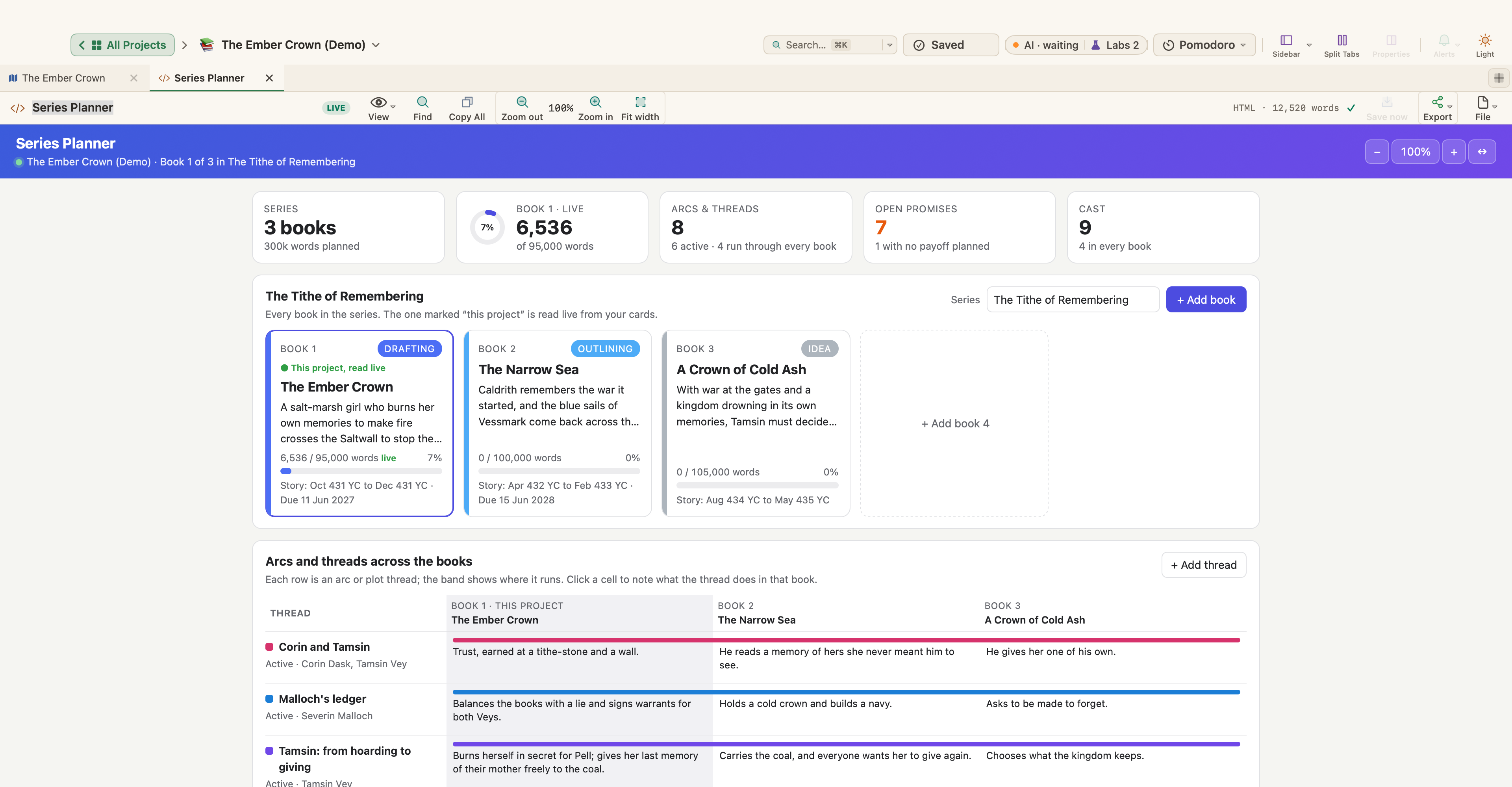
The Ember Crown's plan has both kinds. One plot thread, The cold coal, starts and ends in book one: forced memories burn cold and the coal starves, until one memory freely given saves it. That thread belongs to book one alone, and it closes before the last page. Other threads run on, and the plan says what each one does in each book:
| Thread | Book 1: The Ember Crown | Book 2: The Narrow Sea | Book 3: A Crown of Cold Ash |
|---|---|---|---|
| Tamsin: from hoarding to giving | Burns herself in secret for Pell; gives her last memory of their mother freely to the coal | Carries the coal, and everyone wants her to give again | Chooses what the kingdom keeps |
| Malloch's ledger | Balances the books with a lie and signs warrants for both Veys | Holds a cold crown and builds a navy | Asks to be made to forget |
| Corin and Tamsin | Trust, earned at a tithe-stone and a wall | He reads a memory of hers she never meant him to see | He gives her one of his own |
Each cell is one line, and each line is a change, not a summary. The grid also shows where a thread goes thin. A thread with an empty middle book is either not part of the series or a sign that the middle book needs it.
Promises and payoffs
The novelist Brandon Sanderson, in his lectures on writing, describes plot as promises, progress and payoff: what the story leads readers to expect, how it moves towards it, and how it delivers. In a series the promises are spread across books, and the risk grows with every volume: a question raised in book one and forgotten by book three is the kind of thing readers remember.
Keep a list of every question or promise you plant, with the book that sets it up and the book that pays it off:
- Plant only what you mean to pay off, or mark it in the list as something you are leaving open on purpose.
- Pay something off in every book. Readers will wait for the big answers if the small ones keep arriving.
- Check the list before you plant more. The longer the list of open promises, the harder the last book has to work.
The Ember Crown's list has eight promises. One is already paid off in book one: the coal only takes what is freely given. Others wait for book two (who was Hesper Vey to the Unlit?) or book three (why does Malloch write "Paid" in the ledger?). One, Pell and the herons that talk, has no payoff planned yet. That is not an error. It is a decision still to make, and the list makes it visible.
Characters across the books
A character arc that runs across a series has to be paced across it. If a hero completes her change in book one, the next books have nowhere for her to go. Give each book one stage of the arc, as the Tamsin row above does: hoarding, carrying, choosing. How to write a character arc covers the arc itself.
Plan who appears where, too. In The Ember Crown's plan, a mentor dies in book one, Tamsin and Pell's mother is only mentioned in book one and has a major part in book two, and a new antagonist, the king of Vessmark, arrives in book two. Writing down each character's part in each book (a point-of-view character, a major or minor part, mentioned only, or dies) catches a promised return that never happens.
Time between the books
Decide when each book takes place and what happens in the gaps. Readers notice when a character has aged a year in a book that covers three months, or when nothing has changed in the world over a two-year gap.
The Ember Crown's plan dates its books in the kingdom's own calendar: book one runs from October to December of the year 431, book two from April 432 to February 433, and book three from August 434 to May 435. The gaps are short and specific. For your own series, note in one line what happens in each gap, even if no scene ever shows it. It becomes backstory you can rely on.
How much to plan before book one
You don't need the whole series outlined to write book one well. You do need enough to avoid painting yourself into a corner. A plan that works for many writers gets thinner with distance:
- Book one: fully outlined, with its own question, climax and ending.
- Book two: a premise, the threads it carries on, and the promises it pays off.
- Book three and beyond: a premise and the direction of the ending, even if the details change.
- The series bible: names, places, rules of the world and every fact you have committed to in print. See how to build a story bible.
The Ember Crown's three books stand at exactly these stages: book one drafting, book two outlining, book three an idea.
Planning a series in WriterMorph
One project per book
Keep each book in its own project. Its scenes, targets and compile settings then belong to that book, and its word count is the book's own. The series plan lives on a page inside the project you are writing, which reads that book live from your cards.
The Series Planner
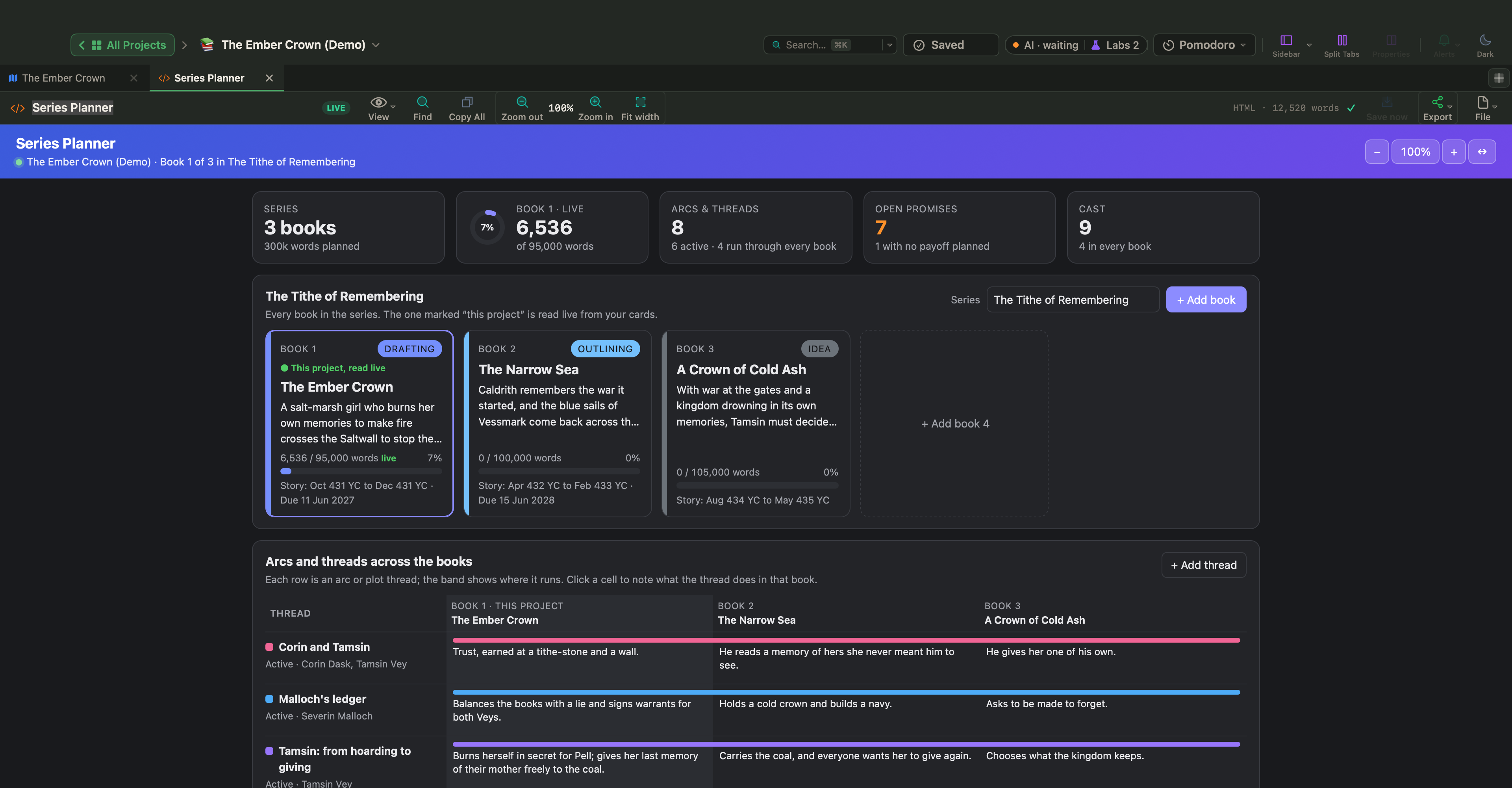
The Series Planner is a Live Page, a Labs feature: turn on Turn HTML pages into small apps (Live Pages) in Settings › Labs, then choose New ▾ › Live Page ▸ › Examples ▸ in the sidebar; it is in the Fiction submenu. To see it filled in, open The Ember Crown from Help › Demo Projects, or download it from Sample projects. It is the page pictured at the top.
- + Add book adds a book with its title, number in the series, status (Idea, Outlining, Drafting, Revising or Published), target words, one-line premise, the years in which its story starts and ends, and a release date. Tick This project is this book (its words and scenes are read live) for the book you are writing.
- Arcs and threads across the books is the grid in this article's table. + Add thread gives each thread a kind (Character arc, Plot thread, Mystery, Relationship or World and history), a status, the books it starts and ends in, its characters, and what it does in each book. Click a cell to write that book's line.
- Promises to pay off is the list: each promise with the book it is Set up in and the book it is Paid off in, or Not decided, and a status of Open, Paid off or Dropped.
- Cast across the books lists the project's character cards and any names you add, with their part in each book: POV, Major, Minor, Mention or Dies.
- Series timeline places the books in story time, with the gaps between them, and This book, live shows the current book's words, scenes and status from your cards. Notes holds the decisions that belong to the whole series.
Threads that match your plotlines
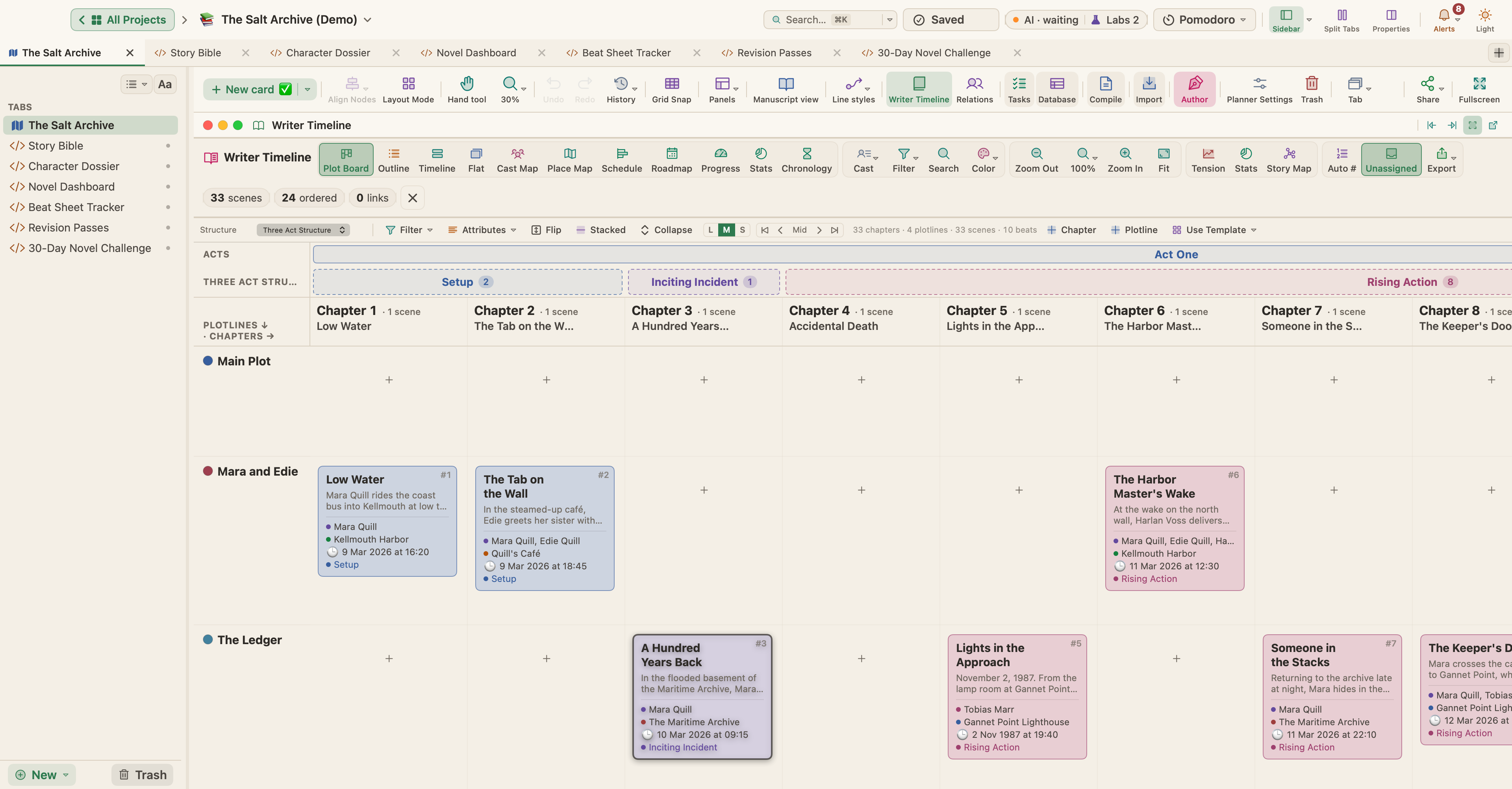
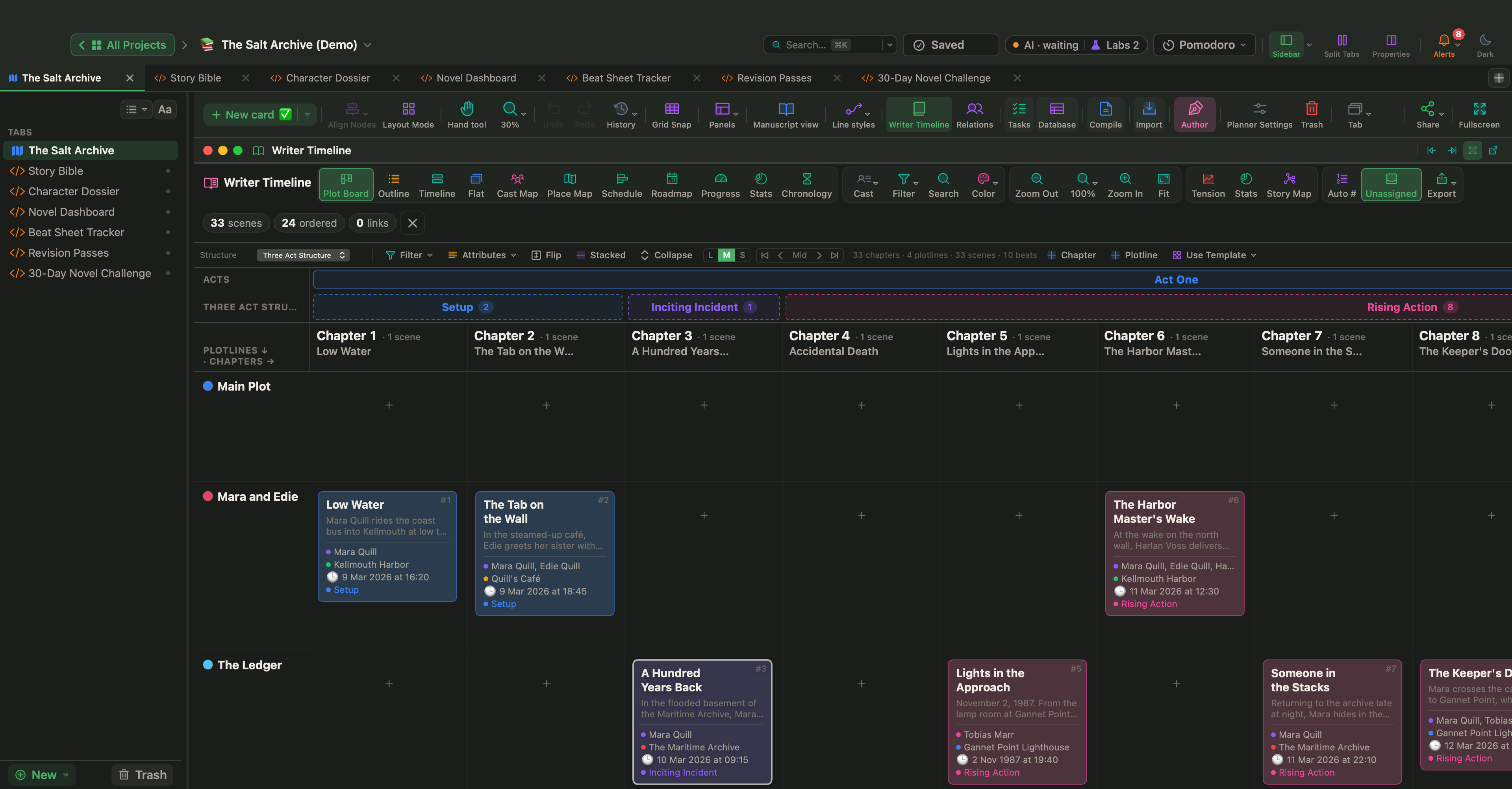
On the Plot Board in the Writer Timeline (View › Writer Timeline, ⌥⌘T), plotlines run down the side and scenes sit in the cells. If a thread in the Series Planner has the same name as a plotline, the grid shows how many of this book's scenes carry it, so you can see at a glance which series threads the current book actually advances.
The cast and the world
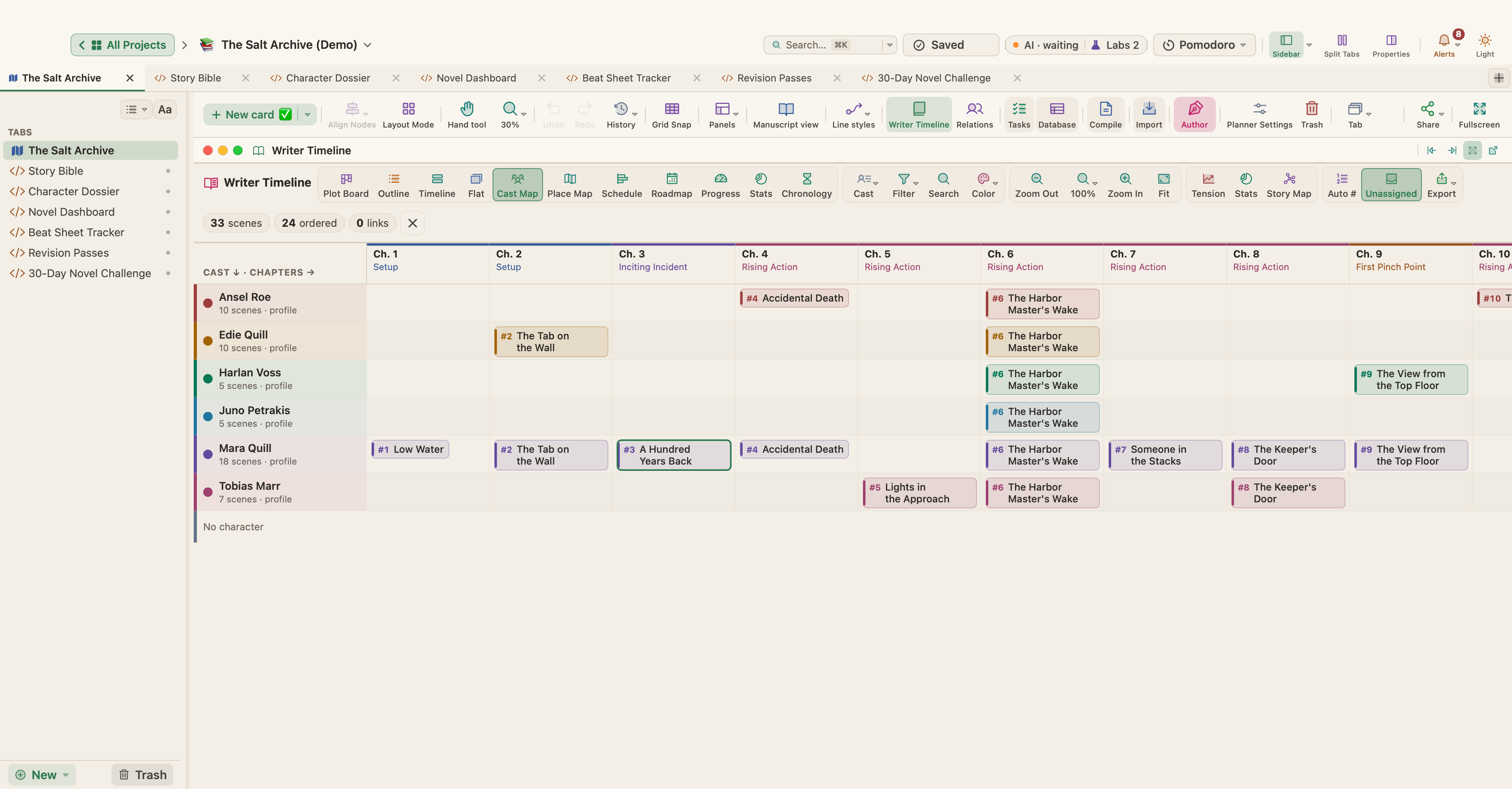
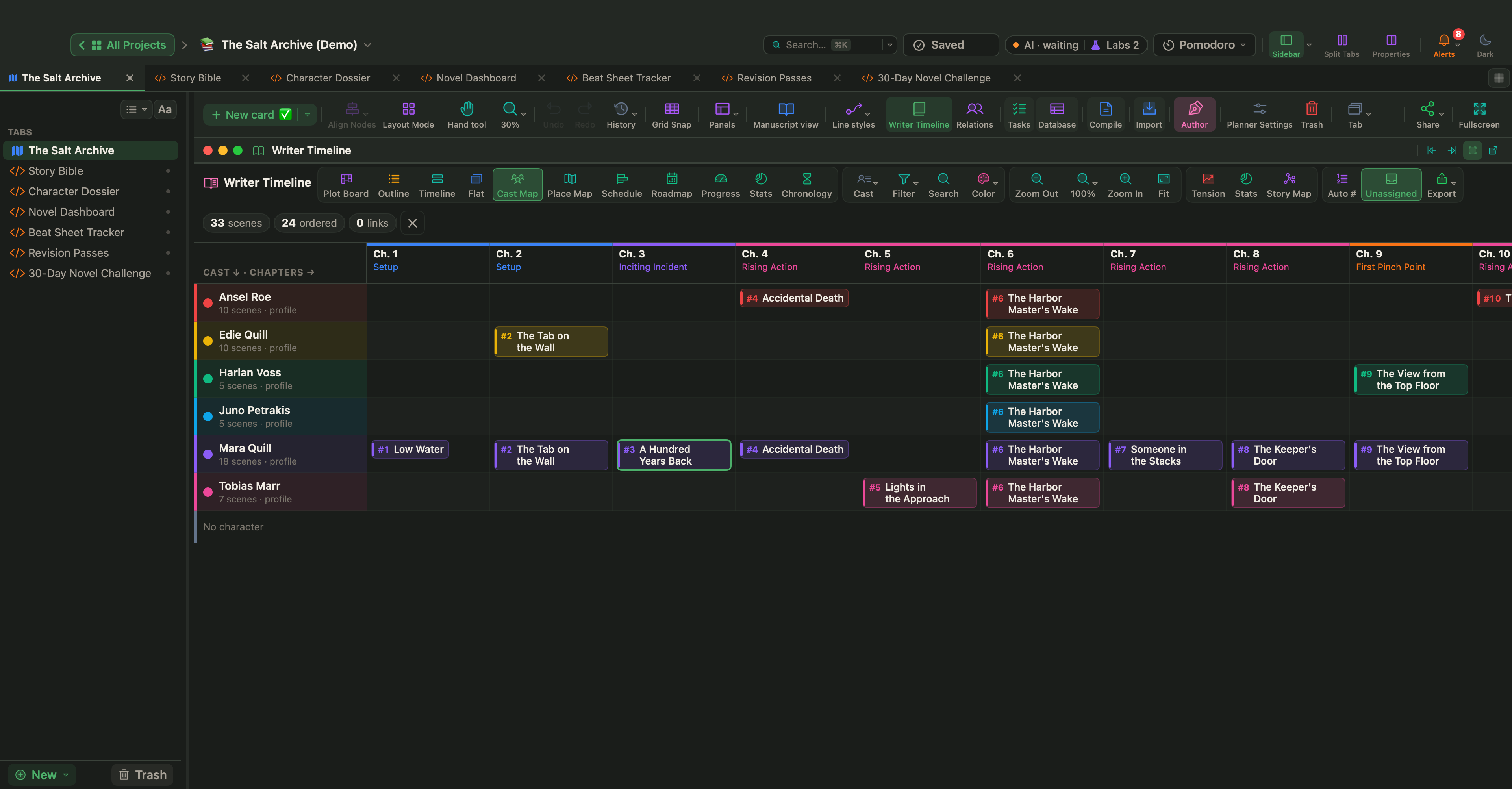
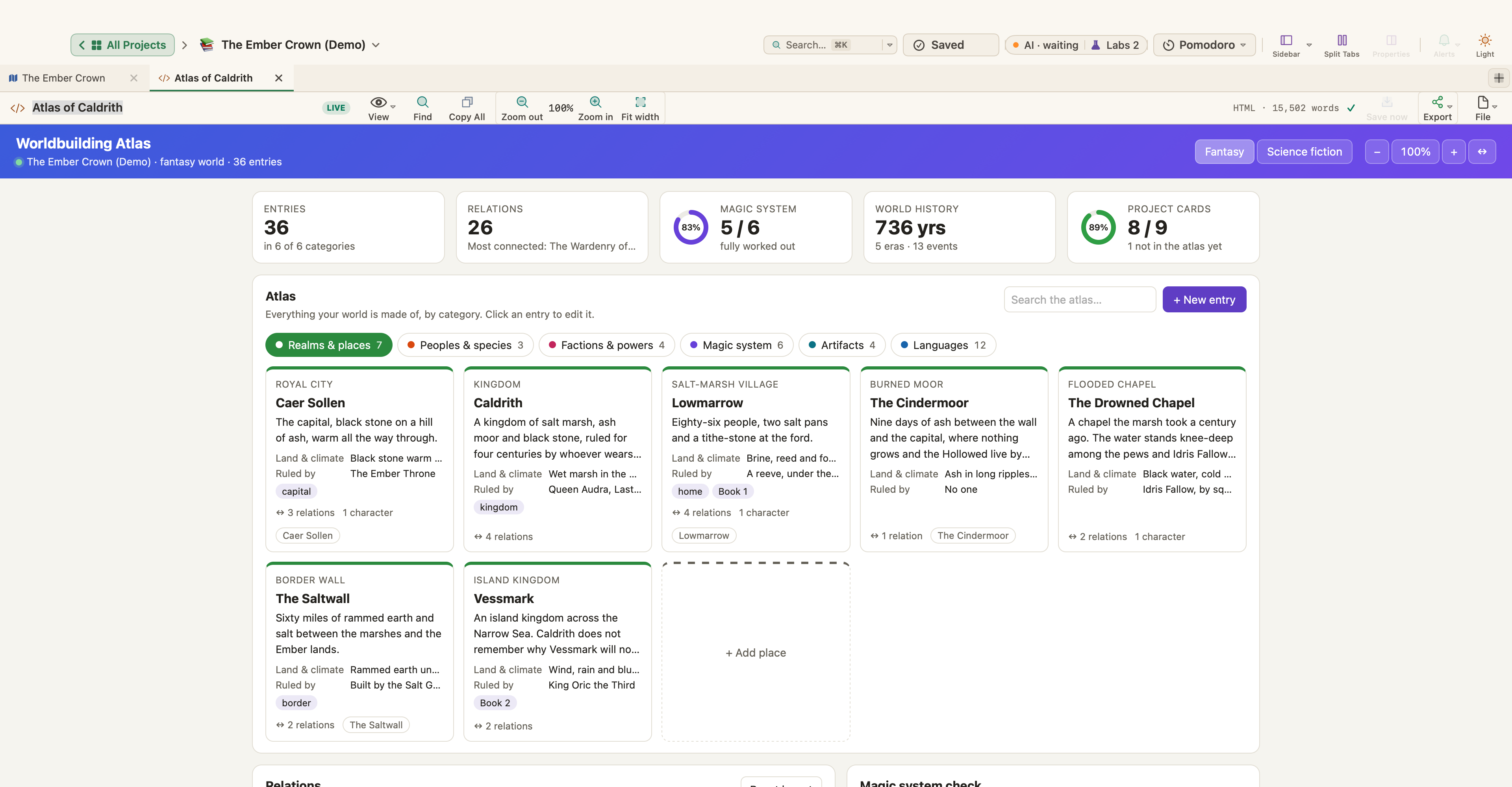
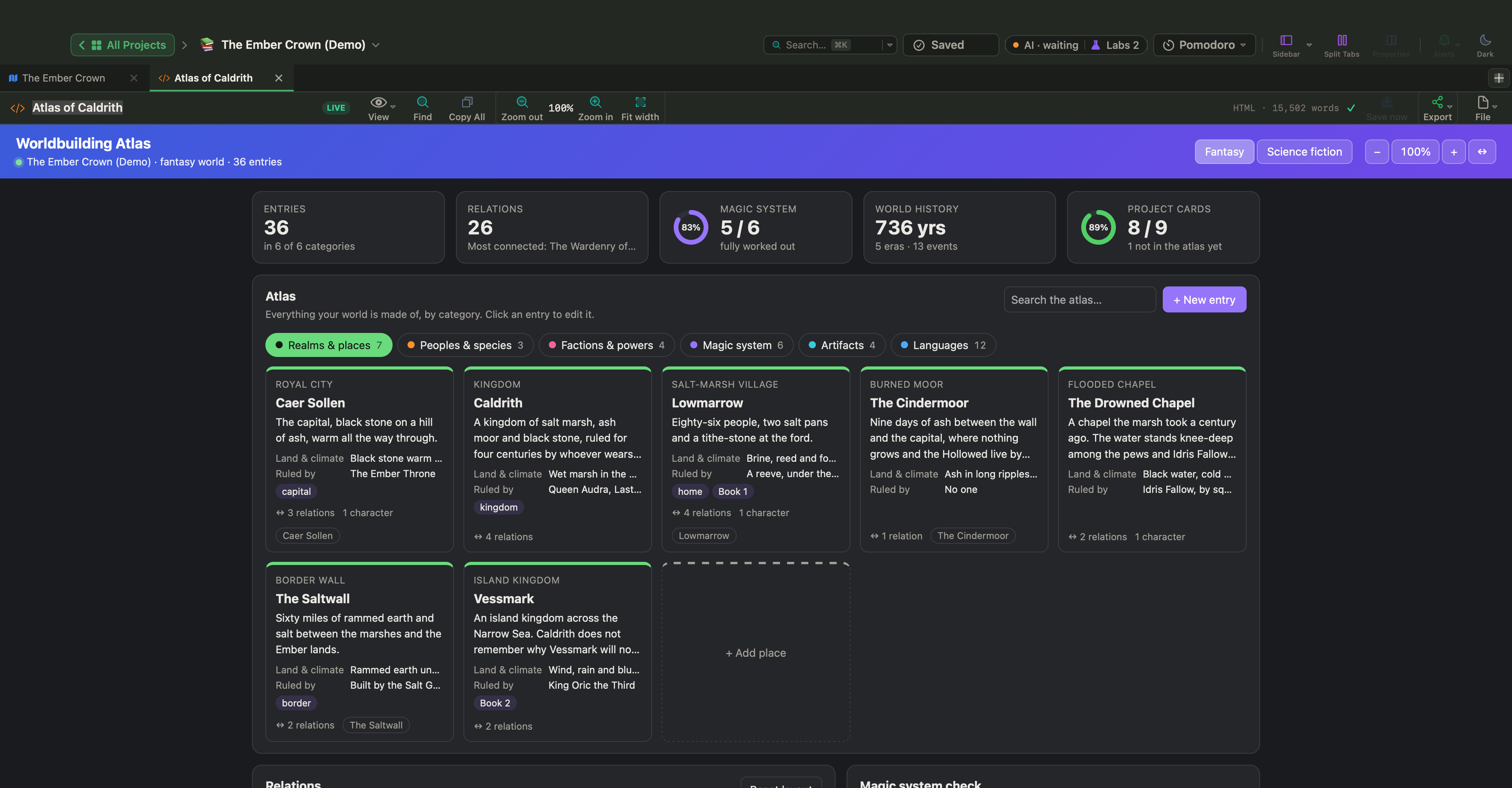
The Writer Timeline's Cast Map shows who appears in which chapter, so a character the series needs later does not vanish from a whole book without a reason. For a fantasy or science-fiction series, the Worldbuilding Atlas page keeps places, peoples, factions, rules and invented words in one place; The Ember Crown tags some of its entries with a book, such as Book 1 or Book 2. Worldbuilding for a fantasy novel explains what to put in it.
Starting book two
When book one is done, right-click its project on the Home screen and choose Duplicate. The copy, named after the original with "copy" at the end, has the same cards, plotlines and Live Pages, with what you entered in them. Rename… it, delete book one's scenes and keep the characters, places and notes. Then open the Series Planner, edit book two and tick This project is this book (its words and scenes are read live): the threads, promises and cast you planned are waiting.
Start with the two questions on a single page: what this book answers, and what the series asks. Then fill the grid for book one, and let the rest of the series stay a sketch until book one has earned it.