 WriterMorph

Story structures beyond three acts: five acts, kishōtenketsu, seven points and more
Five ways to shape a book other than three acts, from Freytag's five-act pyramid and the four parts of kishōtenketsu to Dan Wells's seven points, a two-timeline novel and a series arc. Each with what it suits, a beat list with rough positions, and how to build it as your own structure in WriterMorph.
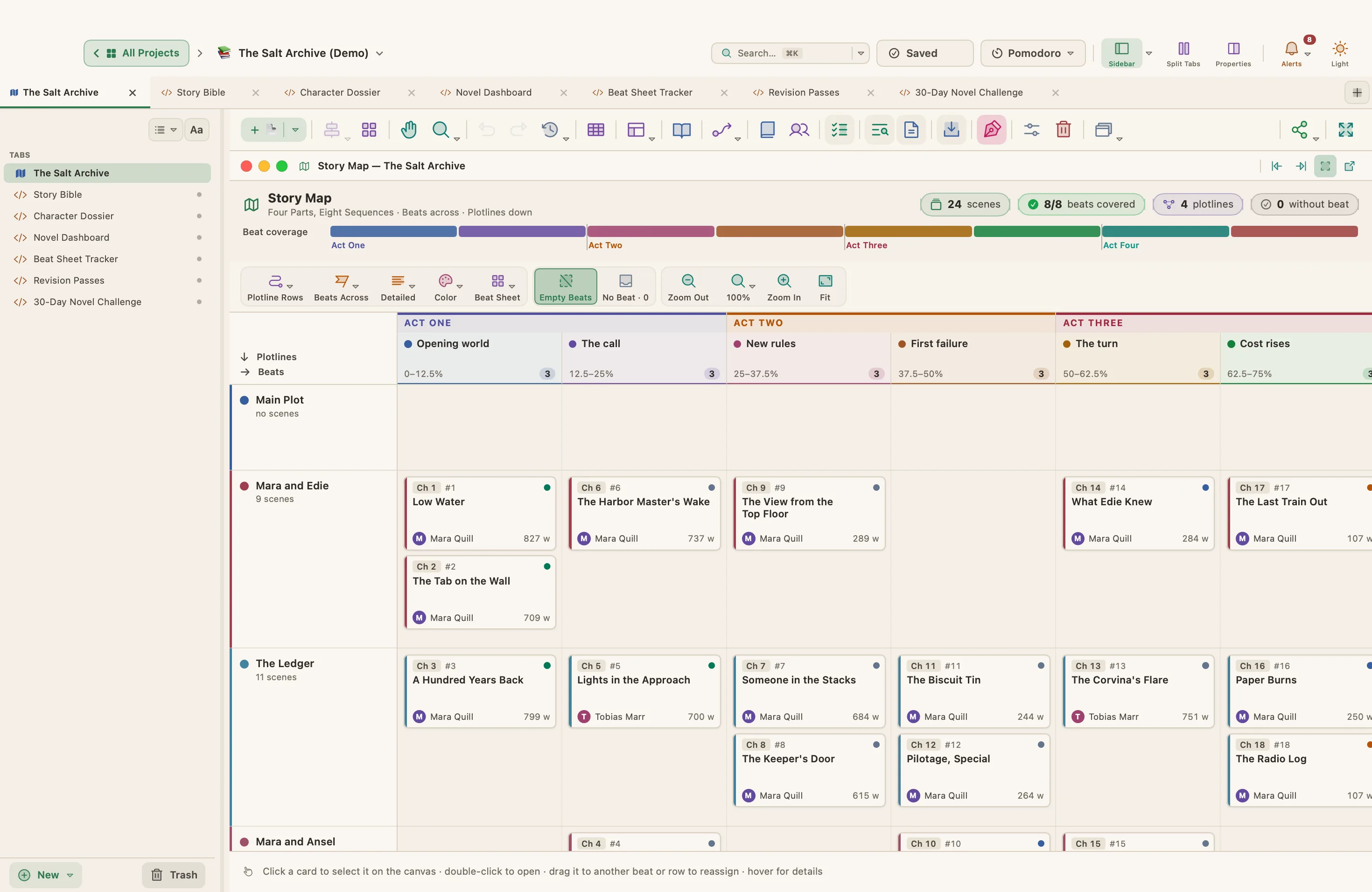
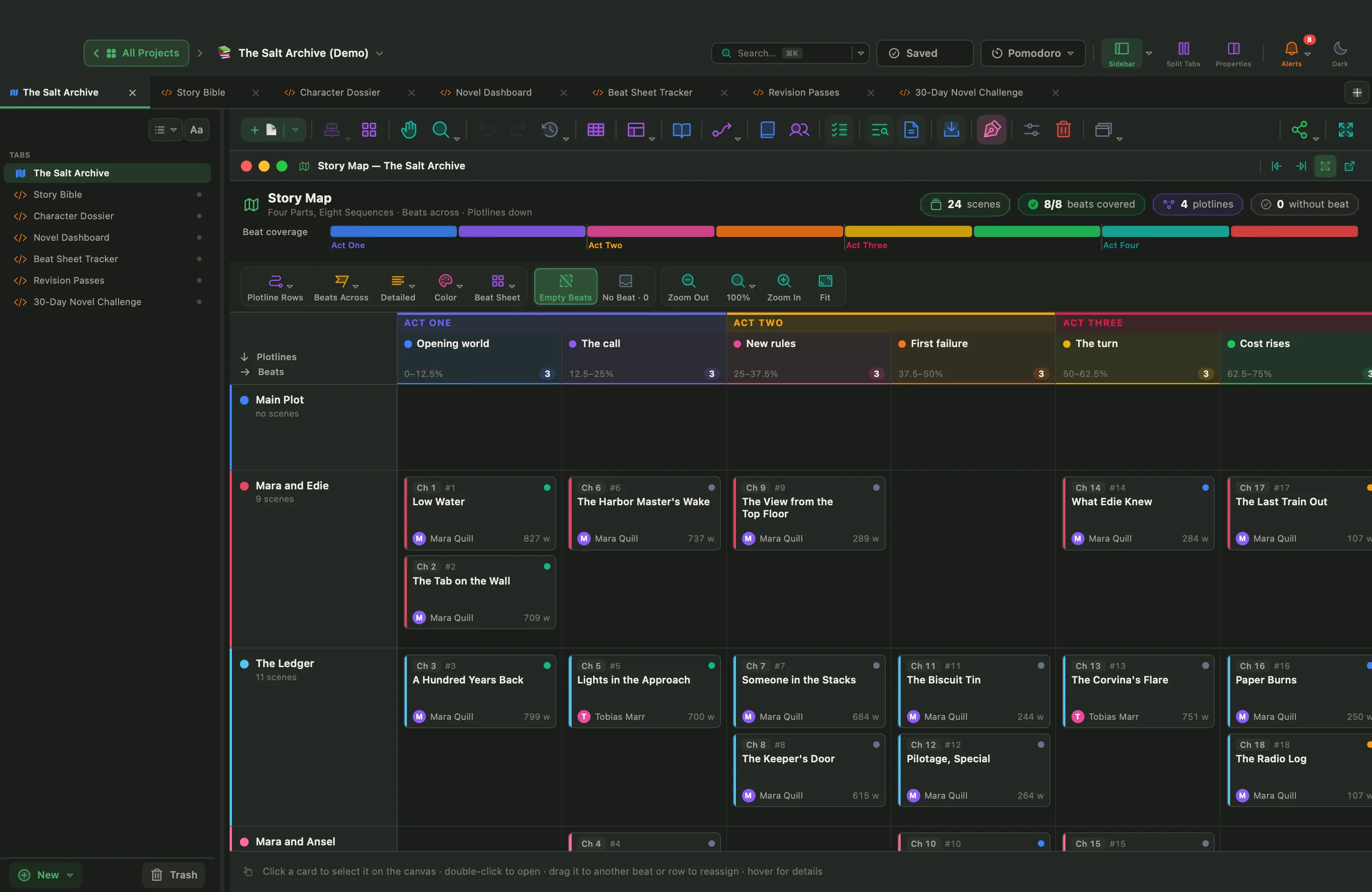
Three acts are the usual shape of a plan, and for many books they are the right one. They are not the only shape stories have taken. Playwrights worked in five acts for centuries. A tradition that began in Chinese poetry builds a story around a turn rather than a clash. Many genre writers plan from seven points. And a novel told in two timelines, or a story told across several books, has a shape that one three-act diagram shows badly.
This guide sets out five structures beyond three acts: where each comes from, the books it suits, a beat list with rough positions, and how to build that exact structure in WriterMorph. For the three-act plan itself, see three-act structure for novels; for the built-in beat sheets and how to choose among them, story structure and turning points.
Why look past three acts
Any story with a beginning, a middle and an end can be described in three acts; Aristotle made the point about tragedy in the Poetics. The difficulty is the middle. In a long book, "act two" covers half the pages and says little about what happens in them. Other structures cut the book in different places, and where you cut decides which questions you ask while you plan:
- Five acts give the middle a climax of its own, and the fall after it a shape of its own.
- Kishōtenketsu asks what new light a turn throws on everything before it, not who wins.
- Seven points ask where the protagonist ends up, then work back to where they start.
- Two timelines ask where the two lines of the book touch.
- A series arc asks what each book settles and what it leaves open.
None of these is better than three acts. Each is a different set of questions. Choose the one whose questions your book most needs answered, or try two and see where they agree.
How to read the positions
Every structure below lists its beats with the point where each one starts, as a share of the whole book. A beat runs until the next one starts, and the last beat runs to the end. The numbers are rules of thumb: they show proportion, such as a long rise and a short fall, not the page where something must happen. In an 80,000-word novel, 10% is about 8,000 words, two or three chapters.
Five acts: Freytag's pyramid
Roman and Renaissance drama was divided into five acts. Horace advised in the Ars Poetica that a play should have no more and no fewer, and Shakespeare's plays are printed in five acts in modern editions. Gustav Freytag, a German novelist and critic, described the shape of five-act tragedy in Die Technik des Dramas (1863): a rise to a climax near the middle, then a fall to the catastrophe. Later readers drew it as a pyramid. Freytag also named three moments between the parts: one that sets the action going, one that starts the fall, and a moment of final suspense just before the end, when it seems the outcome could still change.
What it suits. Tragedy and stories of rise and fall: an ambition pursued, a crime and its consequences, a protagonist who gets what they want halfway through and then pays for it. It also suits stage plays, and any novel whose most important event sits in the middle rather than near the end.
Where it goes wrong. The fourth act. Once the climax is past, a plan easily coasts towards the ending. Give the fall its own pressure: counter-moves, consequences closing in, a last chance that is offered and lost.
| Act | Beat | Starts at | What happens |
|---|---|---|---|
| One | Exposition | 0% | The world, the people and the tension under the surface |
| One | Inciting moment | 10% | The event that sets the action going |
| Two | Rising action | 20% | The protagonist pushes forward; complications pile up |
| Two | Complication | 30% | The plan gets harder and the stakes become clear |
| Three | Climax | 40% | The highest point: the deed is done, the prize won or the line crossed |
| Three | Tragic moment | 50% | The first sign that the climax will rebound |
| Four | Falling action | 60% | Opposing forces gather; the consequences close in |
| Four | Final suspense | 70% | A last chance at escape, which raises hope |
| Five | Catastrophe | 80% | The outcome: in tragedy, the fall; in other stories, the reckoning |
| Five | Denouement | 90% | The new order, and what the ending means |
In WriterMorph. Choose New Structure…, set Acts to 5 and name the ten beats. A new structure starts with three acts of two beats each, and every act you add gets as many beats as the last one, so five acts give you ten. Spread Evenly then starts them at 0, 10, 20 and so on, as in the table. If your rise needs more room, move the Climax to 45 % and the Tragic moment to 55 %. WriterMorph also has a built-in Freytag Pyramid: five beats over three acts, a quicker lens when you just want to see whether the book rises and falls once.
Kishōtenketsu: four parts and a turn
Kishōtenketsu comes from the four-part arrangement of classical Chinese poetry, best known from the four-line quatrain. It passed into Japanese, where it has its present name, and into Korean as giseungjeongyeol. Its four parts are ki, the introduction; shō, the development; ten, the turn; and ketsu, the conclusion that brings the parts together. The four-panel comic strip is the textbook example: a situation, its development, something unexpected, and a last panel in which the first three make sense together.
The structure does not depend on a protagonist fighting an antagonist. There can be conflict in it, but the engine is the turn: something from another direction that changes how the reader sees what came before. The question it asks is not "who wins" but "what does this mean now".
What it suits. Literary and quiet fiction, short stories, slice-of-life novels, family stories and memoir, and mysteries whose decisive moment is a revelation rather than a fight. It is also a good second lens for any book whose ending feels like a full stop rather than an understanding.
Where it goes wrong. A turn that is only a twist. If the ten could be removed without changing the meaning of the first half, it is a surprise, not a turn. And a ketsu that only reports the outcome: it should bring the parts together.
| Act | Beat | Starts at | What happens |
|---|---|---|---|
| One | Ki: the place | 0% | The setting and its everyday rhythm |
| One | Ki: the people | 10% | Who lives here, and what they take for granted |
| Two | Shō: development | 25% | The situation deepens; nothing is overturned yet |
| Two | Shō: what it costs | 40% | The development shows its weight |
| Three | Ten: the turn | 60% | Something from another direction changes the picture |
| Three | Ten: the new light | 68% | Earlier scenes take on a different meaning |
| Four | Ketsu: drawing together | 78% | The parts come together |
| Four | Ketsu: the whole | 90% | The reader sees the story as one thing |
Kishōtenketsu has no fixed proportions. This plan gives the first two parts a long, unhurried run and the turn a short, sharp place late in the book.
In WriterMorph. Make a structure with four acts and two beats in each. Acts in WriterMorph are numbered, from Act One to Act Twenty, so put the four names in the beat names, as in the table: on the Plot Board and the Story Map you then read Ki, Shō, Ten and Ketsu above the scenes.
The seven-point structure
The seven-point structure was popularized by Dan Wells, an American thriller and horror novelist, in talks on story structure. It is built around change: the protagonist ends in the opposite state from where they begin, and the points between are the steps of that change.
- Hook. The starting state, the opposite of the ending.
- Plot Turn 1. The event that sets the story moving: the call, the discovery, the new situation.
- Pinch 1. Pressure from the opposition, which forces the protagonist to act.
- Midpoint. The protagonist stops reacting and starts acting.
- Pinch 2. More pressure: the plan fails, help is lost, the protagonist is alone.
- Plot Turn 2. The protagonist finds the last piece they need, often something they learned on the way.
- Resolution. The ending state, which the whole story has been moving towards.
The working method is to plan out of order: the resolution first, then the hook as its mirror, then the midpoint, the plot turns and the pinches. You can give each major plotline its own seven points, so subplots change as clearly as the main plot.
What it suits. Genre novels with several plotlines, such as thrillers, fantasy and romance, and any book whose ending you know before its beginning.
| Act | Beat | Starts at |
|---|---|---|
| One | Hook | 0% |
| Two | Plot Turn 1 | 20% |
| Two | Pinch 1 | 35% |
| Two | Midpoint | 50% |
| Two | Pinch 2 | 62% |
| Three | Plot Turn 2 | 78% |
| Three | Resolution | 88% |
In WriterMorph. Three acts with one, four and two beats. In each act, the Beats stepper adds or removes beats; type each start in its % field. A start always stays between the beats before and after it; if a number will not go in, set the neighboring beat first.
Two timelines or several points of view
A dual-timeline novel usually runs a present-day line and a past one: someone in the present uncovers what happened, and the past line moves, chapter by chapter, towards that same event. A multi-POV novel runs several lines at once. Either way, each line needs an arc of its own, a start, turns and an end, and the book as a whole needs moments where the lines touch: a discovery in one that the other explains, an echo, a convergence.
The usual mistake is to plan each line separately and alternate them, so the reader gets two thin books instead of one. A structure for the whole book should mark the touch points.
| Act | Beat | Starts at | What happens |
|---|---|---|---|
| One | Two openings | 0% | Both lines begin, each with its own question |
| One | The thread | 10% | Something in the present points to the past |
| Two | The past commits | 22% | The past line reaches its point of no return |
| Two | First echo | 35% | An event in one line mirrors the other |
| Three | The past explains | 50% | A revelation in the past changes the present line |
| Three | The past breaks | 62% | The past line's disaster, now inevitable |
| Three | Present low point | 72% | The present line pays for what it now knows |
| Four | Convergence | 82% | The lines meet: a person, a place, an object |
| Four | Both lines settle | 93% | Each line ends, and the ending of one completes the other |
In WriterMorph. Build the structure with four acts, then give each timeline or narrator its own plotline on the Plot Board, with the Plotline button, and rename it. The Plot Board then shows your touch points above the chapters and the lines down the side. On the Story Map, put plotlines or POV down and beats across: an empty cell means a line has nothing at that touch point. In the Writer Timeline's Timeline view, sort by Story time to read the past line in its own order.
A series arc
A series has two structures at once: each book's own, and the arc across the books. Many series writers give each book one act of the arc, so a trilogy is three acts across three volumes, with book two as the long middle. Each book should settle a question of its own and leave a larger one open.
| Act | Beat | Starts at |
|---|---|---|
| One | Book One: the world and the wound | 0% |
| One | Book One: the first turn | 11.1% |
| One | Book One: settled, and opened | 22.2% |
| Two | Book Two: the cost | 33.3% |
| Two | Book Two: the turn | 44.4% |
| Two | Book Two: the worst ending | 55.6% |
| Three | Book Three: the gathering | 66.7% |
| Three | Book Three: the last turn | 77.8% |
| Three | Book Three: the whole arc closes | 88.9% |
In WriterMorph. In the planner where you plan the series, make three acts of three beats each and press Spread Evenly; the starts in the table are what it gives. A structure can have up to 20 acts and 60 beats, so a long series can keep one act per book. To use the same arc in another project, carry it there through an Obsidian vault, as described in story structures from Obsidian and AI apps.
Other shapes worth trying
| Shape | Where it comes from | In WriterMorph |
|---|---|---|
| Eight sequences, each a short story of its own | Taught by Frank Daniel to film students, and set out in a book by Paul Gulino | Four acts, two beats each, Spread Evenly: every sequence 12.5% |
| Four acts: the long middle split in two | Common among screenwriters | Four acts, one or two beats each |
| One-act short story: one situation, one turn | The classic short story | One act, three or four beats |
Building any of them in WriterMorph
All of these are your own structures. Open Project › Project Settings… (⌥⌘,), choose Structures, and click New Structure…, or start from Edit Structures… at the bottom of the Structure menu on the Plot Board or the Writer Timeline. Name the structure, set the acts, name the beats and set where each starts. Leave Use it in this planner on, and your scenes move onto the new beats when you save. Switch back to the structure you used before, and your earlier beats return. Make your own beat sheet in WriterMorph walks through every step.
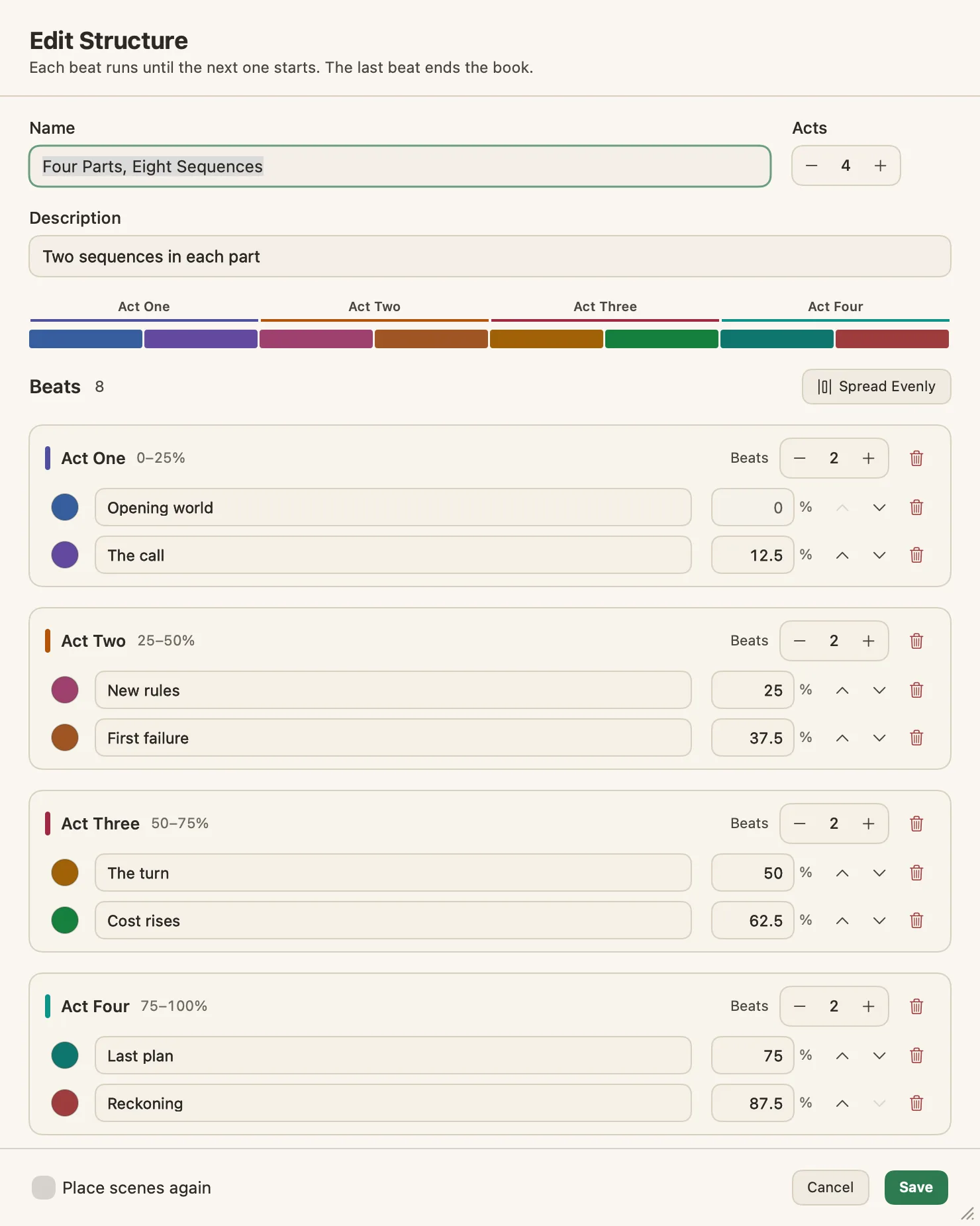
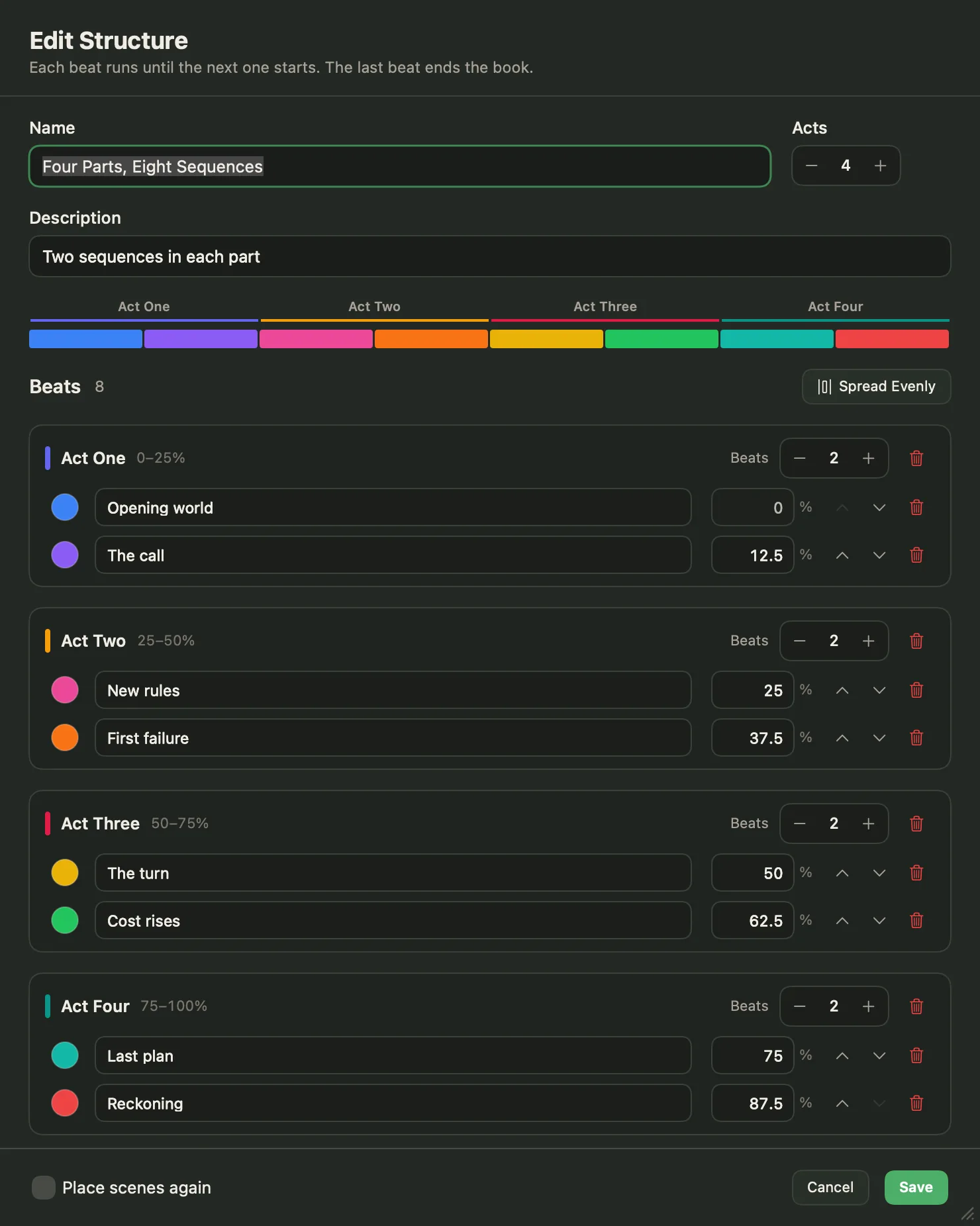
Pick the shape whose questions your book needs, build it, and read your scenes against it. If a beat stays empty, the plan has found a question; if a whole structure fights the book, switch back. Your beats are still there.