 WriterMorph

How to show a human wrote your novel: certification, AI rules and records
What the Human Authored certification covers and costs, what Amazon KDP and literary agents ask about AI, why detectors are weak evidence, and the ordinary records of your own work that are worth keeping from the first note onward.
A few years ago nobody asked whether a person had written a novel. Now some agents ask when you submit, Amazon asks when you publish, and readers wonder. If you wrote every word yourself, the question can feel insulting. It is still worth being able to answer it calmly, with more than "I promise".
This article covers certification, what Amazon and four named agencies say, why detectors can't settle the matter, and which records to keep. The last part shows where they live in WriterMorph. Everything was checked at its source on 24 November 2026; rules change quickly, so read the linked pages before you rely on them. It is general information, not legal advice.
One thing needs saying at the start: no certificate and no folder of drafts can prove beyond argument that a human wrote a book. What you can do is make an honest claim, know exactly what you are claiming, and have a history that fits it.
The Authors Guild's Human Authored certification
In the United States, the Authors Guild runs a certification called Human Authored. It began in 2025 for members only. In March 2026 it opened to all authors whose books are published in the United States.
| Question | What the Guild says |
|---|---|
| Who can apply? | Authors of books published in the US, wherever they live. Unpublished writers, including those still querying, may certify a work too |
| What does it cost? | Free for Guild members; $10 a title for everyone else. Fees may change |
| What do you do? | Create an account, verify your identity if you are not a member, and sign a license agreement stating that the work is human authored |
| What do you get? | A registration number for the title, and a mark for the cover, the copyright page and marketing for that book |
| Can readers check? | Yes. Certified titles are in a public database, searchable by title, author or number |
| Is there a limit? | Ten titles a year, unless the Guild gives permission for more |
Translations and audiobooks need certifications of their own.
What counts as human authored
The text must be written by a person, apart from a minimal amount. The FAQ draws the line like this:
- Allowed: common spelling and grammar checkers, even when they use AI.
- Allowed only at a very high level: brainstorming and outlining with AI, as preparation, with no AI text in the book.
- Against the spirit of the program: developing your characters and plot with AI, even if you then write every sentence.
- Not allowed: AI that rewrites full sentences, or adds or noticeably changes text.
The scheme rests on your word. The Guild says it knows of no truly reliable way to test a text for AI, so it uses a signed agreement, identity checks, a fee for non-members and the public list instead. Unlicensed use of the mark is trademark infringement. That makes the certificate a serious promise, not a test result.
Outside the United States
- United Kingdom. The Authors Guild sends authors of books published in the UK to the Society of Authors. The Society has a scheme of its own in which authors register their books and add a label to the back cover, according to the Australian Society of Authors. Read its current terms before you apply.
- Australia. On the same page, the ASA says it has been in talks with its UK and US counterparts about introducing the label.
- For publishers. Books By People certifies titles through publishers, with a review that includes how the book was created and the history of the manuscript. Its page is aimed at publishers, so ask yours whether it takes part.
What Amazon KDP asks
If you publish through Kindle Direct Publishing, the content guidelines split AI into two kinds. You must tell KDP about the first when you publish a new book, or edit and republish one. You don't have to tell it about the second.
| KDP's term | Meaning | Tell KDP? |
|---|---|---|
| AI-generated | Text, images or translations created by an AI tool, even if you edited them heavily afterward. Cover and interior art count | Yes |
| AI-assisted | You created the content yourself and used AI to edit, refine, check or improve it, or to brainstorm | No |
KDP's line and the Guild's are not in the same place. A novel whose sentences were polished by a chatbot may count as AI-assisted at KDP and still be ineligible for the Human Authored mark. Answer each question as it is asked.
What agents and publishers ask
We found no common rule, so the agency's own page decides. Four examples from the pages themselves:
- Blake Friedmann does not accept submissions originated, written or edited by AI. That includes the cover letter and the synopsis.
- Greyhound Literary asks that the work be entirely yours, and that you say how and why if you used AI in the course of creating it.
- Sobel Weber rejects a manuscript if any portion of it was written by AI.
- Dystel, Goderich & Bourret requires clients' work to be wholly original to them, and warns that AI text can put an author in breach of a publishing contract.
Contracts are where the question becomes serious. Greyhound says the contracts it negotiates commonly include a warranty that AI did not generate any of the work. The Authors Guild points out that undisclosed AI text may breach the originality warranty many book contracts contain, and that knowingly leaving it out of a US copyright application can be fraud. If a clause is unclear, ask your agent or a lawyer before you sign.
Why AI detectors are weak evidence
Three sources explain why a detector's score settles little:
- OpenAI withdrew its own classifier in July 2023 because of its low accuracy. In OpenAI's own evaluation it had labeled human writing as AI 9% of the time.
- A 2023 study in Patterns ran seven detectors on English essays written for the TOEFL exam by non-native speakers. On average the detectors marked about 61% of these human essays as AI.
- In May 2026 the Authors Guild tested five detectors on ten of its own articles from 2022 or earlier. Two scored almost all of them at zero, one was close behind, one ranged from 5% to 76%, and one put every article at 71% or more.
So the tools differ widely. Some did well in that test, but even the best can be wrong. The Guild's guidance for publishers of October 2026 says nobody should rely solely on a detector, and that a flag should start a conversation with the author. It also notes that uploading a manuscript to a detector hands it to another company.
The records worth keeping
The same guidance opposes forcing authors to use software that logs their writing, and supports authors who choose to preserve their drafts in case they are accused. Keep what your work leaves behind anyway, and keep the dates on it.
| Record | What it shows | Its limit |
|---|---|---|
| Early notes, notebooks, photos of index cards | Where the idea came from | Rarely dated unless you date them |
| Outline versions | How the plot changed, and what you dropped | A plan is not prose |
| Dated drafts | Sentences growing, being cut and coming back | A file date can be changed |
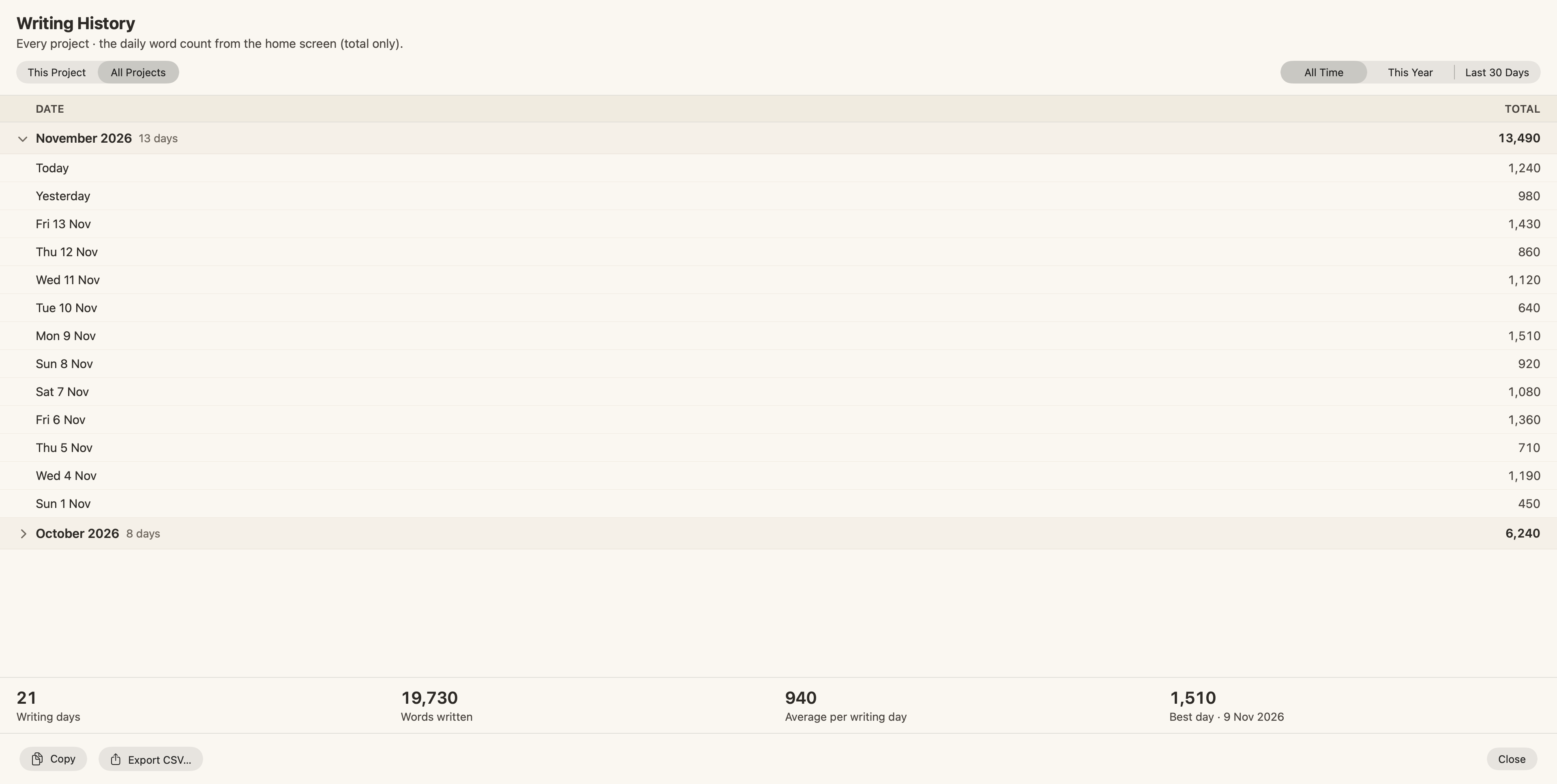
| Word counts by day | A believable pace over months | Says nothing about who typed |
| Marked-up pages, editor's letters, reader comments | Other people saw the book change | Covers the later stages only |
| Emails with your draft attached | A date on somebody else's server | Only as complete as your mailbox |
No single row is strong. Together, a year of them is hard to invent afterward, and costs almost nothing. Three habits are enough:
- Save a named copy at each turning point: the end of the first draft, before and after each big revision, the version you sent out.
- Keep the ugly material. Abandoned chapters and wrong turns show the book being worked out.
- Keep one copy somewhere else, such as an external disk or an email to yourself.
If you did use AI anywhere, write that down too: which tool, for what, on which date.
Keeping the record in WriterMorph
WriterMorph has no AI of its own. It never writes or rewrites your text, and it sends it nowhere. Even Second Read, its revision reports, is rules and word lists running on your own device.
Snapshots with names
Before a rewrite, choose Documents › Snapshots › Take Snapshot with Title… (⇧⌘5) and name it, for example "First draft, finished". The Inspector's Snapshots tab lists each one with its date and word count, and Compare with Current shows what changed. Settings › Backup also sets how often per-card snapshots are taken: daily, weekly or monthly. Snapshots from a Scrivener project keep their titles and dates when you move the book over.
Backups that carry the date
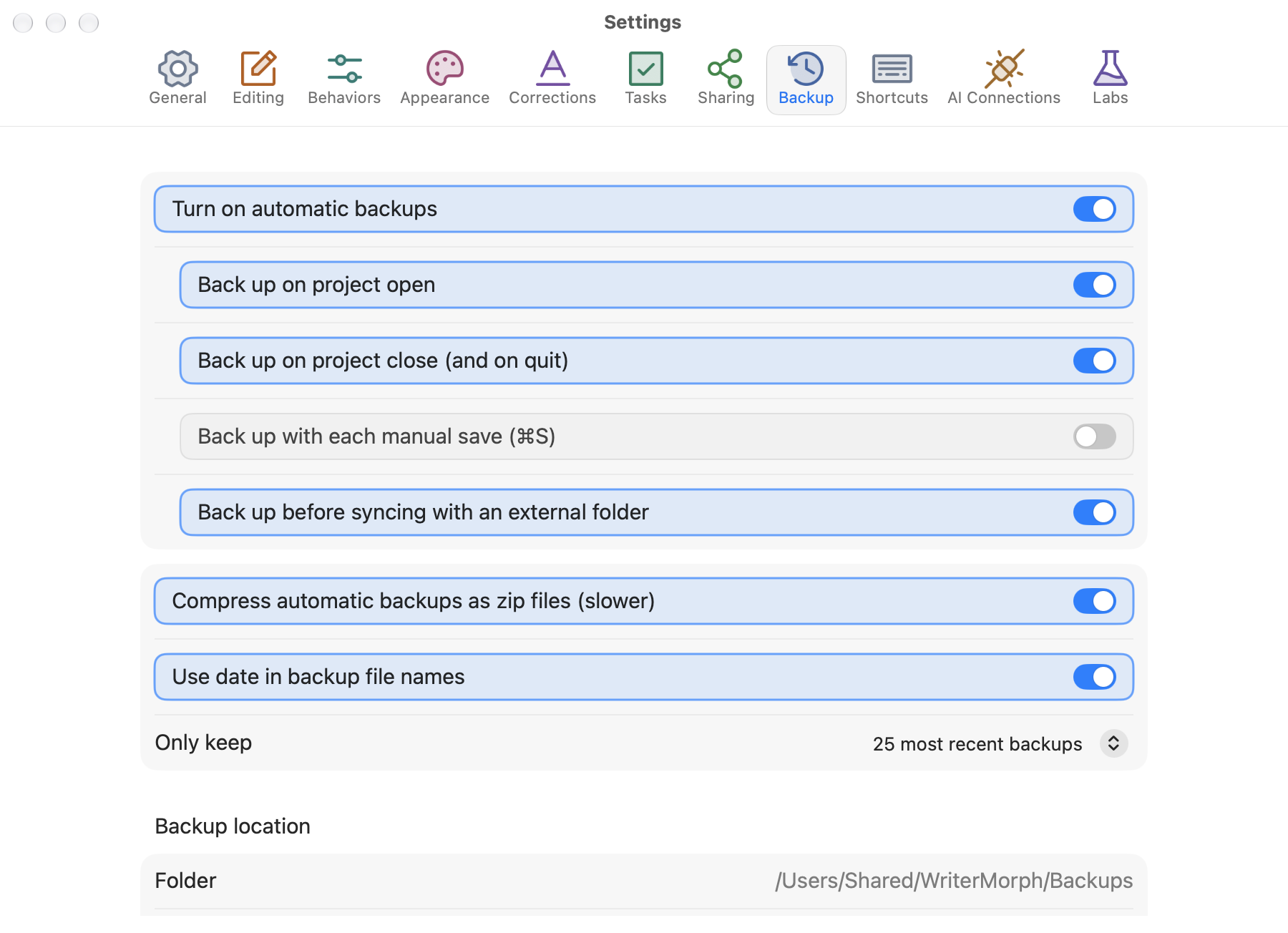
Automatic backups are on by default: a complete copy of the project when you open it and when you close it. Only keep holds the 25 most recent unless you change it, so the early ones will go. For the milestones, choose File › Back Up › Back Up To… and put a copy on another disk. The project itself is an ordinary .wmorph file on your Mac, with no account and no server. See Projects, Files and Backups.
Writing history and the plan
Project › Writing History…, pictured at the top, shows the words written on each day. Choose This Project to see Draft and Other separately, and Export CSV… to save the list.
The outline, scene cards and research sit in the same file as the manuscript. Cards keep a version each time you save them in the card editor, and Project › Project Notes is a good place for a dated log.
If you connect an AI app
On the Mac, AI Connections lets an AI app you already use work in an open project. It is off by default and needs a private key. If you turn on Allow changes, its edits to your text arrive as marked revisions, Suggested by AI, for you to accept or reject, and WriterMorph takes a snapshot named Before AI edit before it changes a document of the book.
Those marks help you see what happened. They don't change what it was. A sentence an AI wrote is still AI text after you accept it, and an app can also draft new cards if you ask it to. Planning the plot with it matters too under the Guild's rules. The Active Services window lists only the latest 40 actions since WriterMorph opened, so it is not a lasting record. If you plan to certify the book, or to submit to an agency that bars AI, the simplest course is to leave the connection off. If you used it, say so when you are asked. The choice, and the honesty, are yours.
Before you sign anything
- Read the exact question: text only, or images, planning and translation too?
- Check your notes for every tool that touched the manuscript.
- Claim only what you know, and keep a copy of what you signed.
- Put today's draft somewhere safe, with the date in its name.
Then get back to the book. A record is a by-product of writing one, and the next chapter adds more to it than any form. If the draft is nearly done, How to write a query letter covers what comes next.