 WriterMorph

How to find beta readers, and what to ask them
When a draft is ready for beta readers, where to find them in the UK, the US and online, how to ask, what to send, 20 questions that bring useful answers, and what to do when the answers disagree.
A beta reader is someone who reads your finished draft the way a reader would, and tells you what it was like. Not an editor, not a proofreader, not necessarily a writer. Their value is that they know only what is on the page.
This article covers where to look and how to ask so that you get something you can use. The last section shows a beta round in WriterMorph.
Is the draft ready?
Each reader can read your book for the first time only once, so spend that on a draft you can't improve alone. It is ready when:
- it is complete, with the ending written;
- you have fixed the big problems you already know about;
- you have read it through once as a reader. How to revise a draft with a second read is a plan for that;
- the small slips no longer distract. It doesn't have to be perfect, but a reader who keeps tripping over typos stops noticing the story.
If you can still list five things you would change, change them first.
Who reads what, and when
The names overlap, and people use them loosely. This is how they are usually told apart:
| Reader | Sees the book | Reads as | What you get |
|---|---|---|---|
| Alpha reader | While you write, unfinished or unrevised | A trusted first listener | Encouragement, early warnings, whether the idea works |
| Critique partner | Often chapter by chapter, usually in exchange | A fellow writer | Craft notes, and suggestions for fixes |
| Beta reader | Complete and revised | Your future audience | Where they were gripped, bored, confused or unconvinced |
| Sensitivity or authenticity reader | Complete, often late | Someone who knows a life or place you don't | How you portray it; normally paid work |
| Editor | When you have done all you can | A professional | A structured report or edit, for a fee |
Beta readers are normally unpaid. The Jericho Writers guide describes the exchange: they are usually friends, fellow writers or fans, who may ask for a favor in return, such as a read of their own work.
How many do you need?
Enough to see a pattern. Jericho Writers suggests at least three to five reading at one time. Scribophile says no fewer than three and no more than thirteen, and to recruit more than you need because some will drop out. Asking six people in the hope of hearing back from four is a sensible first round.
Two small rounds can teach more than one large one: revise after the first, then give a fresh group the new draft. Mix your readers on purpose. Most should read your genre for pleasure; one can be a stranger to it. If the book is set in the UK, or anywhere readers know well, include at least one reader from there.
Where to find beta readers
We opened each of these pages on 24 November 2026. Read the rules before you post: many expect you to give before you ask.
Online communities
- Scribophile: a large workshop with free sign-up. You earn points by critiquing other people's work and spend them to post your own. It has a section for beta readers.
- Critique Circle: online since 2003 and free to join, with a paid upgrade. You earn credits with critiques and spend them to submit your own story.
- Absolute Write: a forum with a Beta Readers, Mentors, and Writing Buddies board, with new requests this autumn.
- Beta Reader Group on Goodreads: a private group of nearly 30,000 members, where a moderator lets you in. Post in the right folder; the free section is for free reading only.
In the UK
- Jericho Writers: the free part of its community, Townhouse, has forums, groups and peer feedback, and lists finding critique partners and beta readers among its uses.
- NAWG: the National Association of Writers and Groups keeps a directory of writing groups by region, updated on 2 November 2026. Some groups may be full, so write first.
- BSFA Orbit groups: groups of about five writers who read and comment on one another's work, run by the British Science Fiction Association. Ask which groups have room, and whether you need to be a member.
- RNA New Writers' Scheme: not a beta swap, but a paid yearly scheme of the Romantic Novelists' Association in which a published author reports on your romance novel. The 2026 places are closed; it usually opens in February.
Closer to home
Book clubs, library reading groups, the people who already read your newsletter. Someone who loves your kind of book and barely knows you is ideal. Family may not tell you they skipped forty pages. Be careful with strangers who approach you with praise and a price list.
How to ask
Ask for a small, clear thing, with an end date, and make it easy to say no:
Hi Sam,
I've finished a novel and I'm looking for five people to read it before I revise. It's a contemporary mystery set in a harbor town, about 85,000 words, with one violent scene and a drowning. I think you'd be a good reader for it because you read so much crime.
I'd send a Word file or an EPUB on 4 January and ask for your answers by 8 February. There are 20 short questions, and you can skip any of them. I'm after how it felt to read, not corrections. If you stop halfway, telling me where is just as useful.
Please don't share the file, or upload it to any online tool. I'd be glad to read something of yours in return. And if it's not a good time, no explanation needed.
With strangers, swap a sample chapter first, so that both of you see what you are agreeing to.
What to send
- A file they can read where they read. Ask. EPUB suits a phone or an e-reader, Word suits people who like to comment in the text, PDF keeps the pages as they are.
- A clean copy. No notes to yourself, no tracked changes, no comments.
- Your name, the title, the draft and the date on the first page and in the file name, so you know which version the comments are about.
- The questions, separately, for after the reading, so they don't steer it.
- A back-cover paragraph and nothing more. If the book needs an explanation, that is your finding.
Then leave them alone. One friendly reminder a week before the date is enough.
Twenty questions for beta readers
Ask about experience, not technique. "Was the pacing good?" invites "yes". "Where did you put it down?" gets a page number.
While you were reading
- At what point did you feel you were in the story?
- Where did you stop for the day, and were you keen to come back?
- Which parts did you skim?
- Where were you confused, even briefly?
- What did you expect to happen that didn't?
The people
- Who did you care about most? When did that begin?
- Was there anyone you didn't believe, or kept mixing up with someone else?
- Did anyone do something only because the plot needed it?
- What did you think the main character wanted?
- Which relationship worked best, and which least?
The story
- What is the book about, in one or two sentences?
- When did you guess the ending, if you did?
- Which scene stayed with you? Which one could go?
- Did anything feel too easy, too late or too convenient?
- Did the ending satisfy you? What was left hanging?
The writing and the world
- Could you picture the places? Where couldn't you?
- Did any dialogue sound wrong for the person speaking?
- Was there anything you know about that the book got wrong?
Afterward
- What would you tell a friend about it?
- If you could change one thing, what would it be?
Add one or two about your particular worry, and cut whatever doesn't fit the book. Twenty is a ceiling.
When the feedback disagrees
It will. One reader loves the chapter another wants to cut. Before you change a word:
- Wait, and say thank you. Don't argue or explain. Ask only to understand: "Which page was that?"
- Put all the answers in one list, by chapter. Alone, a comment is an opinion. Beside the others, it may be a pattern.
- Trust the place more than the cure. When three readers stumble in chapter nine, something is wrong there or a little before, even if they suggest three different repairs.
- Weigh who is speaking. A bored reader who never reads your genre may not be your reader. A bored fan of it is news.
- Sort into three piles: will fix, won't fix, and think about. A single comment that makes you wince with recognition goes in the first.
- Let the disagreement stand when it is about taste. If half your readers love a character and half can't bear her, she may be working.
Then go from big to small, as in How to edit a novel.
Thanks, boundaries and money
Tell each reader which of their comments changed something. Thank them in the acknowledgements if they agree, send a copy when the book is out, and read for them when they ask. If somebody goes quiet, let it go. If a reader turns unkind, thank them and close the round: you don't owe anyone a rewrite.
You can pay for a read, and then you should expect a written report and a deadline. The Editorial Freelancers Association's 2026 rate chart, based on a survey about work done in 2025, lists beta reading at 0.5 to 0.8 US cents a word, or about $450 to $720 for 90,000 words. Sensitivity reading and manuscript assessment are listed higher.
A beta round in WriterMorph
Clear the slips first
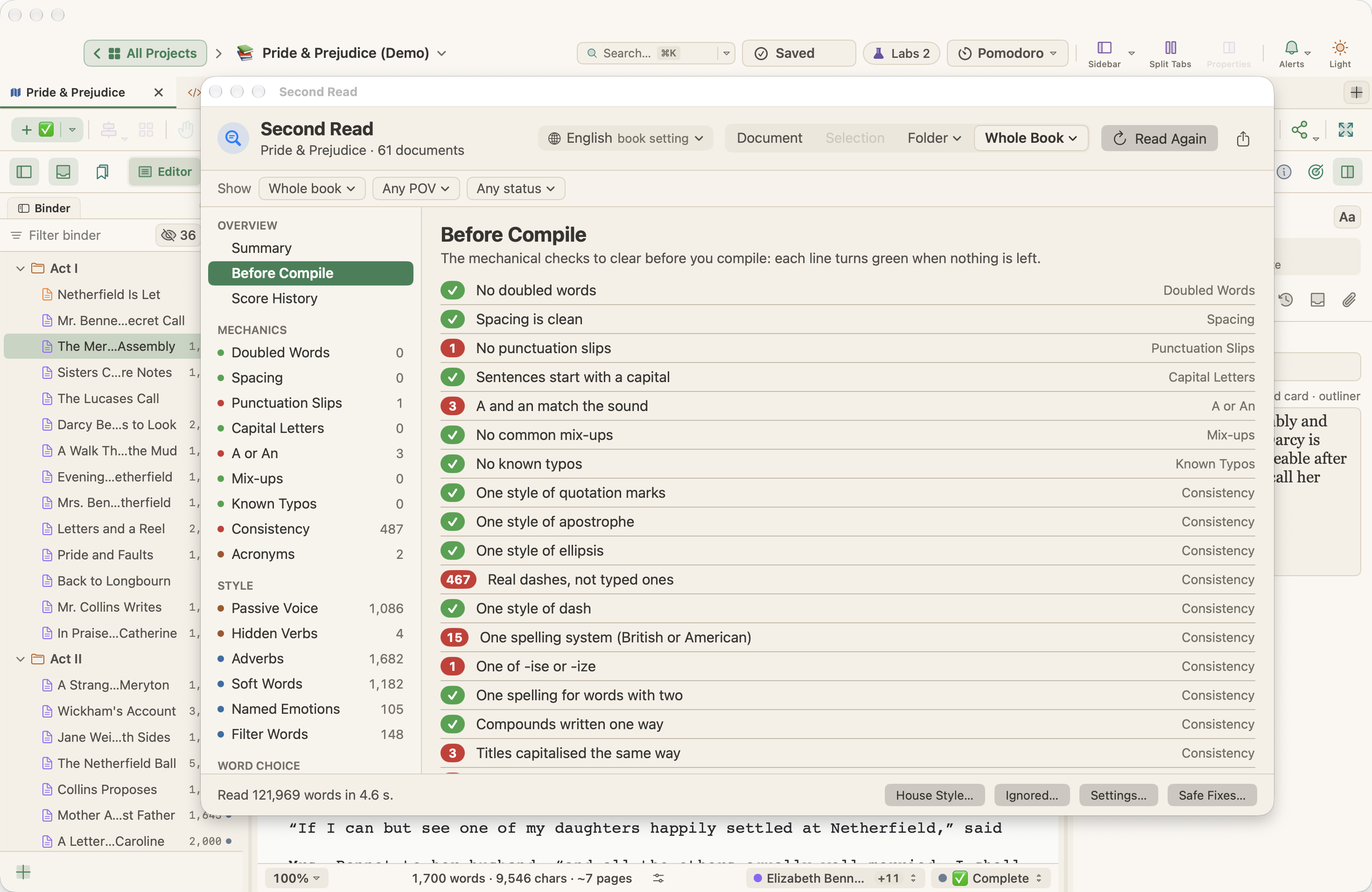
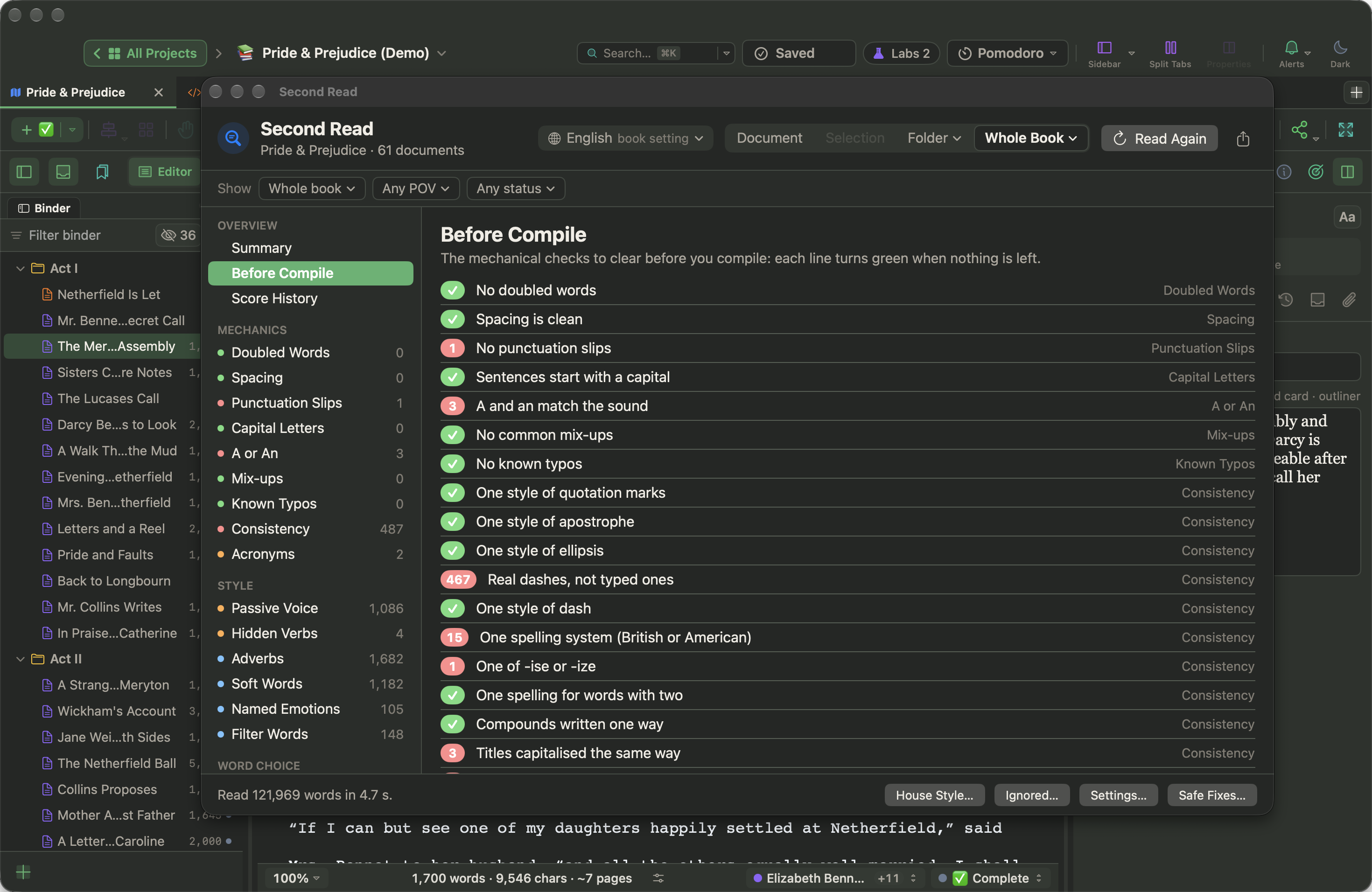
Choose Project › Second Read… (⌥⇧⌘R), Whole Book, then Before Compile. Each line opens its report, and Safe Fixes… lists every change before it makes any. Second Read is rules and word lists on your own device, with no AI.
Keep the version you send
Choose File › Back Up › Back Up To… for a copy of the whole project as it is on that day. For a chapter you expect to rewrite, add Documents › Snapshots › Take Snapshot with Title… (⇧⌘5), "Beta round 1", to compare with later.
Compile a clean copy
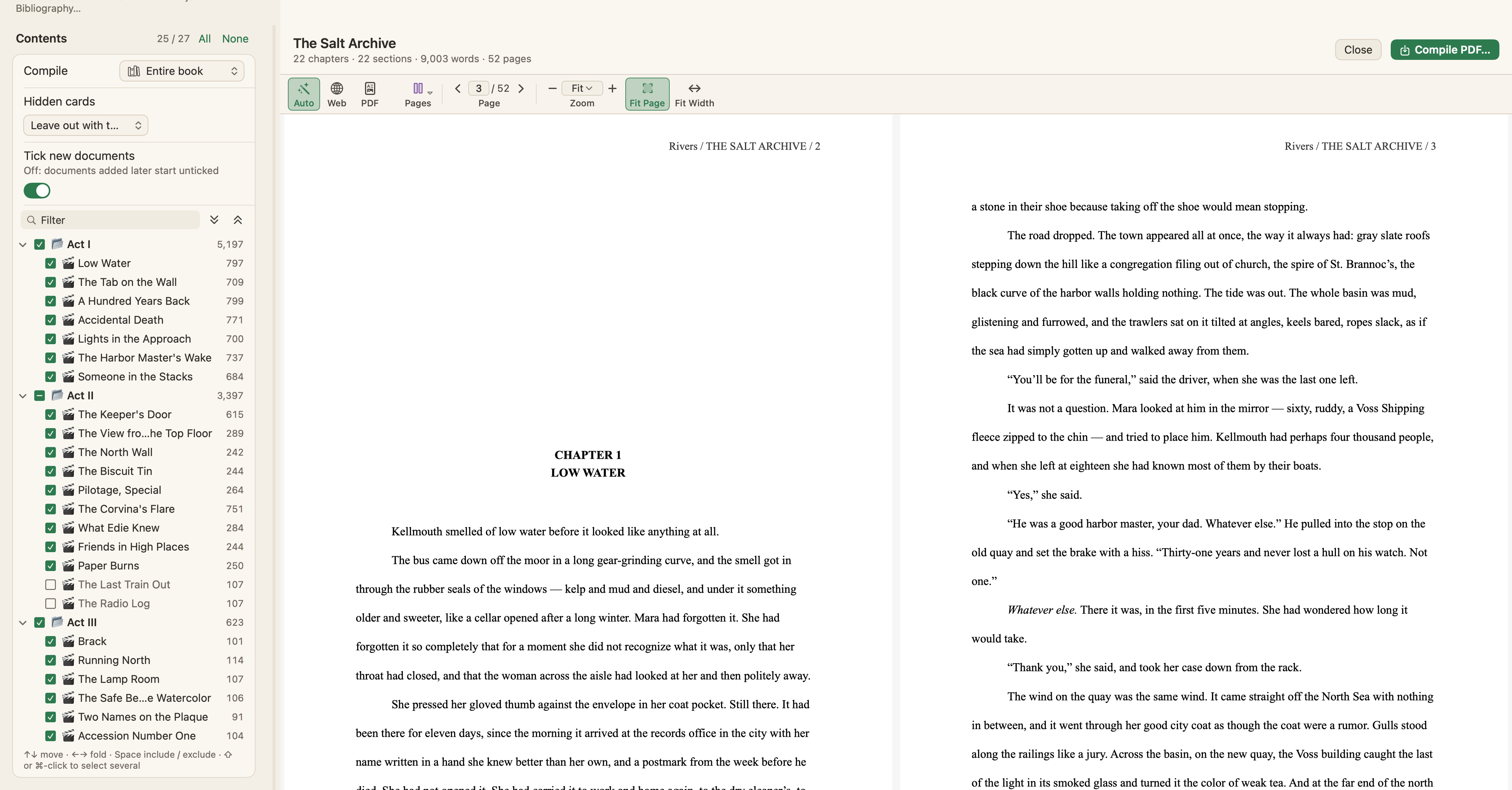
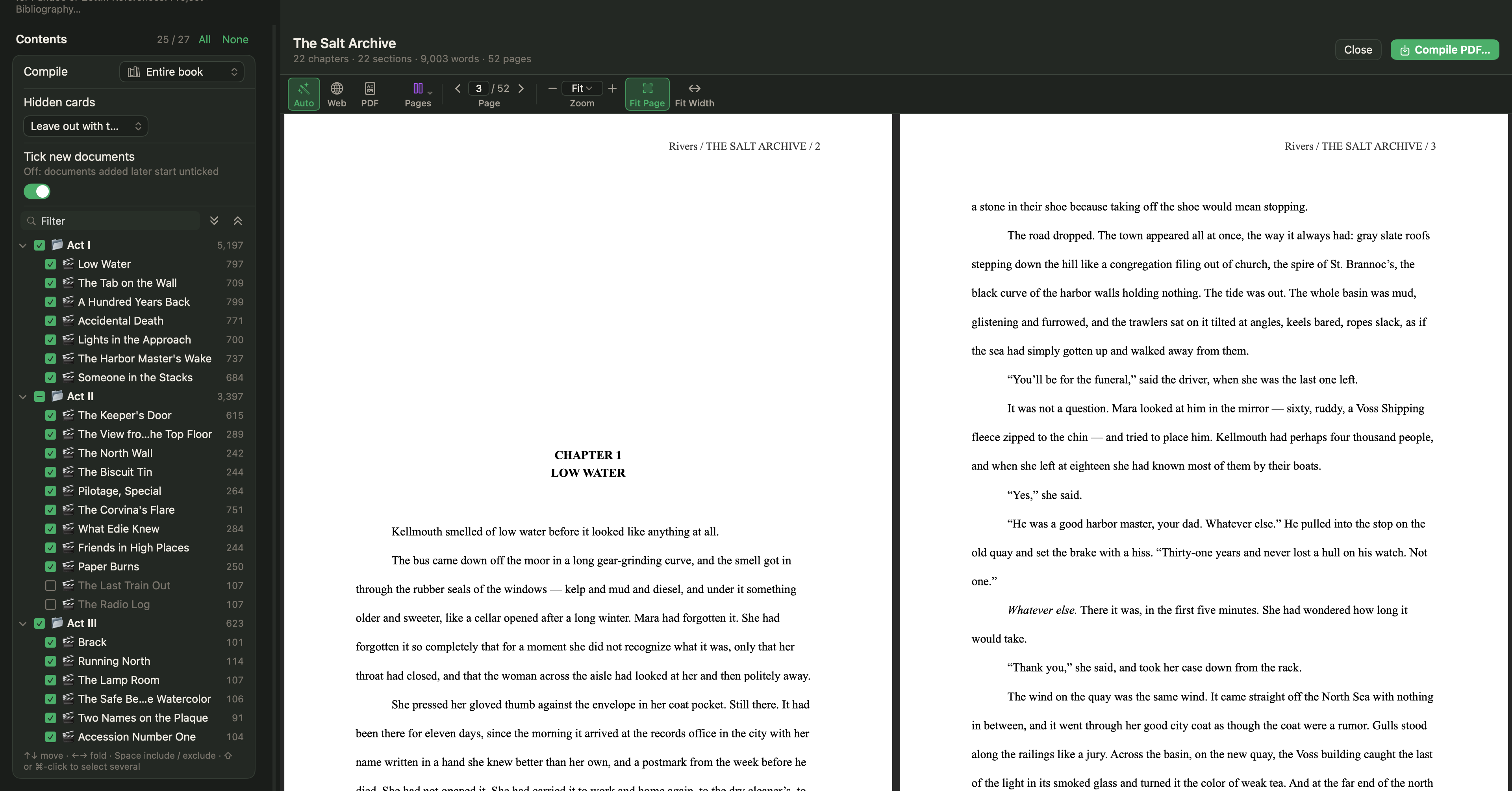
Choose Project › Compile… (⌥⌘E). The Manuscript preset with Word (DOCX) or PDF suits readers at a desk; the E-book preset with EPUB 3 suits a phone or an e-reader. Leave Comments, Notes and Revision marks as Word tracked changes off for a clean copy, and untick chapters under Contents to send only the opening. Compiling never changes your text. The settings are in Compile your manuscript. WriterMorph on iPad compiles to Word, PDF and EPUB too.
Bring the comments back
When a reader returns a Word file with comments, open Manuscript Mode and choose File › Import Files › Word, OpenDocument or RTF into the Book…. Word comments come in as comments. If the file has tracked changes, choose Keep as Revision Marks to review them one at a time. The file comes in beside your own chapters and doesn't replace them, so turn off Documents › Include in Compile (toggle) for the reader's copy. View › Editor Layout › Split Vertically puts it next to yours. See Importing your work.
For remarks that come by email, put the cursor at the place and choose Insert › Comment (⇧⌘8), starting with the reader's initials. The Inspector's Comments tab lists them in order.
Give it a date
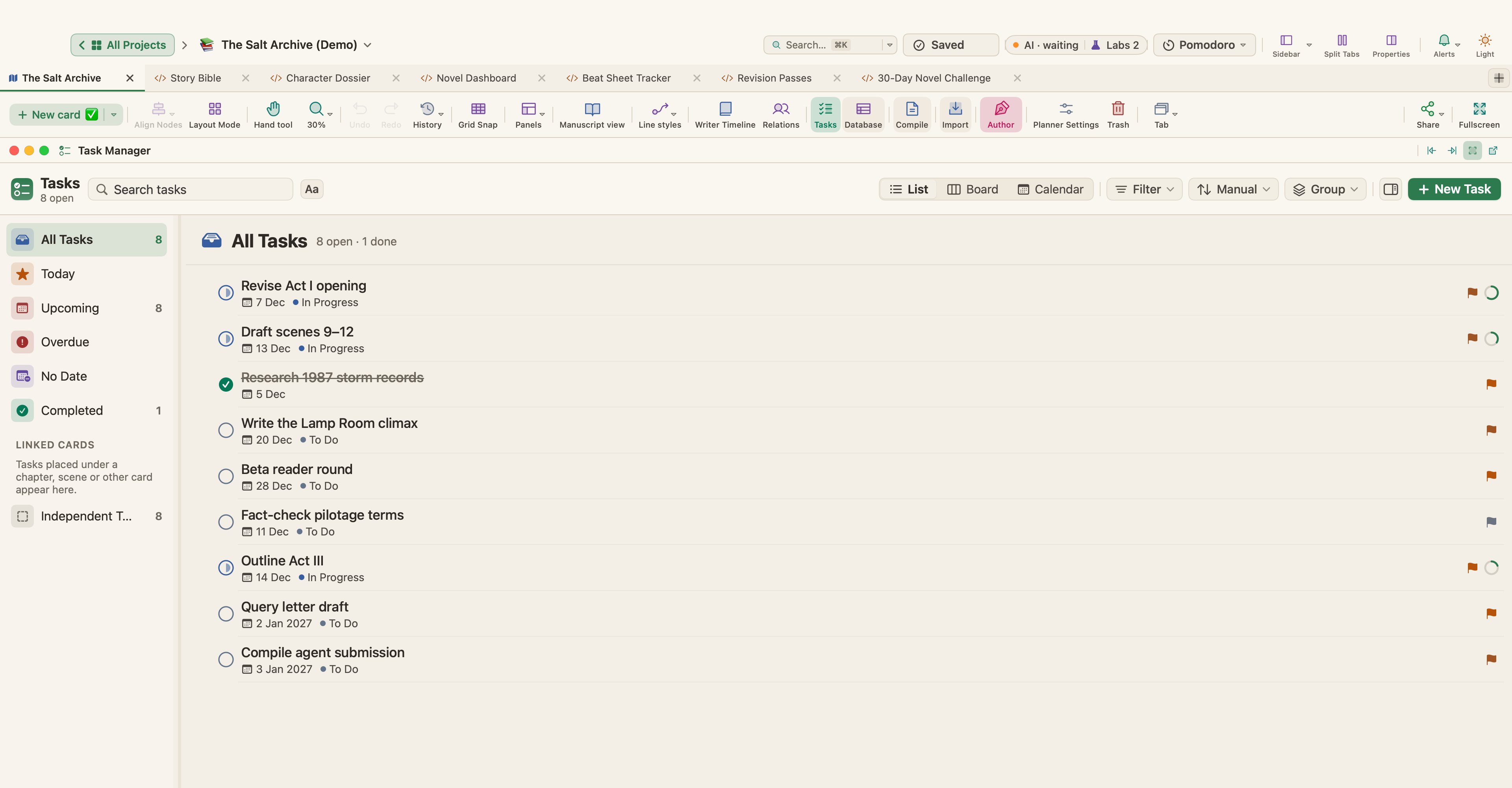
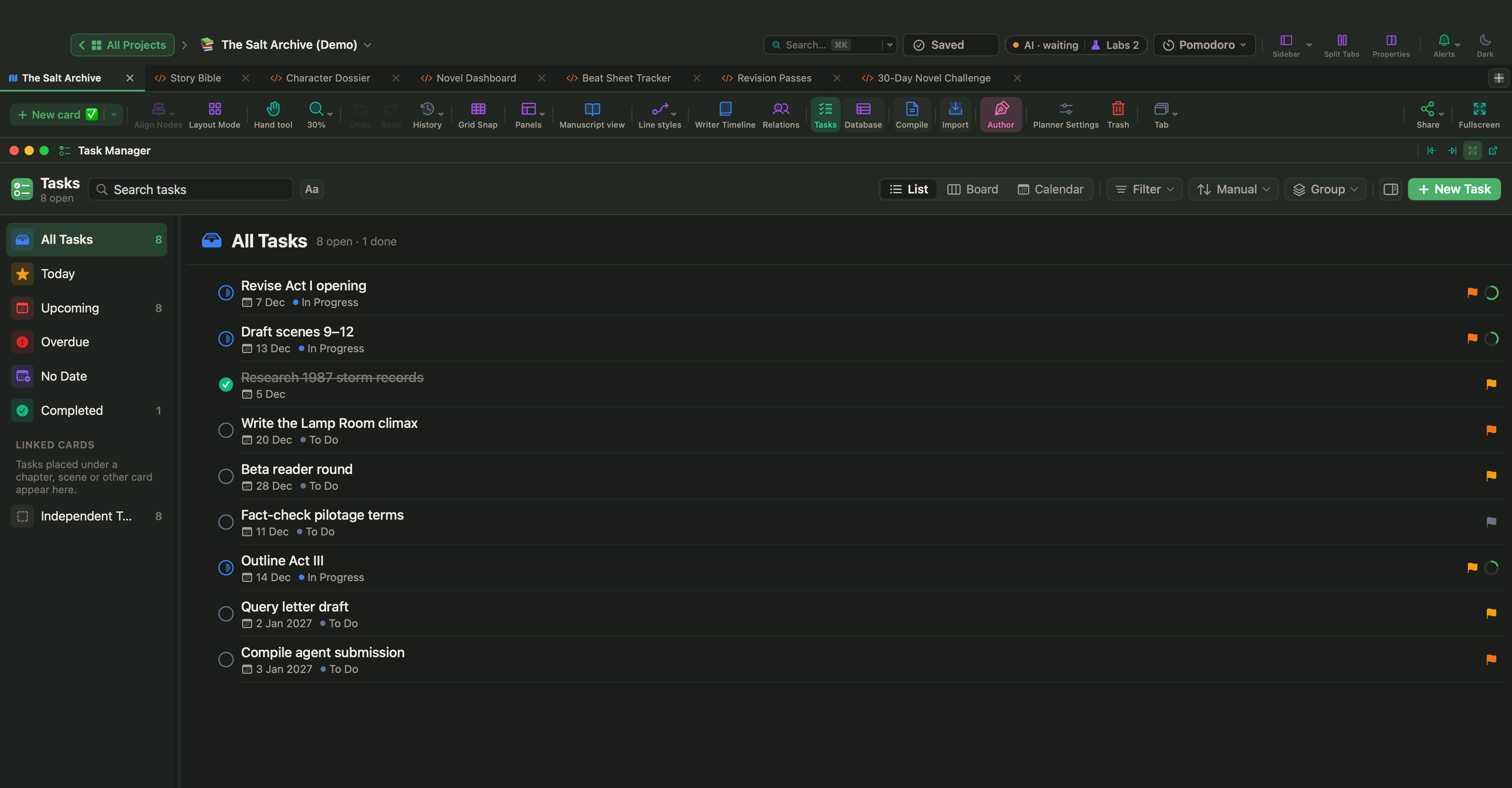
Choose Insert › New Task Card, name it "Beta reader round" and set the due date to the day you need answers. Turn on Reminder in its Properties for the nudge a week before. The Task Manager (View › Task Manager, ⌃⌘K), pictured at the top, shows it among the rest of the book's work.
When the round is over, the Revision Passes Live Page, a Labs feature, sets every scene against the passes you choose; How to edit a novel shows how to turn it on.
Start with two names, and write to them this week.