 WriterMorph

How to plan your writing year: look back at 2026, then set goals for 2027
Before you write a single resolution, read last year's numbers, how often you really wrote and at what pace. Then choose one main project, set two kinds of goals and split 2027 into quarters you can check.
Every December, writers make the same promise in different words: this is the year I finish the book. By February many of those promises have gone quiet. Not because the writers were lazy, but because the plan was a wish with a date on it.
A writing year that holds up starts from what actually happened last year, not from what you hope will happen next. This article goes through it in order: look back at 2026 with real numbers, work out your true pace, choose what the year is for, set goals of two kinds and split the year into quarters you can check. The last part shows where each piece lives in WriterMorph.
Look back before you look ahead
Give the review one quiet hour before the holidays swallow the month. Answer in writing, with numbers where you can:
| Question | Why it matters |
|---|---|
| What did you finish this year? | A draft, a revision, a story sent out. Finishing is the skill a year plan exists to train |
| On how many days did you write? | Your real habit, not the one you remember |
| How many words on an ordinary writing day? | The average, not the best day, is your pace |
| Which weeks went missing, and why? | Illness, a deadline at work, a move, a holiday: most of these come back next year |
| When and where did the good sessions happen? | The time and place to protect in 2027 |
| What did you enjoy? | A plan you dread will not survive the spring |
Be exact, and be kind. If the honest answer is "I wrote on 41 days and finished nothing", that is not a verdict on you. It is the most useful number you have, because next year's plan can be built on it.
Work out your real pace
Most yearly goals fail on arithmetic. A writer who has averaged two sessions a week sets a goal that needs five, and is behind by the second week of January.
So build the year from three numbers from your review:
- Writing days per week that you actually managed in an ordinary month.
- Words per writing day, the average.
- Writing weeks in the year. Not 52. Take out holidays, the weeks you already know will be busy at work or at home, and a few for illness. Forty-four is a sensible first guess.
Multiply them. Three writing days a week at 600 words over 44 weeks is 79,200 words: the first draft of many novels, or the revision of one and a few short stories. Four days at 900 words is 158,400. Either is a real year of writing, and neither needs heroics.
If the result disappoints you, change an input you control, such as one more session a week, before you change the goal. If it surprises you the other way, good: you have room for revision, which never shows up in a word count.
Choose what the year is for
A year can hold one big project and one or two small ones. It rarely holds three big ones. Pick:
- One main project, the thing that will be finished, in a sense you define, by 31 December 2027: a complete first draft, a revised manuscript sent to agents, a novella published as an e-book.
- One small project for variety and quick finishes: short stories, essays, a newsletter.
- A list of not-this-year ideas. Write them down so they stop competing. They are safe on the list.
Define "finished" in a sentence you could check, such as "a revised draft of 85,000 words with five beta readers by 30 September". That is the outcome the rest of the plan serves.
Set two kinds of goals
An outcome goal says what will exist at the end. A process goal says what you will do every week. You need both: the outcome tells you where you are going, and the process is the only part you control on a wet Tuesday in March.
| Outcome goal | A process goal that serves it |
|---|---|
| Finish the first draft by 30 June | Write four mornings a week, 45 minutes each |
| Send the manuscript to agents in the autumn | One revision pass a month from July, in order |
| Write six short stories | Draft one story every two months, and revise it the month after |
| Read like a writer | Two novels in your genre a month, with a page of notes on each |
A familiar test for the outcome is the SMART checklist from management writing, usually traced to an article by George T. Doran in 1981; today the letters are most often read as specific, measurable, achievable, relevant and time-bound. For writers, two of them do most of the work: measurable (a word count or a stage of the book) and time-bound (a date).
Give each process goal a floor for bad weeks, decided in advance: "two sessions, even short ones". A floor keeps the habit alive in the weeks when the full plan is impossible, and it means a bad week still counts.
Split the year into quarters
A year is too long to feel urgent; three months is not. Give each quarter one job for the main project and a check at the end.
| Quarter | Months (2027) | Job for the main project | Check at the end |
|---|---|---|---|
| Q1 | January to March | Finish the first draft | The last page is written |
| Q2 | April to June | Structural revision | Every scene earns its place; the second draft is complete |
| Q3 | July to September | Line revision, then beta readers | A clean draft is with readers |
| Q4 | October to December | Final pass, then submit or publish | Queries sent, or the book is out |
Your four jobs will differ; the point is one per quarter. If you already know a quarter will be heavy, such as a house move or a busy season at work, give it a lighter job instead of pretending. For the first quarter, a twelve-week plan to finish your novel gives January to March week by week, and after the first draft covers the mapping that a second draft starts from.
A year that fits around a job
Most novelists write around paid work, caring for someone and the rest of life. A plan for that life looks different from a full-time writer's:
- Count hours, not days. Two hours on Saturday and three 30-minute weekday sessions make three and a half hours a week. Over 44 weeks that is 154 hours, which is a lot of book.
- Give short sessions decided work. Twenty minutes on a lunch break is enough to draft a scene you planned the night before, or to revise two pages. It is rarely enough to solve a plot problem. Save the thinking for the long session.
- End each session with a note that says what comes next, so the next one starts with typing instead of rereading. Ernest Hemingway described the same habit: stop for the day when you know what will happen next.
- Plan the busy months as maintenance. If December at work is chaos every year, December's goal is the floor, and meeting it counts as success.
Check monthly, reset quarterly
At the end of each month, spend fifteen minutes on three questions: how many sessions happened, how far the main project moved, and what got in the way. Change one thing for the next month, not five.
At the end of each quarter, compare the check in your table with where the book really is. If you are behind, choose one of three answers: lower the goal, move the date, or drop the small project for a quarter. Write down which, and why. A changed plan is still a plan; a quietly abandoned one is a wish again.
A worked example
An invented writer with a full-time job reviews 2026. The numbers: 112 writing days, about two a week, at an average of 650 words. A November sprint left a mystery at 38,000 words, about 45,000 short of the end. Weeks lost: most of March to a project at work, and a fortnight of illness in August.
Their first idea for 2027 was "finish the draft by Easter, submit in the summer". The arithmetic says otherwise. Three sessions a week, one more than last year, on Saturday mornings, at 650 words make 1,950 words a week. At that pace 45,000 words take about 23 weeks. Counting March as a floor month of one session a week, the draft is finished at the end of June.
So the plan becomes: Q1 and Q2, finish the draft; Q3, the structural revision; Q4, line revision and beta readers; queries early in 2028. The small project is two short stories, each written in a fortnight between phases. It is less exciting than "submit in the summer". It is also a plan that can happen.
Planning the year in WriterMorph
Read the numbers for 2026
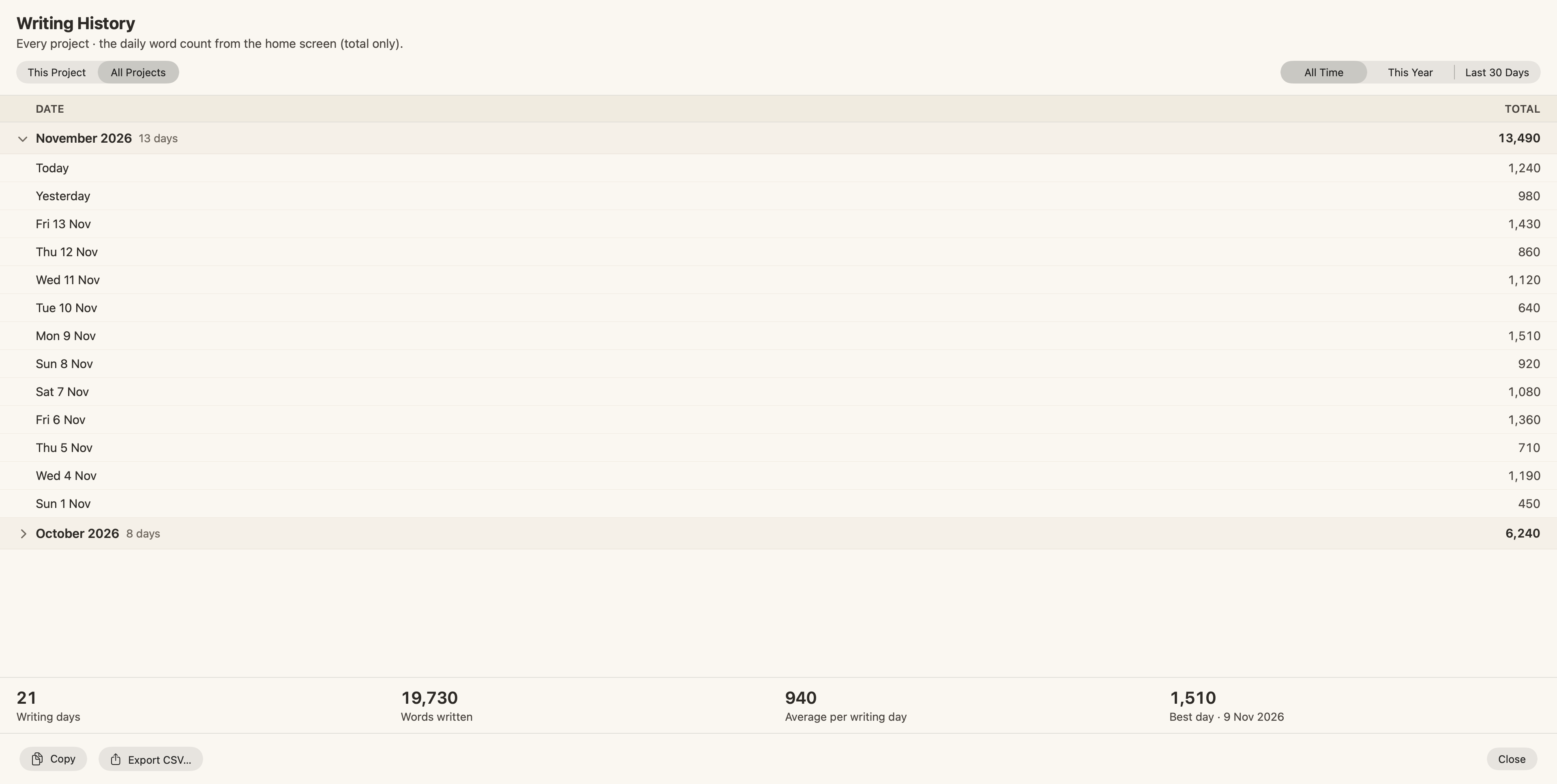
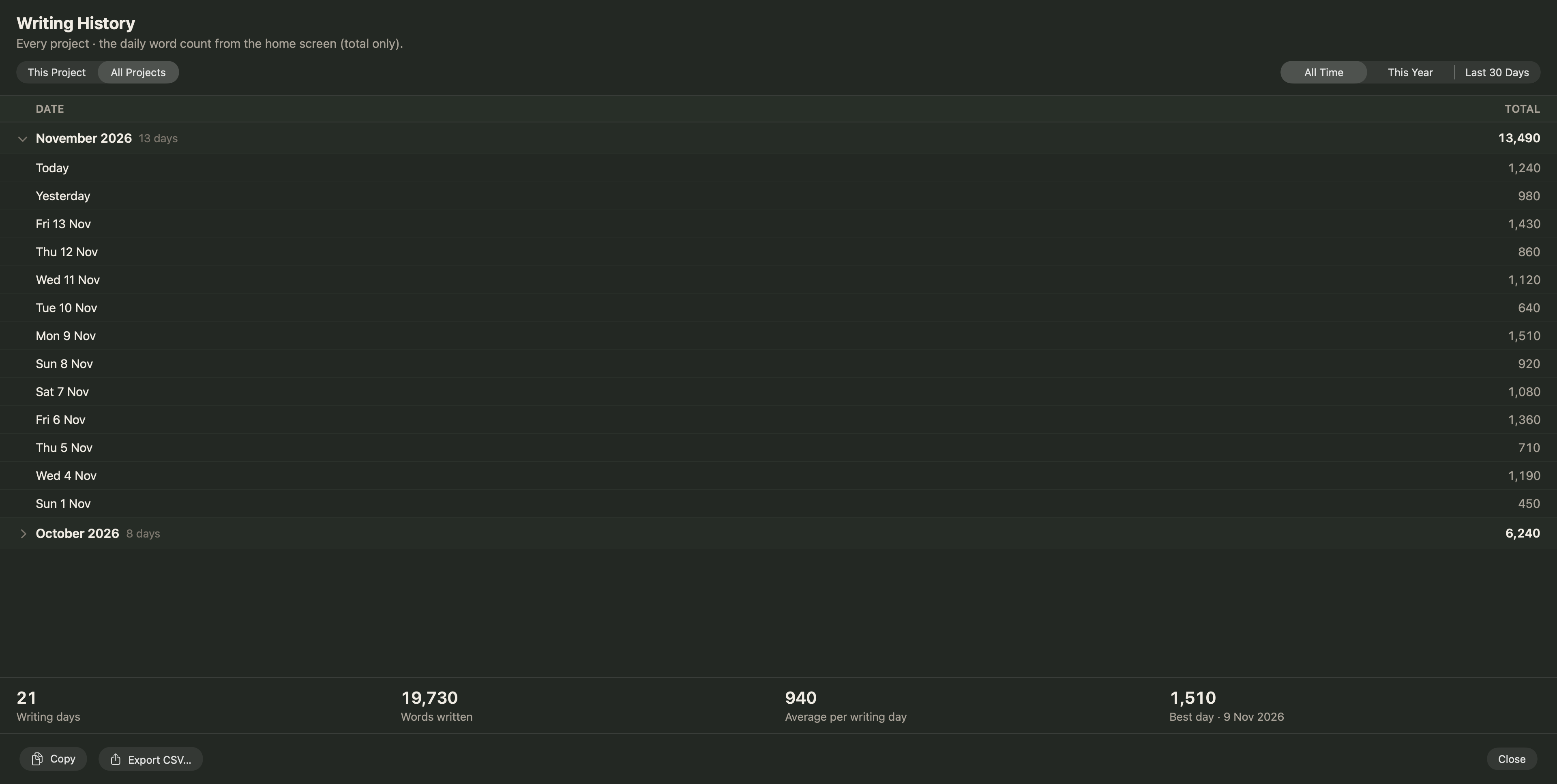
Choose Project › Writing History…. With All Projects and This Year, it lists every day you wrote this year and, below the list, your writing days, words written, average per writing day and best day: the review's numbers in one window. This Project splits one book's words into Draft and Other, so notes and planning don't inflate the count. Export CSV… saves the list for a spreadsheet, if you want to count by week or month.
Keep the main project in front
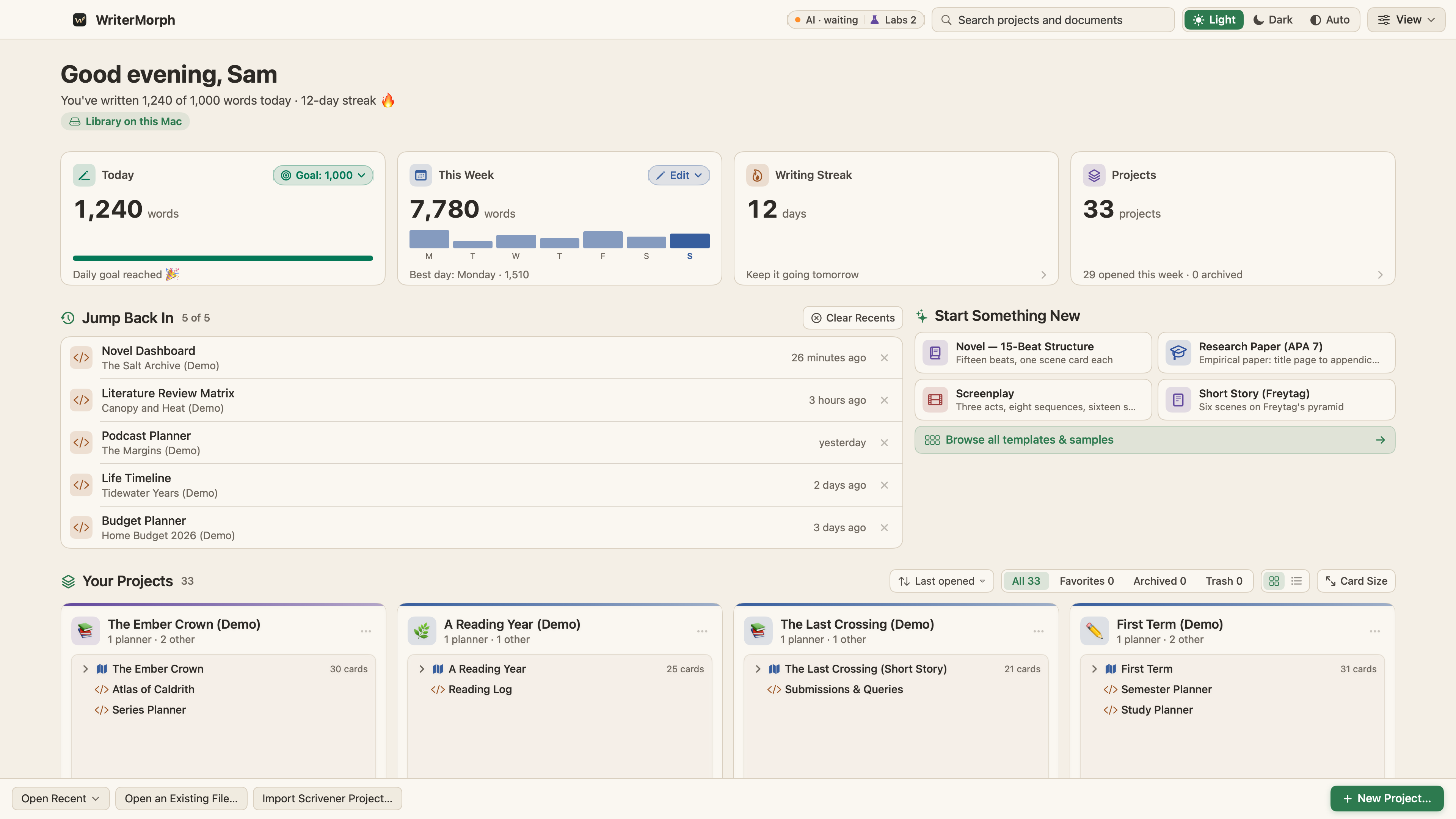
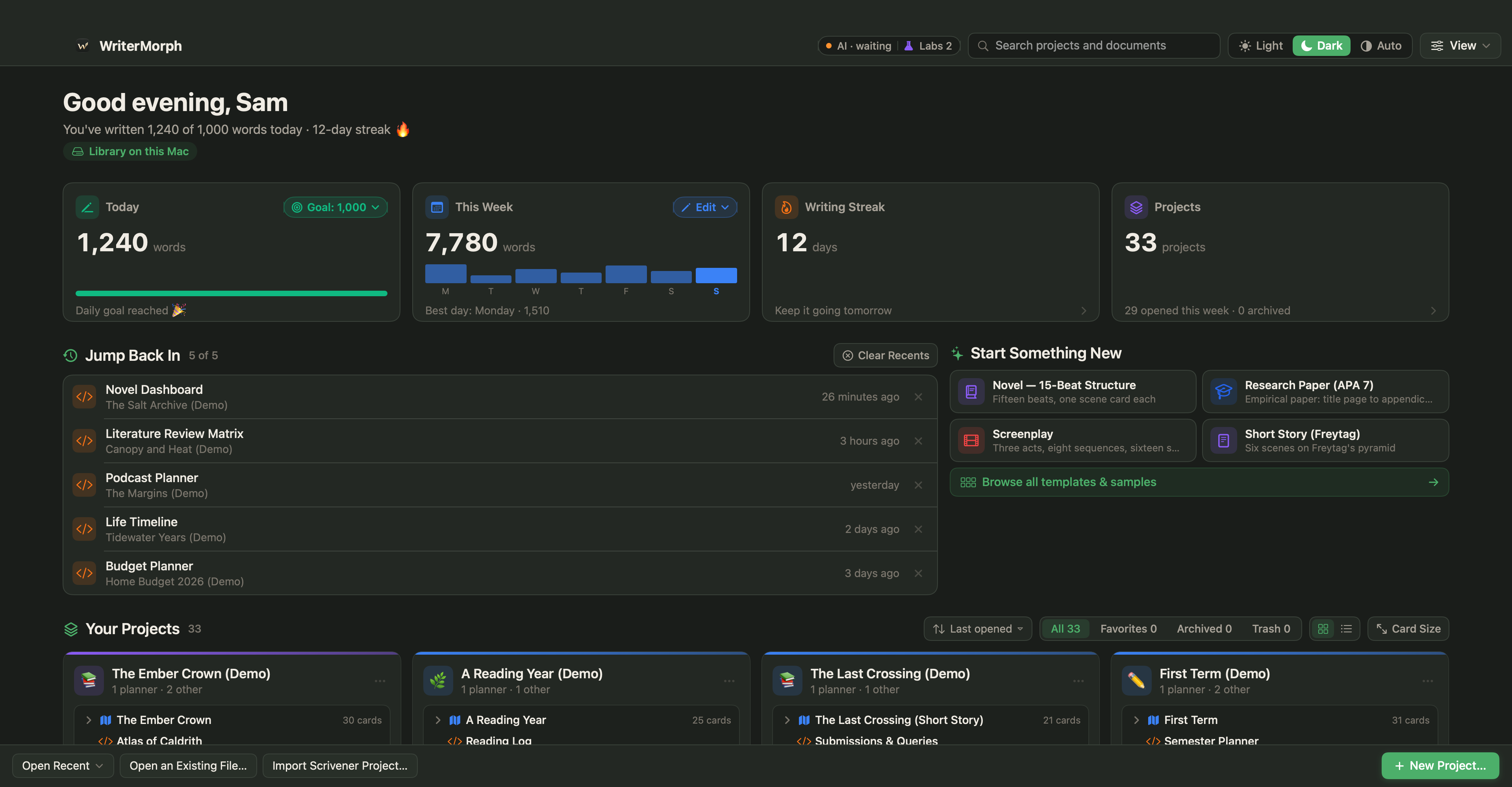
The Home screen, pictured at the top, lists Your Projects. Right-click a project you won't touch this year and choose Archive, so the list shows what the year is for, and add the main project to Favorites. In Settings › General › Home Screen, turn on the Project Goal card and pick the main project with Choose: its progress towards its target then sits on the Home screen.
Turn the outcome into a target
In the main project, choose Project › Show Project Targets (⇧⌘T). Enter the Manuscript target, turn on Deadline with the end date of the quarter, and click your Writing days: WriterMorph tells you how many words a day you need. With Set the session target from the deadline on, a missed session is spread over the days that remain. How to hit your daily word count covers targets and timed sessions in detail.
Put the quarters on a calendar
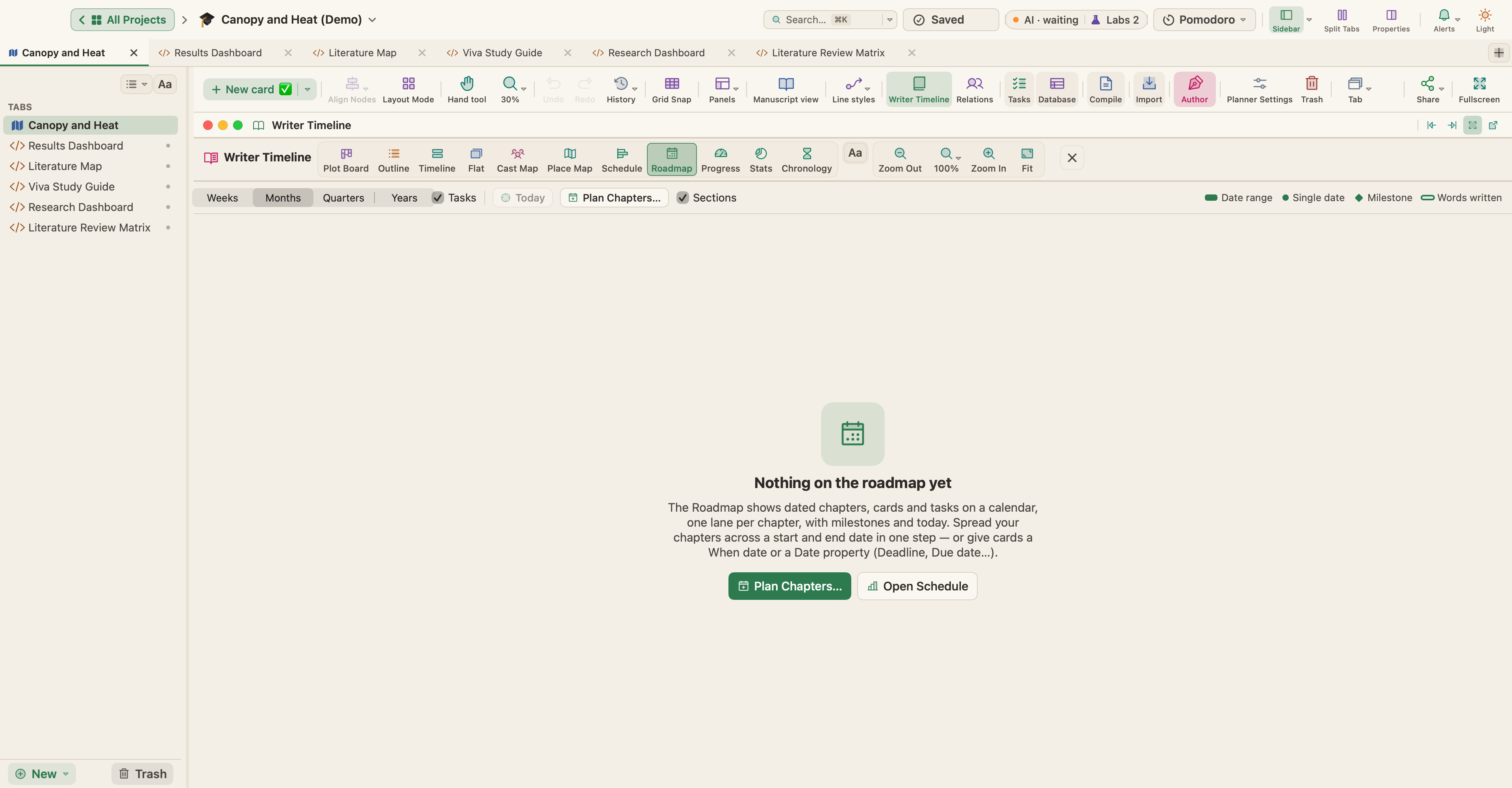
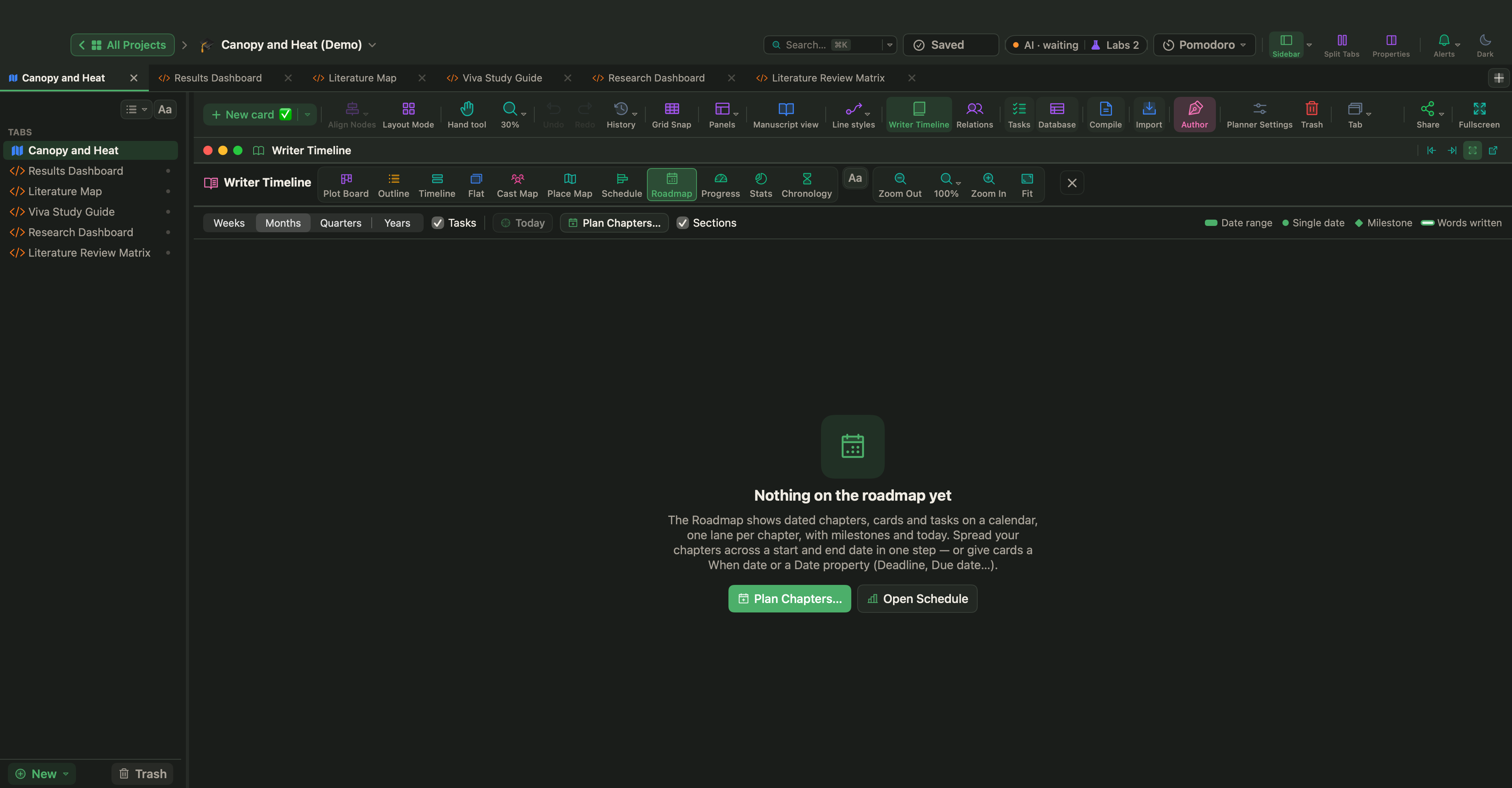
Make each quarter's job a task: choose Insert › New Task Card, give it the type Milestone, and set its Start and Due dates. The Task Manager (View › Task Manager, ⌃⌘K) shows tasks as a list, a board or a calendar. In the Writer Timeline (View › Writer Timeline, ⌥⌘T), the Roadmap view puts dated chapters, cards and tasks on a calendar, one lane per chapter, with milestones and today; switch it to Quarters or Years to see the whole plan. Plan Chapters… spreads the chapters between two dates, evenly or by word target. See Tasks, Schedule, Targets and Pomodoro.
Track the process goals by the week
On the Home screen, Today counts words against your daily goal (click Goal to change it), This Week shows the words of each day, and Writing Streak counts the days in a row you have written.
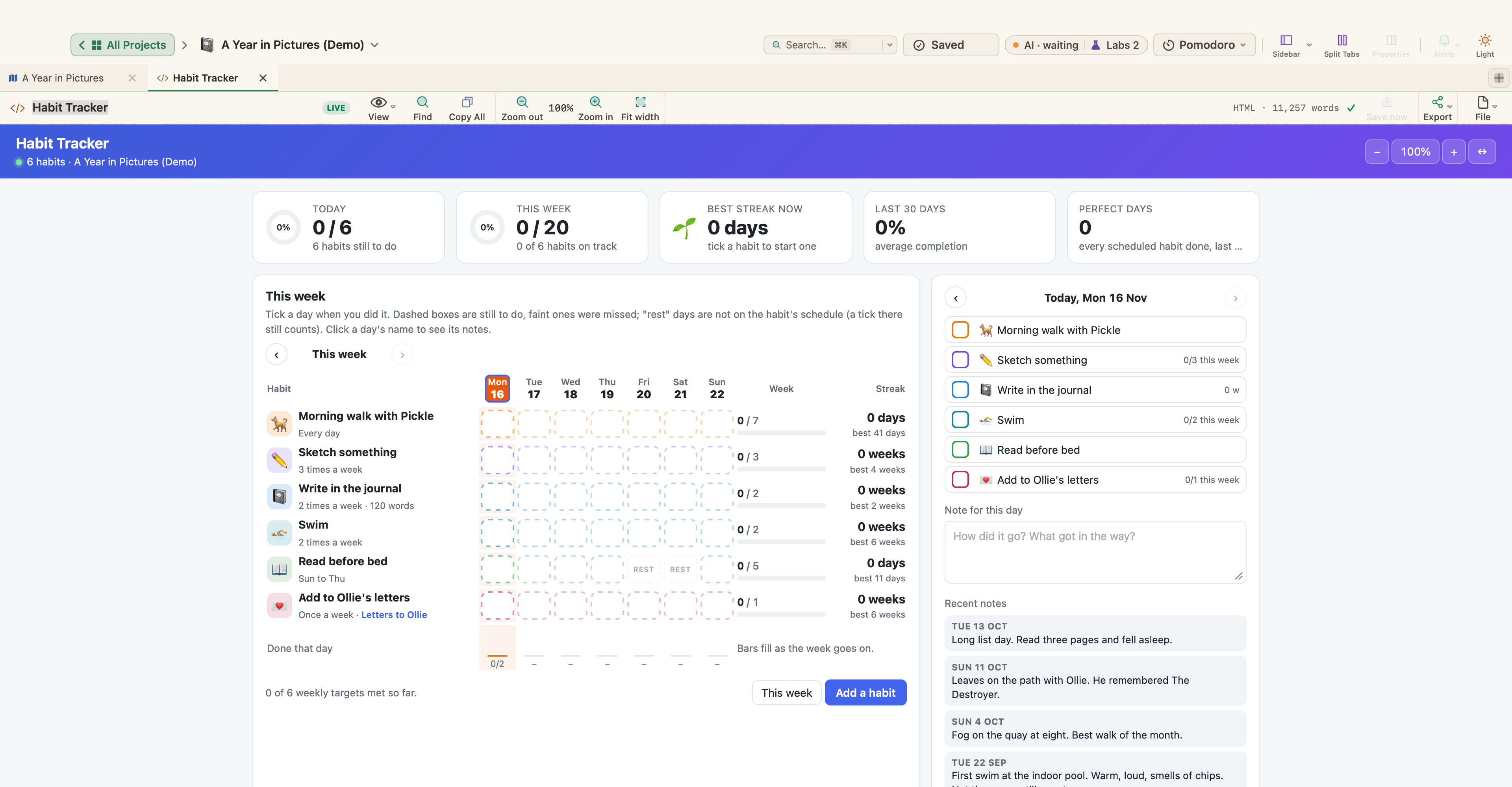
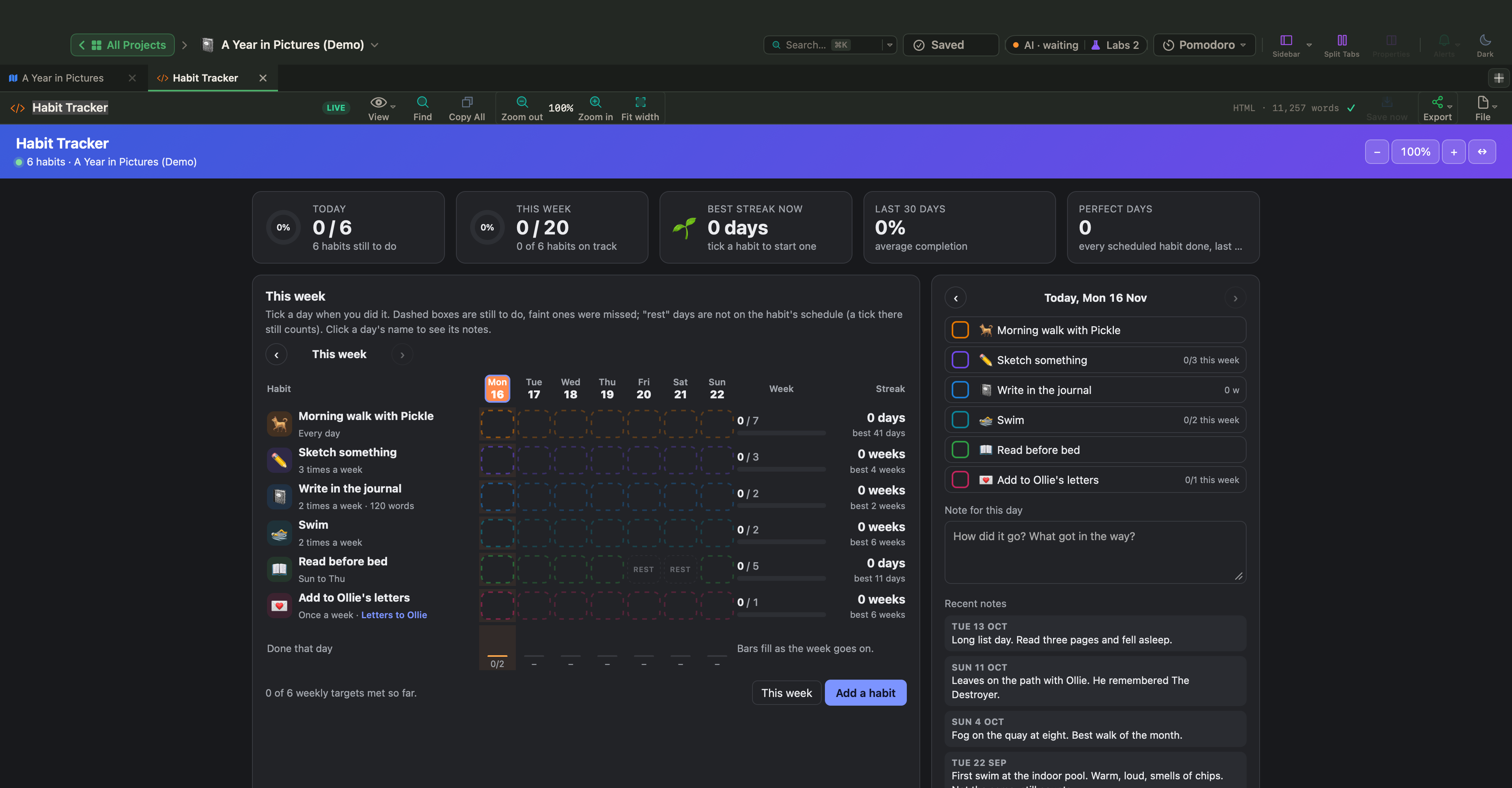
If your goals are weekly, such as three sessions a week rather than every day, the Habit Tracker page fits them better. Each habit has its own schedule (every day, a number of times a week, or set days), with a week grid to tick, streaks, weekly targets and a year view, habit by habit. A habit can have a word goal and a link to a card; the page notes the project's word count on each day it is open, and ticks a habit with a word goal by itself on days you reach it. It is a Live Page, a Labs feature: turn on Turn HTML pages into small apps (Live Pages) in Settings › Labs, then choose New ▾ › Live Page ▸ › Examples ▸ in the sidebar; the Habit Tracker is in the Life & Home submenu. See Live Pages.
Review each month in the project
Project › Project Notes is a good place for the monthly fifteen minutes: the date, the sessions, how far the book moved and the one thing you will change. At the end of each quarter, open Writing History… again with This Year, and see whether the average per writing day has moved.
Do the review this weekend, while 2026 is still fresh. Then write the main project's "finished" sentence on a single line, and put the first session of January in the calendar.